

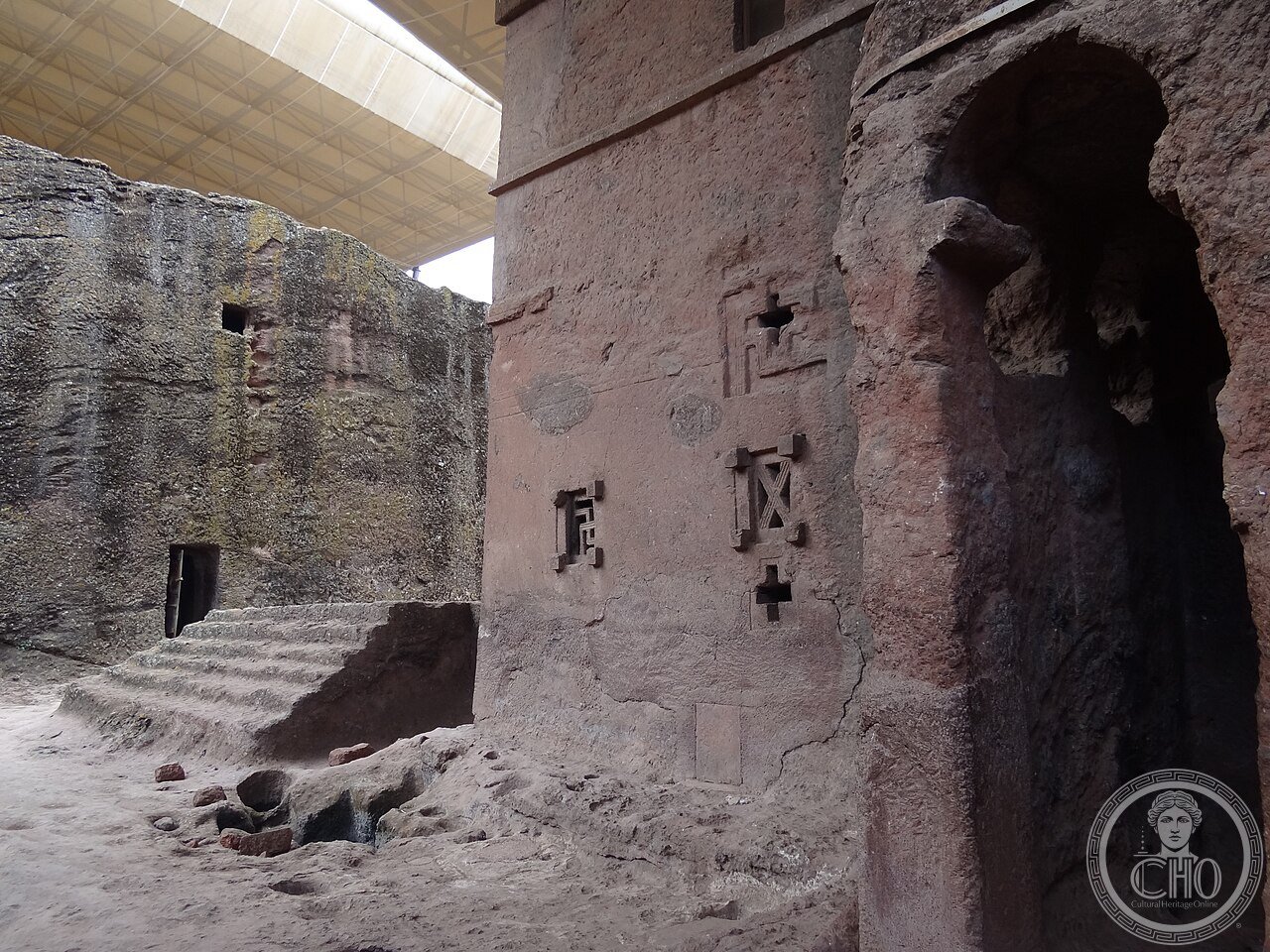
In Lalibela, Ethiopia, the church of Bete Maryam, the Church of Saint Mary, was carved out of a single block of volcanic rock. It is traditionally attributed to the reign of King Gebre Mesqel Lalibela, of the Zagwe dynasty, about 1181 to 1221, and is held to be the oldest and the first of the eleven churches to be made. Some archaeological analysis, however, suggests two distinct building phases, the earlier going back to the 11th or early 12th century, a hypothesis that would place the first excavation before the reign traditionally attributed to Lalibela. This is a scholarly hypothesis, not an established historical fact. The interior has carved columns with decorated capitals, blind arcades, cross-shaped windows and reliefs with floral and rosette motifs, as well as painted ceilings held to be among the finest in all Lalibela. Local tradition, which cannot be verified, holds that King Lalibela himself painted them. In the courtyard there is a pool whose water is popularly credited with properties of healing and blessing, often associated with fertility rites for women who wish to have children, although this particular custom is documented mainly in travel writing and not in rigorous academic sources. Inside the church there is also a central pillar, said by legend to bear inscriptions on the history of the building of the church, kept covered and hidden from view for centuries: a tradition widely repeated in the guidebooks, but whose actual content has never been documented. Bete Maryam belongs to the north-western group of the churches of Lalibela, connected to Bete Medhane Alem by a tunnel cut in the rock. Since 1978 it has been part of the UNESCO World Heritage site «Rock-Hewn Churches, Lalibela».
About Bete Maryam
Bete Maryam, the Church of Saint Mary, in Lalibela, Ethiopia, was carved from a single block of volcanic rock, traditionally attributed to the reign of King Gebre Mesqel Lalibela of the Zagwe dynasty, dated approximately 1181 to 1221, and is widely regarded as the oldest and first of the eleven rock-hewn churches to have been carved. Some archaeological analysis, however, suggests two distinct construction phases, the earlier dating to the 11th or early 12th century, which would place the initial excavation before King Lalibela’s traditional reign — a scholarly hypothesis worth noting rather than an established historical fact. The interior features carved columns with decorated capitals, blind arcades, cross-shaped windows and reliefs of floral and rosette motifs, alongside painted ceilings considered among the finest at Lalibela; local tradition, unverifiable, holds that King Lalibela himself painted them. A pool in the churchyard is popularly credited with healing and blessing properties, often associated with fertility rites for women hoping to conceive, though this specific custom is documented mainly in travel literature rather than rigorous academic sources. Inside the church stands a central pillar, said by legend to bear inscriptions recounting the history of the building’s construction, kept covered and hidden from view for centuries — a widely repeated tradition whose actual content has never been documented. Bete Maryam belongs to the northwestern cluster of Lalibela’s churches, connected to Bete Medhane Alem by a rock-cut tunnel. Since 1978, it has formed part of the UNESCO World Heritage Site “Rock-Hewn Churches, Lalibela.”
Key facts
- c. 1181-1221: traditional construction under King Gebre Mesqel Lalibela.
- Possibly earlier: some archaeological analysis suggests an 11th/early 12th-century first phase.
- Widely considered the oldest and most sacred of Lalibela’s eleven churches.
- Painted ceilings among the finest surviving at Lalibela.
- A hidden central pillar, legend holding it bears the church’s construction history.
- 1978: becomes part of the UNESCO World Heritage Site “Rock-Hewn Churches, Lalibela”
History
Bete Maryam’s status as the traditionally oldest of Lalibela’s rock-hewn churches, reinforced by archaeological hints of an even earlier construction phase, places it at the potential origin point of the entire Lalibela building programme, predating in some hypotheses the reign traditionally credited with the complex’s creation. The enduring legend of its veiled inscribed pillar, never documented or revealed to outside observers across centuries, reflects the layered mystery that continues to surround even the best-studied of Lalibela’s monuments.
What you see
The church’s carved columns, blind arcades and cross-shaped windows frame an interior whose painted ceilings rank among the finest decorative work at Lalibela, while a central pillar, wrapped and hidden from view, draws particular curiosity from visitors. The churchyard pool, associated in local tradition with healing and fertility, sits within the tunnel-connected northwestern cluster linking Bete Maryam to Bete Medhane Alem and the other nearby churches.
Practical information
- Opening hours: generally open daily with seasonal variation; admission fee applies; check current hours before visiting.
- Address: Lalibela, Amhara Region, Ethiopia.
Getting there
Bete Maryam stands within the northwestern cluster of Lalibela’s rock-hewn churches, connected to Bete Medhane Alem by tunnel, reachable on foot within the town. GPS: 12.0337° N, 39.0433° E.
Nearby
- Bete Medhane Alem — the largest of Lalibela’s churches, connected by tunnel.
- Bete Giyorgis — the cross-shaped Church of Saint George, a short walk away.
- Lalibela town — the surrounding highland town, source of the church complex’s name.
Sources
- Wikipedia — “Biete Maryam” (en.wikipedia.org).
- Wikipedia — “Rock-Hewn Churches, Lalibela” (en.wikipedia.org).
- UNESCO World Heritage Centre — “Rock-Hewn Churches, Lalibela” (whc.unesco.org).
Find it on the map
See this place and what’s around it →📷 Become a Cultural Heritage Online photographer
Share your photos of places: they stay published under your name as the author. The more they're seen, the more you get noticed — and soon a contest will reward the most appreciated photos.
Log in or sign up free to add a photo