

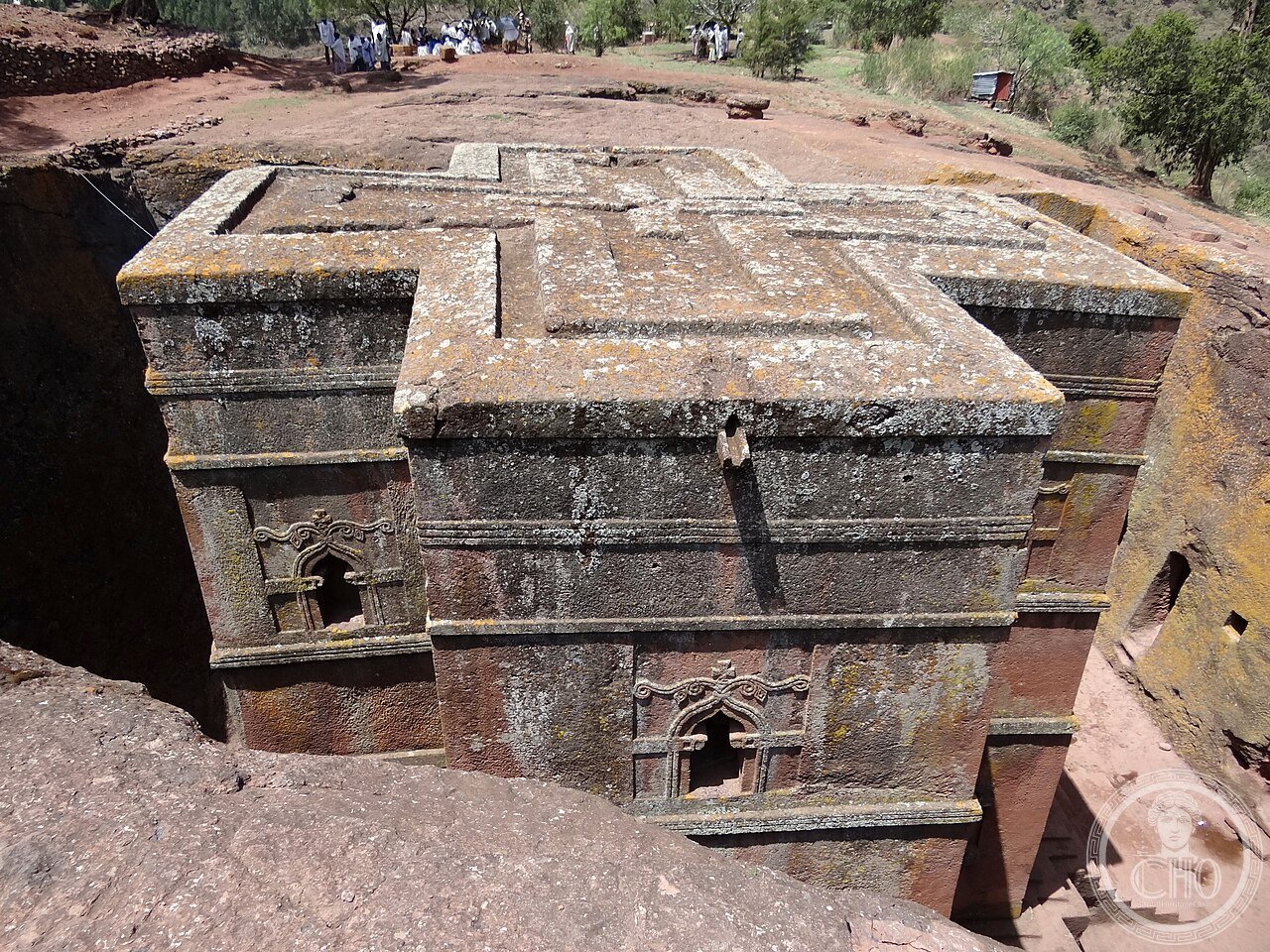
In Lalibela, Ethiopia, the church of Bete Giyorgis (Church of Saint George) was carved entirely from top to bottom out of a single block of volcanic ignimbrite rock, unlike buildings raised from the ground up. It shares that method with the other monolithic churches of Lalibela, attributed to the reign of King Gebre Mesqel Lalibela of the Zagwe dynasty, and commonly dated to the late twelfth or early 13th century. Tradition holds it to be the last of the eleven churches completed. Legend says King Lalibela received a vision, attributed either to Saint George himself or to God depending on the version, ordering him to build the church. One account holds that the king had “forgotten” to dedicate a church to the saint, who appeared angrily to demand one of his own. Local guides still point today to what are presented as the hoofprints of Saint George’s horse, near the entrance. Carved to a depth of roughly 12 metres into the rock, the church has a plan in the shape of a Greek cross, perfectly visible from above. An estimated 3,400 cubic metres of rock were removed around the building, and a further 450 cubic metres inside it. Unlike the other Lalibela churches, linked to one another by trenches and tunnels, Bete Giyorgis stands isolated from the rest of the group, reached through a narrow, spiralling artificial canyon that turns into a tunnel near the entrance. It is generally considered the best-preserved and most photographed of the eleven churches. Since 1978 it has formed part of the UNESCO World Heritage Site “Rock-Hewn Churches, Lalibela”.
About Bete Giyorgis
Bete Giyorgis, the Church of Saint George, in Lalibela, Ethiopia, was carved entirely downward from a single block of volcanic ignimbrite rock, rather than built up like a conventional structure — a method shared with the other monolithic churches of Lalibela, attributed to the reign of King Gebre Mesqel Lalibela of the Zagwe dynasty and commonly dated to the late 12th or early 13th century. Tradition holds it to be the last of the eleven churches completed. Legend recounts that King Lalibela received a vision, attributed variously to Saint George himself or to God, instructing him to build the church: one version holds that the king had “forgotten” to dedicate a church to the saint, who appeared angrily to demand his own; local guides still point today to marks near the entrance presented as the hoofprints of Saint George’s horse. Carved to a depth of roughly 12 metres into the rock, the church forms a Greek cross when viewed from above, one of the most recognisable architectural silhouettes anywhere in Ethiopia; an estimated 3,400 cubic metres of rock were removed around the building and a further 450 cubic metres excavated within it. Unlike the other Lalibela churches, connected to one another by trenches and tunnels, Bete Giyorgis stands isolated from the rest of the group, reached through a narrow, spiralling artificial canyon that becomes a tunnel near the entrance. It is generally regarded as the best-preserved and most photographed of the eleven churches. Since 1978, it has formed part of the UNESCO World Heritage Site “Rock-Hewn Churches, Lalibela.”
Key facts
- Late 12th-early 13th century: construction under King Lalibela of the Zagwe dynasty.
- ~12 metres deep, carved downward from a single block of volcanic rock.
- Greek cross plan, fully visible only from above.
- ~3,400 m³ of rock removed around the building, plus 450 m³ excavated within.
- The last of the eleven rock-hewn churches of Lalibela, according to tradition.
- 1978: becomes part of the UNESCO World Heritage Site “Rock-Hewn Churches, Lalibela”
History
Bete Giyorgis’s status as the culminating achievement of Lalibela’s eleven rock-hewn churches, carved as a deliberate cross-shaped monument distinct from and physically separate from the rest of the group, reflects its traditional role as the crowning work of King Lalibela’s ambitious building programme. Its enduring fame as the most photographed and recognisable of Lalibela’s churches has made it, more than any other single structure, the visual symbol of Ethiopia’s rock-hewn Christian architecture worldwide.
What you see
The church rises as a freestanding, cross-shaped block of rock, its walls carved with precise geometric window openings and its roof forming the distinctive Greek cross visible from above. Visitors reach the church through a narrow, spiralling rock-cut passage that descends into a tunnel before opening onto the sunken courtyard surrounding the structure itself.
Practical information
- Opening hours: generally open daily with seasonal variation; admission fee applies; check current hours before visiting.
- Address: Lalibela, Amhara Region, Ethiopia.
Getting there
Bete Giyorgis stands a short walk south of the main cluster of Lalibela’s rock-hewn churches, reachable on foot within the town. GPS: 12.0317° N, 39.0411° E.
Nearby
- Bete Medhane Alem — the largest of Lalibela’s rock-hewn churches, a short walk away.
- Bete Maryam — another of the eleven Lalibela churches, nearby.
- Lalibela town — the surrounding highland town, source of the church complex’s name.
Sources
- Wikipedia — “Church of Saint George, Lalibela” (en.wikipedia.org).
- UNESCO World Heritage Centre — “Rock-Hewn Churches, Lalibela” (whc.unesco.org).
- Encyclopaedia Britannica — “Lalibela, Ethiopia” (britannica.com).
Find it on the map
See this place and what’s around it →📷 Become a Cultural Heritage Online photographer
Share your photos of places: they stay published under your name as the author. The more they're seen, the more you get noticed — and soon a contest will reward the most appreciated photos.
Log in or sign up free to add a photo