

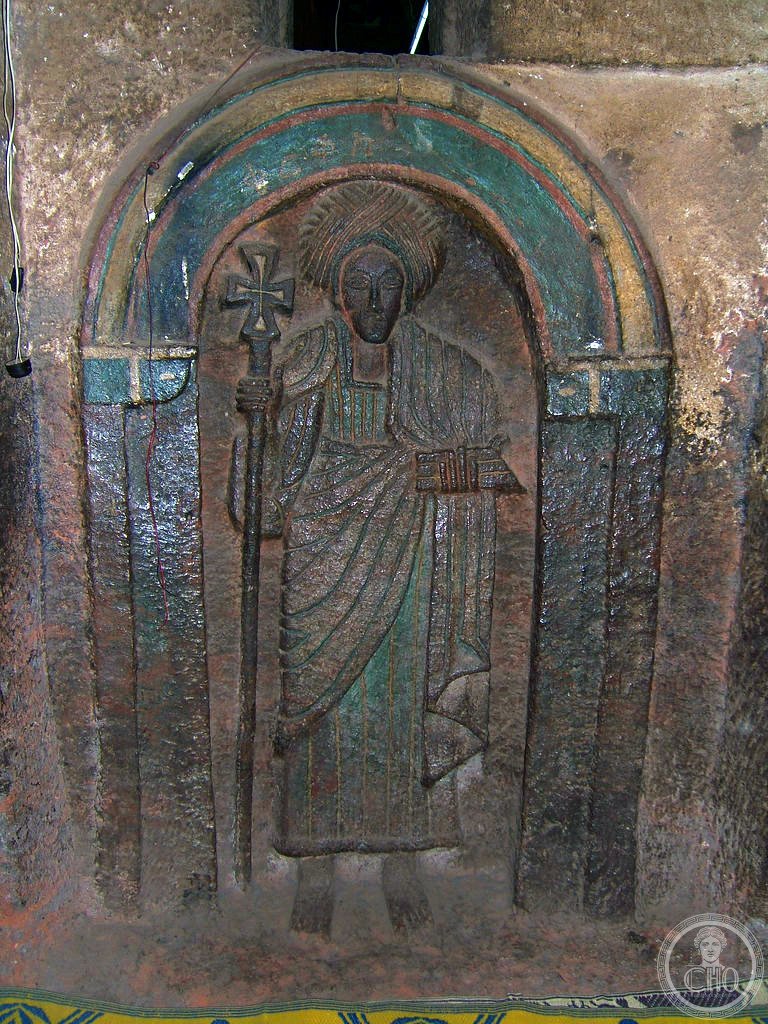
At Lalibela, in Ethiopia, the church of Bete Golgotha belongs to the north-western group of the rock-hewn churches. They are attributed to the reign of King Gebre Meskel Lalibela, of the Zagwe dynasty, around 1181-1221 AD. Tradition says the building of the eleven churches took twenty-four years. Unlike others in the complex, Bete Golgotha is semi-monolithic: it remains partly attached to the rock wall of the neighbouring Bete Maryam, and is entered through the church of Bete Mikael, also called Bete Debre Sina. Inside is the Selassie Chapel, held by tradition to be the holiest space in all of Lalibela. Tradition, not archaeology, also places there the tomb of King Lalibela himself. Only the priest of the church may enter, and pilgrims hold the dust of the place to be sacred. Bete Golgotha is also one of the very few churches in the world where women are barred from some inner sections: a custom widely reported in travel guides, though not in academic sources, tied to the rules of ritual purity of the Ethiopian Orthodox Church. The walls carry life-size reliefs of the twelve apostles. Only four are visible to visitors; the other eight stay curtained inside the Selassie Chapel. There are also reliefs of the four evangelists, and replicas of the tomb of Adam, the tomb of Christ and the manger of the Nativity. Since 1978 the church has been part of the UNESCO World Heritage Site «Rock-Hewn Churches, Lalibela».
About Bete Golgotha
Bete Golgotha, in Lalibela, Ethiopia, belongs to the northwestern cluster of the town’s rock-hewn churches, attributed to the reign of King Gebre Meskel Lalibela of the Zagwe dynasty, dated approximately 1181 to 1221 CE, whose eleven-church building programme is said by tradition to have taken twenty-four years to complete. Unlike some other churches in the complex, Bete Golgotha is semi-monolithic, remaining partially attached to the rock wall of the adjoining Bete Maryam, and is entered through the church of Bete Mikael, also known as Bete Debre Sina. Inside stands the Selassie Chapel, held by tradition to be the holiest space anywhere at Lalibela and, again according to tradition rather than archaeologically confirmed fact, the site of King Lalibela’s own tomb; access is restricted to the church’s own priest, and dust from the site is considered sacred by pilgrims. Bete Golgotha is also one of only a handful of churches anywhere in the world where, according to a tradition widely documented in travel literature though not in academic sources, women are forbidden entry to certain inner sections, tied to Ethiopian Orthodox practices around ritual purity. The walls display life-size relief carvings of the twelve apostles, only four visible to ordinary visitors while the remaining eight stay curtained within the Selassie Chapel, alongside reliefs of the four evangelists and replicas of the Tomb of Adam, the Tomb of Christ, and the manger of the Nativity. Since 1978, the church has formed part of the UNESCO World Heritage Site “Rock-Hewn Churches, Lalibela.”
Key facts
- c. 1181-1221: attributed to the reign of King Gebre Meskel Lalibela.
- Semi-monolithic, partially attached to the rock wall of neighbouring Bete Maryam.
- Selassie Chapel: traditionally the holiest space at Lalibela, restricted to the church’s priest.
- Tradition holds King Lalibela’s tomb lies within or beneath this chapel.
- Women traditionally forbidden entry to certain inner sections.
- Life-size reliefs of the twelve apostles, only four visible to visitors.
- 1978: becomes part of the UNESCO World Heritage Site “Rock-Hewn Churches, Lalibela”
History
Bete Golgotha’s traditional association with King Lalibela’s own burial, kept restricted even from most worshippers within the Selassie Chapel, positions the church at the devotional and symbolic heart of the entire Lalibela complex, its sanctity underscored by the exceptional restrictions surrounding both the tomb tradition and access for women. The church’s role within the tightly interconnected northwestern cluster, entered through Bete Mikael and physically joined to Bete Maryam, illustrates the deliberate architectural and liturgical unity King Lalibela’s builders achieved across the complex’s eleven rock-hewn churches.
What you see
The church’s walls display life-size relief carvings of the twelve apostles and the four evangelists, considered among the finest sculptural work anywhere at Lalibela, alongside replicas of the Tomb of Adam and the Tomb of Christ. The restricted Selassie Chapel, reached through the church’s interior, remains largely unseen by visitors, its sanctity preserved by centuries of access limited to the officiating priest alone.
Practical information
- Opening hours: generally open daily with seasonal variation; admission fee applies; note the traditional restriction on women’s access to certain sections; check current conditions before visiting.
- Address: Lalibela, Amhara Region, Ethiopia.
Getting there
Bete Golgotha stands within the northwestern cluster of Lalibela’s rock-hewn churches, entered through Bete Mikael, reachable on foot within the town. GPS: 12.0337° N, 39.0431° E.
Nearby
- Bete Maryam — the church physically joined to Bete Golgotha, nearby.
- Bete Medhane Alem — the largest of Lalibela’s churches, a short walk away.
- Lalibela town — the surrounding highland town, source of the church complex’s name.
Sources
- UNESCO World Heritage Centre — “Rock-Hewn Churches, Lalibela” (whc.unesco.org).
- Wikipedia — “Rock-Hewn Churches, Lalibela” and “Bete Golgota-Selassié” (en/fr.wikipedia.org).
- Lonely Planet — “Bet Golgotha & Bet Mikael” (lonelyplanet.com).
Find it on the map
See this place and what’s around it →📷 Become a Cultural Heritage Online photographer
Share your photos of places: they stay published under your name as the author. The more they're seen, the more you get noticed — and soon a contest will reward the most appreciated photos.
Log in or sign up free to add a photo