
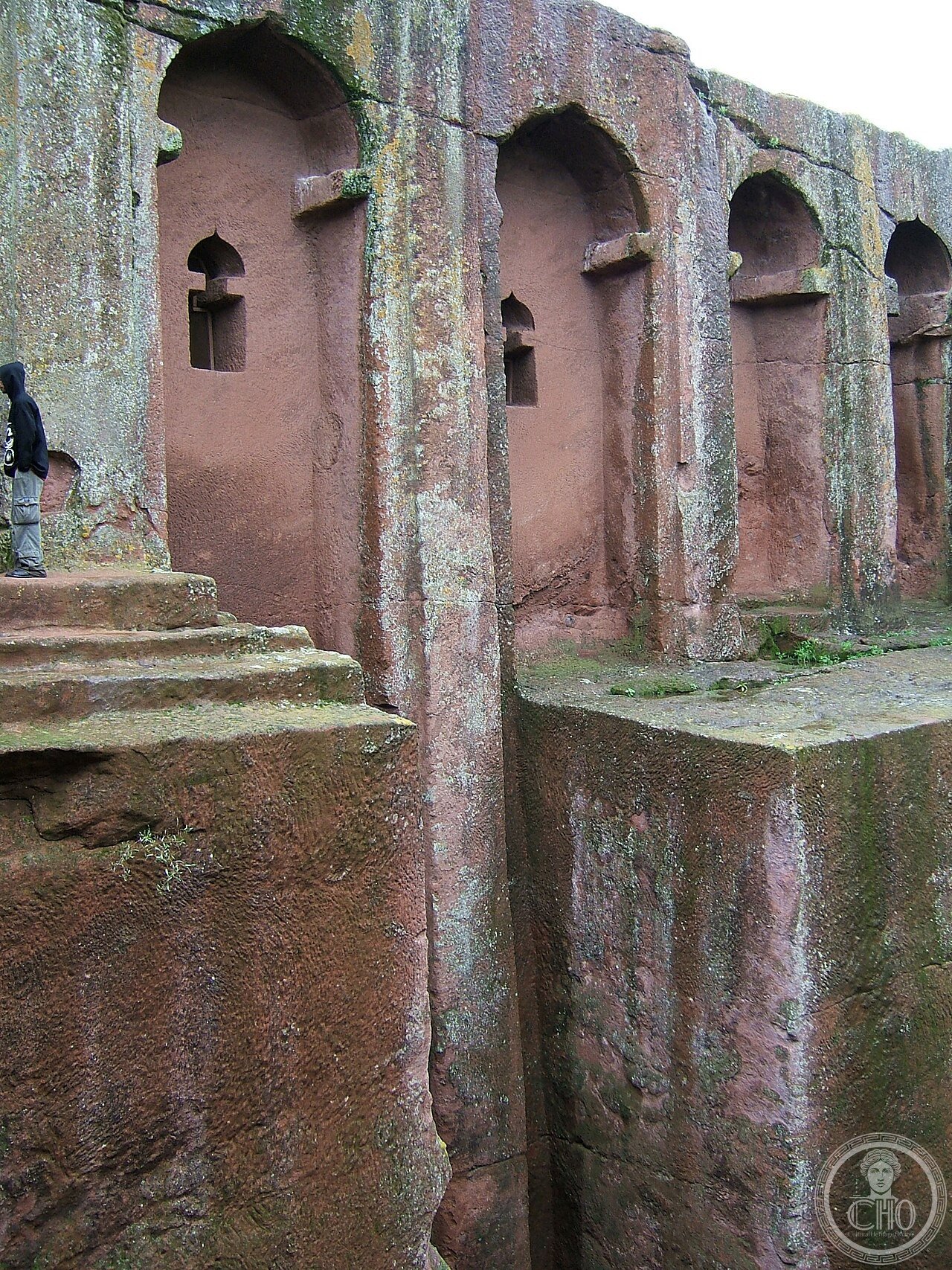
In Lalibela, Ethiopia, the church of Bete Amanuel, the Church of Emmanuel, belongs to the southern group of the rock-hewn churches, together with Bete Merkorios, Bete Gabriel-Rufael and Bete Abba Libanos, south of the symbolic trench known as the «river Jordan» that divides the Lalibela complex. Carved from a single block of volcanic rock, it is attributed to the reign of King Lalibela, of the Zagwe dynasty, datable between the 12th and the 13th century. It is widely held to be the most refined in architecture of the eleven churches. Its four façades are carved to imitate the Aksumite building technique in timber and stone, proper to the older Ethiopian churches, with horizontal beams alternating with projecting and recessed stone panels, reproducing faithfully in the rock a real timber construction. According to a hypothesis that is unproven but supported by some scholars, Bete Amanuel may have been the former private chapel of the Zagwe royal family, on the strength of its architectural refinement and of the broad courtyard around it, fit for ceremonies reserved to the court. The church has cross-shaped windows and, as in the wider Aksumite style of Lalibela, beam-ends carved in imitation of timber building. Inside, a large hall with four pillars leads to a stairway that climbs to an upper gallery, access to which is restricted today. Since 1978 the church has been part of the UNESCO World Heritage site «Rock-Hewn Churches, Lalibela».
About Bete Amanuel
Bete Amanuel, the Church of Emmanuel, in Lalibela, Ethiopia, belongs to the southern cluster of the town’s rock-hewn churches, alongside Bete Merkorios, Bete Gabriel-Rufael and Bete Abba Libanos, south of the symbolic “River Jordan” trench that divides the Lalibela complex. Carved from a single block of volcanic rock, it is attributed to the reign of King Lalibela of the Zagwe dynasty, dated broadly to the 12th or 13th century. It is widely regarded as the most architecturally refined of the eleven churches: all four facades are carved to imitate the Aksumite timber-and-stone building technique found in Ethiopia’s earlier churches, with horizontal beam courses alternating with projecting and recessed stone panels, faithfully replicating in solid rock the appearance of genuine wooden construction. According to an unproven but scholarly hypothesis, Bete Amanuel may once have served as the private chapel of the Zagwe royal family, based on its architectural refinement and the broad surrounding courtyard, consistent with ceremonies reserved for the royal court. The church displays cruciform windows and, in keeping with the broader Aksumite style found throughout Lalibela, carved beam-ends imitating timber construction; inside, a large hall supported by four pillars leads to a stairway ascending to an upper gallery, access to which is currently restricted. Since 1978, the church has formed part of the UNESCO World Heritage Site “Rock-Hewn Churches, Lalibela.”
Key facts
- 12th-13th century: attributed to the reign of King Lalibela, Zagwe dynasty.
- Southern cluster, alongside Bete Merkorios, Bete Gabriel-Rufael and Bete Abba Libanos.
- Widely considered the most architecturally refined of Lalibela’s eleven churches.
- Facades carved to imitate ancient Aksumite timber-and-stone construction.
- Possible royal chapel: an unproven scholarly hypothesis based on the church’s refinement.
- 1978: becomes part of the UNESCO World Heritage Site “Rock-Hewn Churches, Lalibela”
History
Bete Amanuel’s exceptional architectural refinement, widely singled out by art historians among Lalibela’s eleven churches, offers one of the clearest surviving examples of how the town’s rock-hewn builders deliberately translated the older Aksumite timber-and-stone architectural tradition into solid volcanic rock. The unresolved hypothesis of its former role as a private royal chapel adds a further layer of historical interest to a building already distinguished by the sophistication of its carved facades.
What you see
The church’s four facades display alternating projecting and recessed stone panels carved to mimic real timber-and-stone Aksumite construction, framed by cruciform windows and beam-ends imitating wooden building technique. Inside, a four-pillared hall leads to a stairway ascending toward an upper gallery, part of an interior layout that reflects the building’s exceptional architectural ambition among Lalibela’s rock-hewn churches.
Practical information
- Opening hours: generally open daily with seasonal variation; admission fee applies; check current hours before visiting.
- Address: Lalibela, Amhara Region, Ethiopia.
Getting there
Bete Amanuel stands within the southern cluster of Lalibela’s rock-hewn churches, reachable on foot within the town. GPS: 12.0318° N, 39.0456° E.
Nearby
- Bete Abba Libanos — another of the southern cluster’s rock-hewn churches, nearby.
- Bete Gabriel-Rufael — distinctive fortress-like church, a short walk away.
- Lalibela town — the surrounding highland town, source of the church complex’s name.
Sources
- Wikipedia — “Biete Amanuel” (en.wikipedia.org).
- The Metropolitan Museum of Art — “The Rock-Hewn Churches of Lalibela” (metmuseum.org).
- UNESCO World Heritage Centre — “Rock-Hewn Churches, Lalibela” (whc.unesco.org).
Find it on the map
See this place and what’s around it →📷 Become a Cultural Heritage Online photographer
Share your photos of places: they stay published under your name as the author. The more they're seen, the more you get noticed — and soon a contest will reward the most appreciated photos.
Log in or sign up free to add a photo