

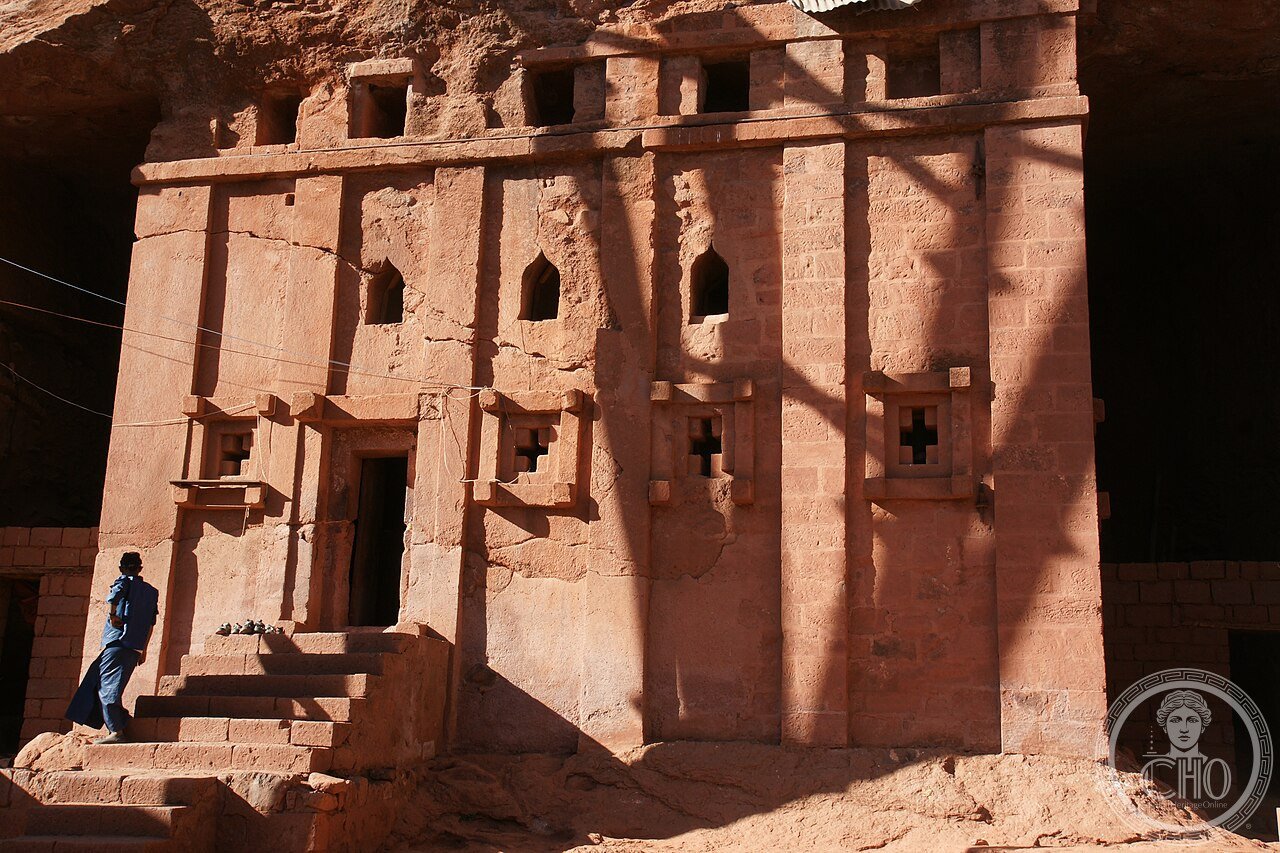
At Lalibela, in Ethiopia, the church of Bete Abba Libanos differs from most of the other monolithic churches of the complex in the way it was cut. Instead of being freed entirely from the surrounding rock, as Bete Giyorgis was, it stays attached to the mountain at its roof, while the other sides were separated by trenches and tunnels cut into the stone. The result is a hybrid between a monolithic church and a cave church. Tradition — widely repeated in tourist sources, but absent from the more solid encyclopaedic accounts — says the church was built at the wish of Queen Meskel Kebra, wife of King Lalibela, as a memorial in her husband’s honour, and that legend has it finished in a single night with the help of angels. The church belongs to the south-eastern group of the churches of Lalibela, along with Bete Amanuel, Bete Merkorios, Bete Gabriel-Rufael and Bete Lehem. Compared with the grander churches of the complex, Bete Abba Libanos has a modest interior, with a nave running east to west and an inner sanctuary, the «Holy of Holies», closed to general access, which holds the altar. Since 1978 the church has been part of the UNESCO World Heritage Site «Rock-Hewn Churches, Lalibela».
About Bete Abba Libanos
Bete Abba Libanos, in Lalibela, Ethiopia, stands apart from most of the complex’s other monolithic churches in its method of excavation: rather than being fully separated from the surrounding rock as at Bete Giyorgis, it remains attached to the mountain at its roof, while its other sides were freed through cut trenches and tunnels, producing a hybrid between a freestanding monolithic church and a cave church. According to tradition, widely repeated in tourism sources though absent from the more rigorously sourced encyclopaedic accounts, the church was commissioned by Queen Meskel Kebra, wife of King Lalibela, as a memorial in her husband’s honour, said by legend to have been completed in a single night with the help of angels. The church belongs to the southeastern cluster of Lalibela’s churches, alongside Bete Amanuel, Bete Merkorios, Bete Gabriel-Rufael and Bete Lehem. Compared to the complex’s more imposing churches, Bete Abba Libanos presents a relatively modest interior, with a nave running east to west and an inner sanctuary, the Holy of Holies, its access restricted, housing the altar. Since 1978, the church has formed part of the UNESCO World Heritage Site “Rock-Hewn Churches, Lalibela.”
Key facts
- Unique construction: carved into a cliff face, remaining attached to the mountain at its roof.
- Tradition: commissioned by Queen Meskel Kebra, wife of King Lalibela, as a memorial to him.
- Southeastern cluster, alongside Bete Amanuel, Bete Merkorios, Bete Gabriel-Rufael and Bete Lehem.
- Relatively modest interior compared to Lalibela’s larger churches.
- 1978: becomes part of the UNESCO World Heritage Site “Rock-Hewn Churches, Lalibela”
History
Bete Abba Libanos’s distinctive cave-church construction, carved into a cliff face rather than fully freed as an isolated monolith, illustrates the range of technical approaches Lalibela’s builders applied across the complex’s eleven churches, adapting each excavation to the specific rock formation available at its site. The enduring tradition crediting Queen Meskel Kebra with the church’s construction, though not confirmed by the strongest available sources, reflects the significant role attributed to Lalibela’s royal women in the wider body of legend surrounding the town’s founding.
What you see
The church’s exterior rises directly from the cliff face it remains attached to at the roofline, its other sides freed by surrounding trenches that allow visitors to walk around the structure. Inside, a modest east-west nave leads toward the restricted Holy of Holies, housing the church’s altar in keeping with traditional Ethiopian Orthodox church design.
Practical information
- Opening hours: generally open daily with seasonal variation; admission fee applies; check current hours before visiting.
- Address: Lalibela, Amhara Region, Ethiopia.
Getting there
Bete Abba Libanos stands within the southeastern cluster of Lalibela’s rock-hewn churches, reachable on foot within the town. GPS: 12.0314° N, 39.0452° E.
Nearby
- Bete Amanuel — considered the most architecturally refined of Lalibela’s churches, nearby.
- Bete Gabriel-Rufael — distinctive fortress-like church, a short walk away.
- Lalibela town — the surrounding highland town, source of the church complex’s name.
Sources
- Wikipedia — “Biete Abba Libanos” and “Lalibela” (en.wikipedia.org).
- Zamani Project — 3D heritage documentation of Lalibela (zamaniproject.org).
- UNESCO World Heritage Centre — “Rock-Hewn Churches, Lalibela” (whc.unesco.org).
Find it on the map
See this place and what’s around it →📷 Become a Cultural Heritage Online photographer
Share your photos of places: they stay published under your name as the author. The more they're seen, the more you get noticed — and soon a contest will reward the most appreciated photos.
Log in or sign up free to add a photo