

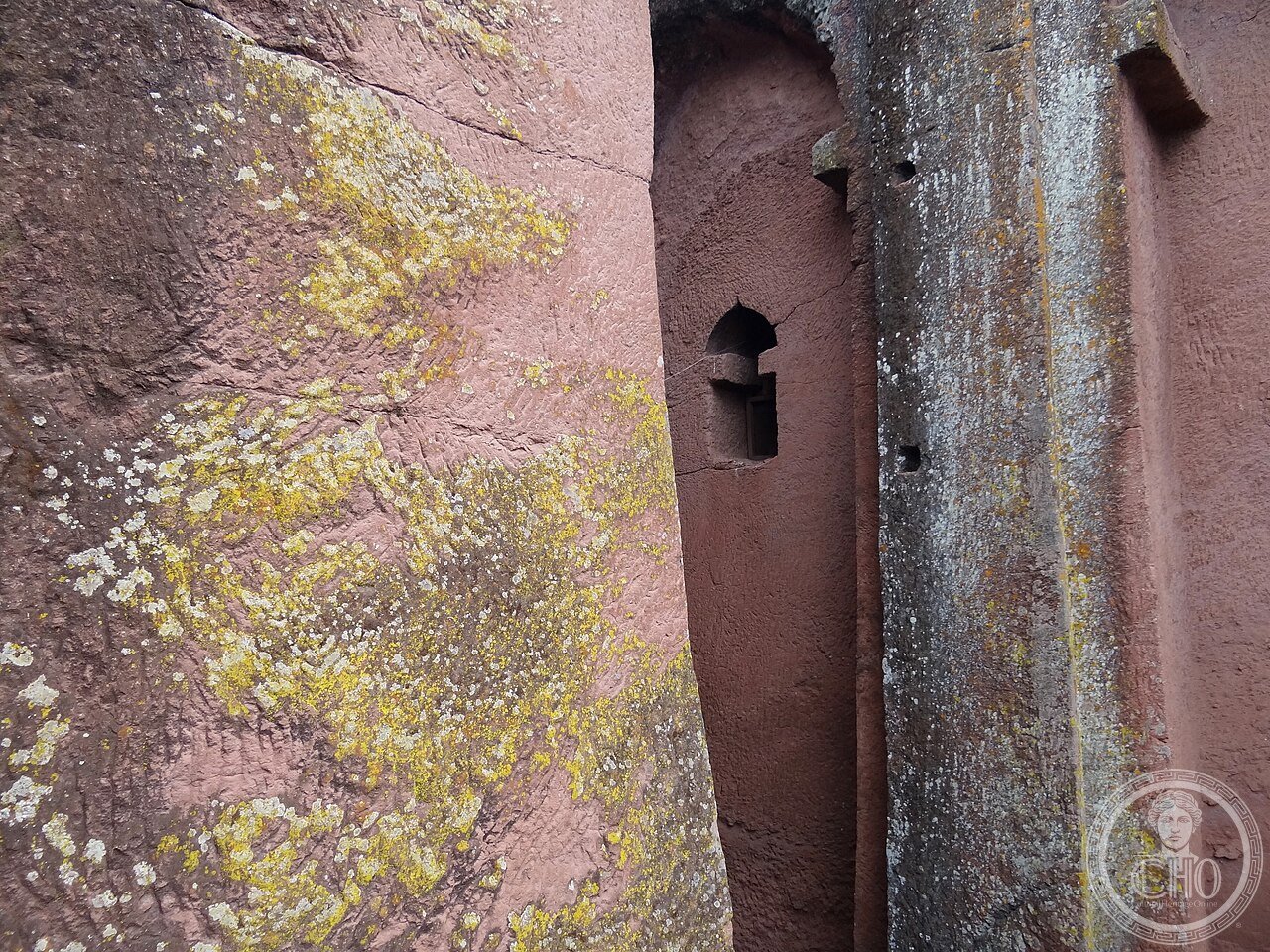
In Lalibela, Ethiopia, the church of Bete Gabriel-Rufael, dedicated to the Archangels Gabriel and Raphael, stands apart from the complex’s other churches for its distinctly fortress-like appearance. Some scholars, among them the Cambridge archaeologist David Phillipson, have proposed that the church, together with the neighbouring Bete Merkorios, may originally have been carved as a fortified royal complex, perhaps a palace or a defensive structure, during the late Aksumite period, roughly the 7th or 8th century. That would place it centuries before King Lalibela’s church-building programme, with the church only later brought into the network of Christian rock-hewn churches. Supporting this unproven but seriously debated hypothesis are the building’s irregular floor plan and its orientation, atypical for a church. Visitors reach the church by crossing a wide tunnel that leads to a narrow bridge over a deep, moat-like trench cut into the rock, which fills with water in the rainy season. Unlike most Lalibela churches, the entrance sits at the top of the structure rather than at ground level. The high, almost windowless walls further reinforce the impression of a fortress rather than a religious building. Bete Gabriel-Rufael belongs to the eastern cluster of Lalibela churches, alongside Bete Amanuel, Bete Merkorios and Bete Abba Libanos. Since 1978 it has formed part of the UNESCO World Heritage Site “Rock-Hewn Churches, Lalibela”.
About Bete Gabriel-Rufael
Bete Gabriel-Rufael, in Lalibela, Ethiopia, dedicated to the Archangels Gabriel and Raphael, stands apart from the complex’s other churches for its distinctly fortress-like appearance. Some scholars, including the Cambridge archaeologist David Phillipson, have proposed that the church, together with the neighbouring Bete Merkorios, may originally have been carved as a fortified royal complex — possibly a palace or defensive structure — during the late Aksumite period, roughly the 7th or 8th century, centuries before King Lalibela’s church-building programme, only later incorporated into the town’s network of Christian rock-hewn churches. Supporting this unproven but seriously debated hypothesis are the building’s irregular floor plan and its orientation, atypical for a conventional church. Visitors reach the church by crossing a wide tunnel leading to a narrow bridge spanning a deep, moat-like trench cut into the rock, which fills with water during the rainy season; unlike most Lalibela churches, its entrance sits at the top of the structure rather than at ground level. High, largely windowless walls further reinforce the building’s defensive, fortress-like impression over that of a typical church facade. Bete Gabriel-Rufael belongs to the eastern cluster of Lalibela’s churches, alongside Bete Amanuel, Bete Merkorios and Bete Abba Libanos. Since 1978, it has formed part of the UNESCO World Heritage Site “Rock-Hewn Churches, Lalibela.”
Key facts
- Possible late Aksumite origin (7th-8th century) as a fortified royal complex, per a scholarly hypothesis.
- Dedicated to the Archangels Gabriel and Raphael.
- Reached via a tunnel and narrow bridge across a deep, moat-like rock-cut trench.
- Entrance at the top of the structure, unlike most Lalibela churches.
- Eastern cluster, alongside Bete Amanuel, Bete Merkorios and Bete Abba Libanos.
- 1978: becomes part of the UNESCO World Heritage Site “Rock-Hewn Churches, Lalibela”
History
Bete Gabriel-Rufael’s fortress-like architecture and dramatic trench-and-bridge approach set it apart even within a complex renowned for its unconventional rock-hewn engineering, lending real weight to the scholarly hypothesis that it began life as a defensive structure rather than a church. If correct, the theory would place the origins of this particular excavation centuries before King Lalibela’s own reign, making it one of the oldest carved structures in the entire complex, later repurposed for Christian worship as the town’s religious identity took shape.
What you see
The church’s high, largely blank cliff-like facade rises above the deep trench that separates it from the surrounding rock, crossed by a narrow bridge leading to an entrance set unusually at the top of the structure. Inside, two joined spaces, Bet Gabriel and Bet Rufael, connect through an internal doorway, though only Bet Gabriel remains in regular use for services today.
Practical information
- Opening hours: generally open daily with seasonal variation; admission fee applies; check current hours before visiting.
- Address: Lalibela, Amhara Region, Ethiopia.
Getting there
Bete Gabriel-Rufael stands within the eastern cluster of Lalibela’s rock-hewn churches, reachable on foot within the town via its distinctive trench-and-bridge approach. GPS: 12.0312° N, 39.0446° E.
Nearby
- Bete Merkorios — adjoining church, separately theorised to have served as a former prison.
- Bete Amanuel — considered the most architecturally refined of Lalibela’s churches, nearby.
- Lalibela town — the surrounding highland town, source of the church complex’s name.
Sources
- Wikipedia — “Biete Gabriel-Rufael” (en.wikipedia.org).
- Wikipedia — “Rock-Hewn Churches, Lalibela” (en.wikipedia.org).
- Lonely Planet — “Bet Gabriel-Rufael, Lalibela, Ethiopia” (lonelyplanet.com).
Find it on the map
See this place and what’s around it →📷 Become a Cultural Heritage Online photographer
Share your photos of places: they stay published under your name as the author. The more they're seen, the more you get noticed — and soon a contest will reward the most appreciated photos.
Log in or sign up free to add a photo