

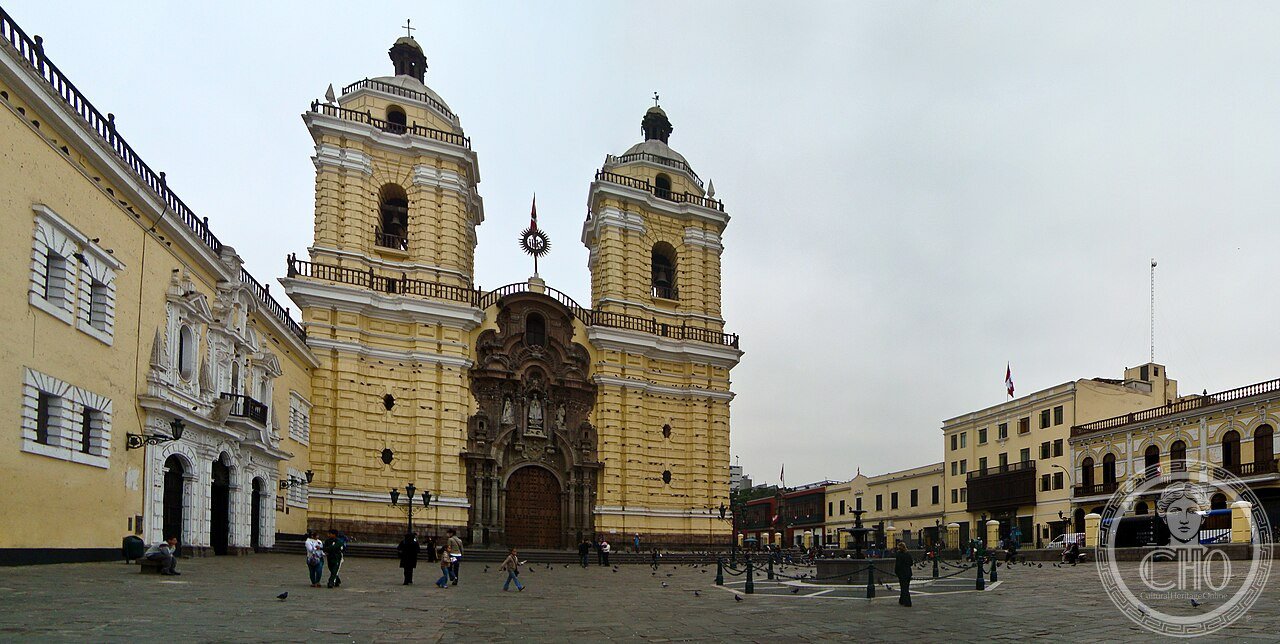
In the historic centre of Lima, in Peru, the Basilica and Convent of San Francisco stand on land granted to the Franciscans in 1535, the year the city was founded. The first church, built around 1546, was destroyed by the violent earthquake of 4 February 1655; rebuilding began in 1657 under the Portuguese architect Constantino de Vasconcelos and the master builder Manuel de Escobar, who adopted the quincha technique, a flexible structure of wood and cane, thanks to which the building survived the earthquakes of 1687 and 1746 almost intact. Beneath the church stretch the famous catacombs, used as Lima’s main cemetery until 1810: estimates of the remains held there range between 25,000 and 70,000 people, arranged in some chambers in geometric and circular patterns. The convent library, among the most important on the whole American continent in the colonial period, holds around 25,000 volumes, including rare sixteenth-century editions. Since 1988 the complex has been part of the UNESCO World Heritage of the historic centre of Lima.
About the Basilica and Convent of San Francisco
The Basilica and Convent of San Francisco stands in the historic centre of Lima, Peru, on land granted to the Franciscan order in 1535, the year of the city’s founding; a modest first church was built around 1546. That structure was destroyed by the devastating earthquake of 4 February 1655, and reconstruction began in 1657 under the design of Portuguese architect Constantino de Vasconcelos and master builder Manuel de Escobar, whose use of quincha construction — flexible frames of wood and woven reed — allowed the new complex, inaugurated in 1672, to survive subsequent earthquakes in 1687 and 1746 largely intact, a rare feat among Lima’s colonial-era buildings. Beneath the church extend the famous catacombs, used as Lima’s principal cemetery until 1810; estimates of the remains held there vary considerably across sources, commonly cited in a range from roughly 25,000 to 70,000 individuals, with bones in several chambers arranged in deliberate geometric and circular patterns. The convent’s historic library, among the most important assembled in the Americas during the colonial period, holds around 25,000 volumes in Spanish, Latin and Quechua, including rare 16th-century editions predating much of Peru’s printed history. The complex combines Spanish Baroque architecture with Mudéjar, Moorish-influenced detailing, its cloisters decorated with Sevillian azulejo tiles dated to 1642 depicting Franciscan saints. Since 1988, the Basilica and Convent of San Francisco has formed part of the UNESCO World Heritage Site covering the Historic Centre of Lima, and the church remains an active Franciscan community today, its catacombs open to visitors as part of a guided museum tour.
Key facts
- 1535: Franciscans granted the land, the year Lima was founded
- 1655: earthquake destroys the original church
- 1657-1672: reconstruction under Constantino de Vasconcelos and Manuel de Escobar, using flexible quincha construction
- Catacombs: Lima’s principal cemetery until 1810, holding an estimated 25,000-70,000 remains
- ~25,000 volumes in the convent’s historic library, including rare 16th-century editions
- 1988: inscribed as part of the UNESCO World Heritage Site “Historic Centre of Lima”
History
The Basilica and Convent of San Francisco’s survival through repeated colonial-era earthquakes, credited to Vasconcelos’s flexible quincha construction technique, makes it one of the best-preserved examples of 17th-century Spanish colonial religious architecture in the Americas, standing largely as rebuilt after the catastrophic 1655 earthquake. Its catacombs, serving as Lima’s principal burial ground for over a century and a half, offer a uniquely direct physical record of the city’s colonial-era population, while the convent’s extensive historic library preserves one of the richest collections of early printed material anywhere on the continent.
What you see
The church’s Spanish Baroque facade, with Mudéjar architectural detailing reflecting Moorish influence transmitted through Spain, opens onto cloisters decorated with Sevillian azulejo tiles dated to 1642, depicting Franciscan saints in vivid blue and white. Beneath the complex, the catacombs display carefully arranged bone chambers, some organised into geometric and circular patterns, while the convent’s historic library preserves thousands of colonial-era volumes in reading rooms open to visitors.
Practical information
- Opening hours: generally open daily with seasonal variation; admission fee for the guided catacombs and museum tour; check current hours before visiting
- Address: Jirón Áncash, corner of Jirón Lampa, Cercado de Lima, Peru
Getting there
The Basilica and Convent of San Francisco stands roughly 350 metres from Lima’s Plaza de Armas, in the heart of the historic centre, easily reached on foot. GPS: 12.0433° S, 77.0309° W.
Nearby
- Plaza de Armas de Lima — the city’s main square, a short walk away
- Lima Cathedral — the city’s principal cathedral, nearby
- Government Palace — the seat of the Peruvian presidency, near the Plaza de Armas
Sources
- Wikipedia — “Basilica and Convent of San Francisco, Lima” (en.wikipedia.org)
- Wikipedia — “Catacombs of Lima” (en.wikipedia.org)
- UNESCO World Heritage Centre — “Historic Centre of Lima” (whc.unesco.org)
Find it on the map
See this place and what’s around it →📷 Become a Cultural Heritage Online photographer
Share your photos of places: they stay published under your name as the author. The more they're seen, the more you get noticed — and soon a contest will reward the most appreciated photos.
Log in or sign up free to add a photo