

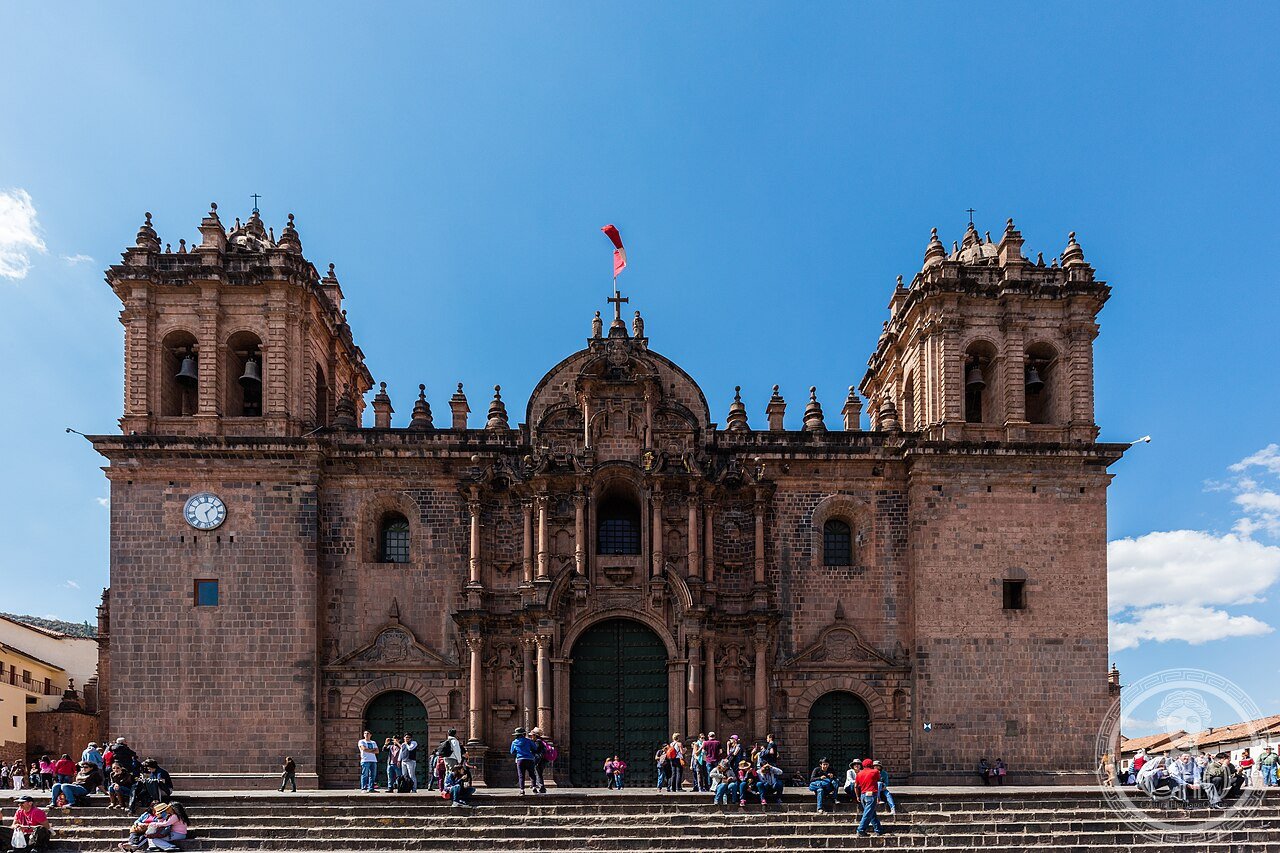
On the Plaza de Armas of Cusco, in Peru, the Cathedral of the Virgin of the Assumption stands on the site of Kiswarkancha, the palace of the Inca Wiracocha. The Spanish demolished it after the conquest. Much of the stone used to build the cathedral was quarried from the nearby Inca fortress of Sacsayhuamán, dismantled block by block over the following decades. Work began in 1559 and ended, according to the most commonly cited sources, around 1654, with the official consecration in 1668: almost a century of building, in a style that joins a Renaissance front to Baroque, late-Gothic and Plateresque interiors. Inside is one of the most celebrated masterpieces of the Cusco School, the colonial Andean painting tradition: the Last Supper painted by Marcos Zapata around 1753, in which Christ and the apostles sit before a roast cuy, the guinea pig, a dish typical of the Andes, instead of the paschal lamb of the European tradition. The bell tower holds María Angola, among the largest bells in South America, into whose casting, local tradition says, gold donated by the people of the city was poured. Since 1983 the cathedral has been part of the UNESCO World Heritage Site of the city of Cusco.
About Cusco Cathedral
Cusco Cathedral, formally the Basílica Catedral de la Virgen de la Asunción, stands on Cusco’s Plaza de Armas on the site of Kiswarkancha, the palace of the Inca ruler Wiracocha, which Spanish colonisers demolished following the conquest. Much of the stone used in the cathedral’s construction was quarried from the nearby Inca fortress of Sacsayhuamán, dismantled block by block over subsequent decades to supply building material for colonial Cusco — a striking physical continuity between the Inca and Spanish colonial city. Construction began in 1559 and, according to the most commonly cited sources, concluded around 1654, with the cathedral formally consecrated in 1668, representing nearly a century of building in a style blending a Renaissance facade with Baroque, late-Gothic and Plateresque interior elements across three naves with Gothic ribbed vaulting. The cathedral houses one of the most celebrated works of the Cusco School (Escuela Cuzqueña), the colonial-era Andean-Christian painting tradition that blended European religious subjects with Andean symbolism, colour and technique, largely produced by Indigenous and mestizo artists: Marcos Zapata’s Last Supper, painted around 1753, depicts Christ and the apostles gathered around a table centred on a roasted cuy, or guinea pig, a distinctively Andean dish standing in for the traditional paschal lamb of European Last Supper imagery. The cathedral’s bell tower holds María Angola, one of the largest bells in South America, whose casting in the 17th century is, according to local tradition, said to have included gold donated by residents of the city, giving the bell both its name and its legendarily far-carrying tone. Since 1983, Cusco Cathedral has formed part of the UNESCO World Heritage Site covering the City of Cuzco.
Key facts
- Site: built over Kiswarkancha, the palace of the Inca ruler Wiracocha.
- Stone: largely quarried from the dismantled Inca fortress of Sacsayhuamán.
- 1559-c.1654: construction period, consecrated in 1668.
- Marcos Zapata’s Last Supper (c. 1753): Christ and the apostles depicted with a roasted cuy at the centre of the table.
- María Angola bell: one of the largest bells in South America, said by tradition to contain donated gold.
- 1983: inscribed as part of the UNESCO World Heritage Site “City of Cuzco”
History
Cusco Cathedral’s construction directly atop a former Inca royal palace, using stone taken from one of the Inca empire’s most important fortifications, embodies the physical and cultural layering that defines colonial Cusco, where Spanish religious architecture rose quite literally from the dismantled remains of Inca power. The cathedral’s role as a principal repository of Cusco School painting reflects the broader artistic response of Indigenous and mestizo artists to Spanish colonial rule, producing a distinctive visual tradition that persisted for some three centuries and remains among the most studied bodies of colonial-era art in the Americas.
What you see
The cathedral’s Renaissance stone facade opens onto a three-naved interior combining Baroque, late-Gothic and Plateresque elements beneath Gothic ribbed vaulting, its walls hung with an extensive collection of Cusco School paintings including Marcos Zapata’s Last Supper and works attributed to Diego Quispe Tito. The bell tower houses the María Angola bell, while the cathedral’s silver-clad altars and elaborately carved choir stalls reflect the wealth accumulated by the colonial-era Church in the former Inca capital.
Practical information
- Opening hours: generally open daily with seasonal variation; admission fee applies; check current hours before visiting.
- Address: Plaza de Armas, Cusco, Peru.
Getting there
Cusco Cathedral stands on the Plaza de Armas in the heart of Cusco, easily reached on foot from anywhere in the historic centre. GPS: 13.5163° S, 71.9781° W.
Nearby
- Plaza de Armas de Cusco — the city’s main square, directly in front of the cathedral.
- Church of the Society of Jesus (La Compañía) — another major Baroque church on the same square.
- Sacsayhuamán — the Inca fortress that supplied the cathedral’s stone, on the hills above the city.
Sources
- Wikipedia — “Cusco Cathedral” (en.wikipedia.org).
- Wikipedia — “Cusco School” (en.wikipedia.org).
- UNESCO World Heritage Centre — “City of Cuzco” (whc.unesco.org).
Find it on the map
See this place and what’s around it →📷 Become a Cultural Heritage Online photographer
Share your photos of places: they stay published under your name as the author. The more they're seen, the more you get noticed — and soon a contest will reward the most appreciated photos.
Log in or sign up free to add a photo