

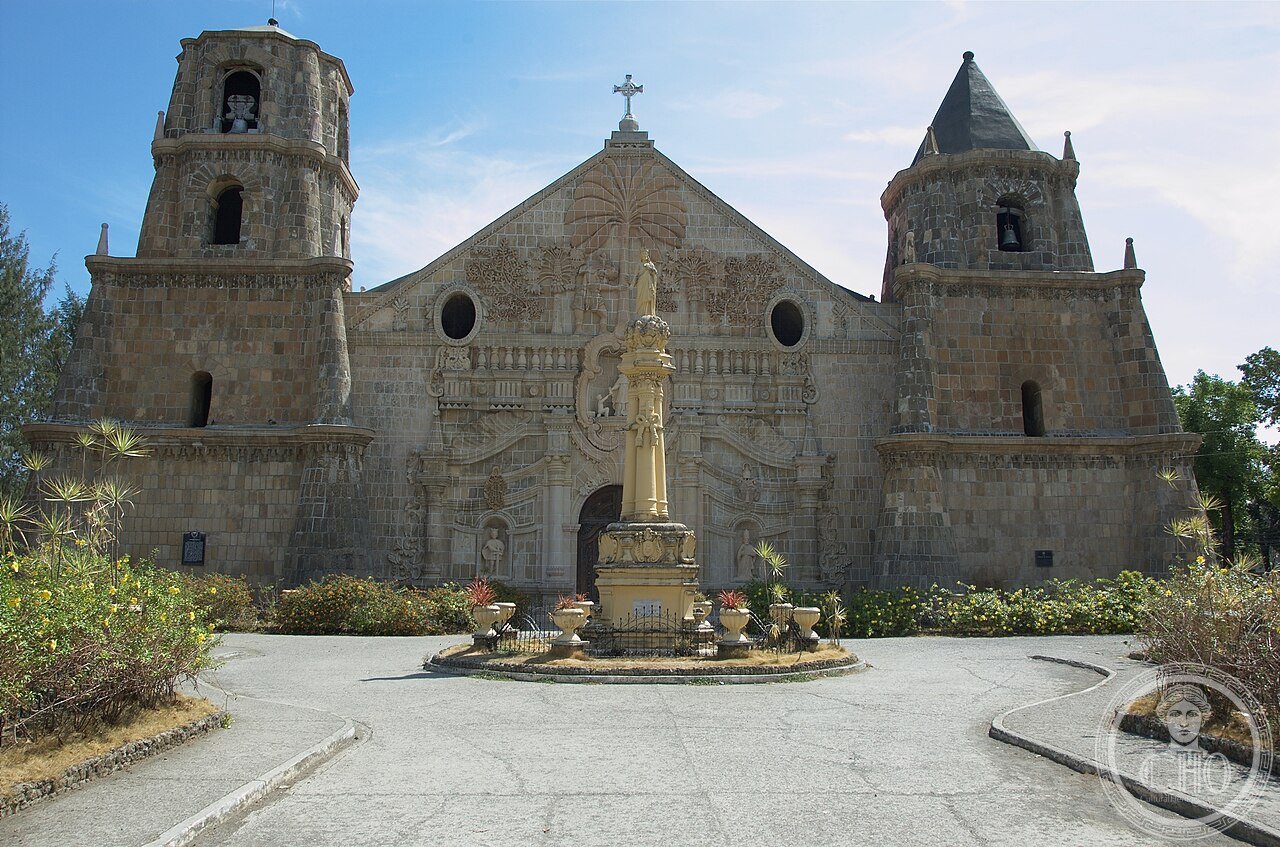
In Miagao, in the province of Iloilo, in the Philippines, the church of Santo Tomás de Villanueva was built by Augustinian friars together with the local townspeople between roughly 1786 and 1797. The works were supervised by the friar Francisco Gonzales, and the new church replaced two earlier ones destroyed by Moro pirate raids in 1741 and 1754: it was raised on higher, more defensible ground. Its walls are about one and a half metres thick and built of coral stone, adobe and limestone. Its two asymmetrical bell towers, of differing heights, also served as watchtowers against raiders from the sea, and make the building as much a fortress as a place of worship. Its facade, carved in bas-relief, is famous throughout the world for fusing Christian religious iconography with local Filipino motifs. At the centre a huge coconut palm stands as a Tree of Life, beneath which Saint Christopher carries the Christ child on his shoulders, dressed in traditional Filipino rather than European clothes, surrounded by tropical plants such as papaya. In 1993 the church was inscribed, together with three other Filipino Baroque churches, on the UNESCO World Heritage list.
About Miagao Church
Miagao Church, formally the Santo Tomás de Villanueva Parish Church, in Miagao, Iloilo Province, Philippines, was built by Augustinian friars together with the local townspeople between roughly 1786 and 1797, under the supervision of the friar Francisco Gonzales, replacing two earlier churches that had been destroyed following Moro pirate raids in 1741 and 1754; the new church was deliberately sited on higher, more defensible ground. The building’s walls, roughly 1.5 metres thick and constructed of coral stone, adobe and limestone, reflect a design conceived as much for defence as for worship, an impression reinforced by the church’s two asymmetrical bell towers of differing heights and designs, which doubled historically as watchtowers against seaborne raiders. The church’s greatest fame rests on its elaborately carved bas-relief facade, widely regarded as one of the finest examples of folk Baroque art in the Philippines for its distinctive fusion of European Christian iconography with local tropical and indigenous motifs: at its centre rises a monumental coconut palm rendered as a Tree of Life, beneath which Saint Christopher carries the Christ child on his shoulders, both figures dressed in local Filipino rather than European attire, surrounded by native tropical plants including papaya. In 1993, Miagao Church was inscribed as part of the UNESCO World Heritage Site “Baroque Churches of the Philippines,” a serial listing that also includes San Agustín Church in Manila, Paoay Church in Ilocos Norte, and the Church of Santa María in Ilocos Sur. The church remains an active Roman Catholic parish under the Archdiocese of Jaro and is recognised as a National Cultural Treasure of the Philippines.
Key facts
- c. 1786-1797: construction by Augustinian friars and local townspeople.
- Walls roughly 1.5 metres thick, built of coral stone, adobe and limestone.
- Two asymmetrical bell towers, historically doubling as watchtowers against pirate raids.
- Facade centrepiece: a coconut palm Tree of Life with Saint Christopher and the Christ child in local Filipino dress.
- 1993: inscribed as part of the UNESCO World Heritage Site “Baroque Churches of the Philippines”
- Status: National Cultural Treasure of the Philippines; active parish church under the Archdiocese of Jaro.
History
Miagao Church’s fortress-like design, forged in direct response to repeated Moro raids on the earlier coastal churches it replaced, reflects the broader pattern of defensive church-building across the Visayas region during the Spanish colonial period, when coastal communities faced recurring threats from seaborne raiders. Its 1993 UNESCO inscription alongside three other Philippine Baroque churches recognised not only its architectural and artistic merit but its place within a wider colonial-era building tradition that fused European ecclesiastical forms with Chinese, Muslim and indigenous Filipino craftsmanship.
What you see
The church’s massive coral-stone and adobe walls, reinforced by substantial buttresses, rise toward two mismatched bell towers, one taller than the other, each historically serving a watchtower function alongside its religious role. The famous carved sandstone facade dominates the entrance, its bas-relief centrepiece depicting a coconut palm as the Tree of Life beneath which Saint Christopher, in local dress, carries the Christ child, surrounded by native tropical vegetation in one of the most distinctive examples of Spanish-Filipino folk Baroque art anywhere in the country.
Practical information
- Opening hours: generally open daily with seasonal variation; free admission; check current hours before visiting.
- Address: Miagao, Iloilo Province, Philippines.
Getting there
Miagao Church stands in the town centre of Miagao, roughly 40 km southwest of Iloilo City, reachable by bus or jeepney from Iloilo City. GPS: 10.6419° N, 122.2354° E.
Nearby
- Iloilo City — the provincial capital, roughly 40 km away.
- San Joaquin Church — another notable colonial-era fortress church, further along the Iloilo coast.
- Guimaras Strait — the coastal waters facing the town, historically the route of Moro raiders.
Sources
- Wikipedia — “Miagao Church” (en.wikipedia.org).
- UNESCO World Heritage Centre — “Baroque Churches of the Philippines” (whc.unesco.org).
- Municipality of Miagao — official Santo Tomás de Villanueva Church page (miagao.gov.ph).
Find it on the map
See this place and what’s around it →📷 Become a Cultural Heritage Online photographer
Share your photos of places: they stay published under your name as the author. The more they're seen, the more you get noticed — and soon a contest will reward the most appreciated photos.
Log in or sign up free to add a photo