
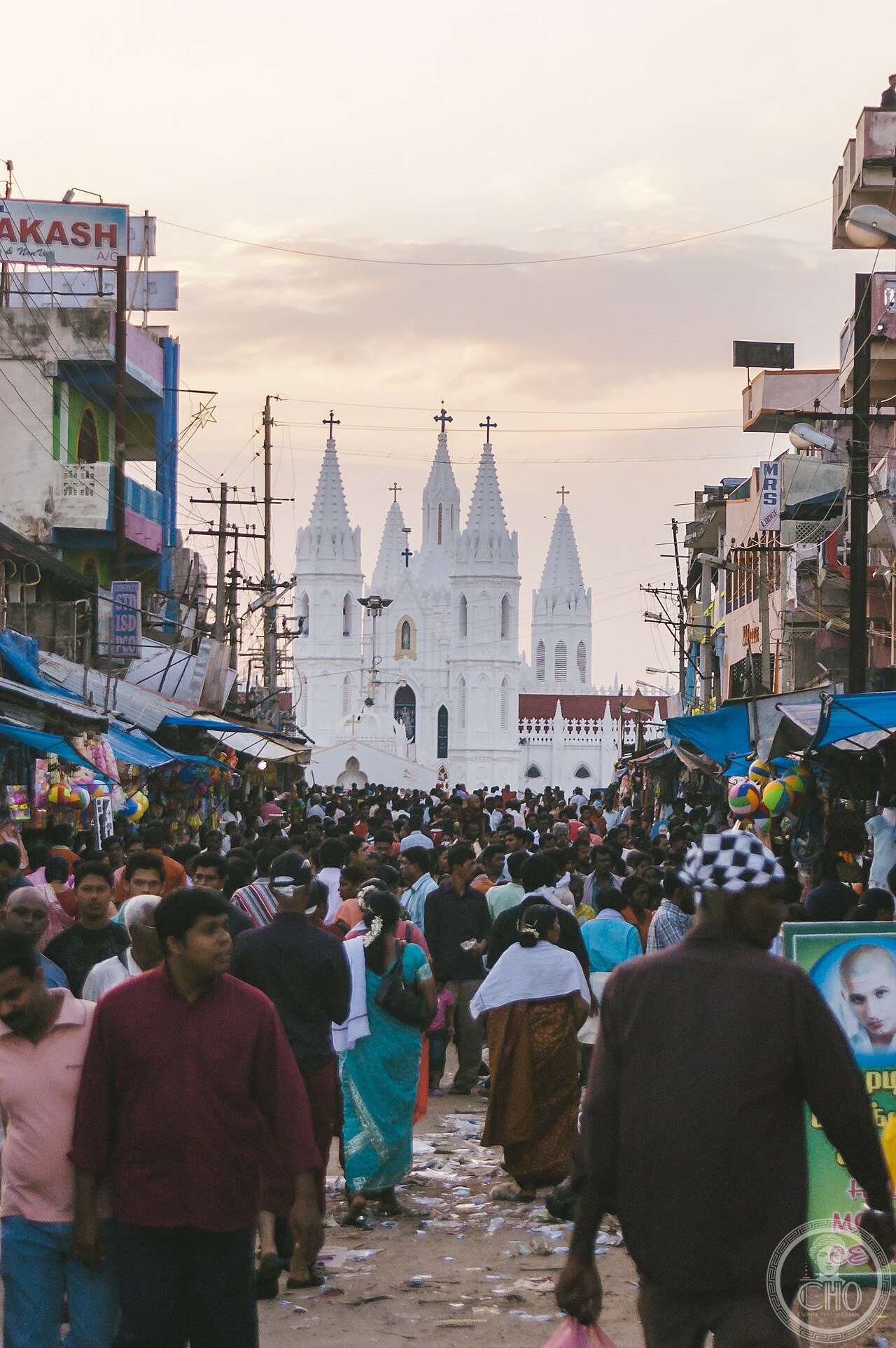
In Velankanni, on the coast of the Bay of Bengal in Tamil Nadu, India, Marian devotion has its roots in three traditional stories, not verifiable historically but handed down without a break. Around 1570, a boy carrying milk is said to have met a woman with a child who asked him for a drink, and then found his own container still full. Around 1597, a lame buttermilk seller was healed by a woman with a child who asked him to have a chapel built. Finally, towards the end of the 17th century, Portuguese sailors who survived a storm in the Bay of Bengal, which died down, according to tradition, on 8 September, built a chapel in gratitude, giving rise to the date of the feast still kept today. From a first thatched chapel of the middle of the 16th century, the shrine became a parish in 1771, then grew through successive enlargements in 1928 and in 1933, up to the great expansion of 1974-75, which added a two-storey church with a dome of 28 metres and Gothic spires about 25 metres high. Pope John XXIII raised the shrine to the rank of minor basilica by pontifical decree of 3 November 1962. The shrine is known for drawing pilgrims not only Christian but also Hindu and Muslim, in a plural devotional practice distinctive to the place, which among Hindu faithful includes gestures such as shaving the head or piercing the ears as a vow. The feast of 8 September, the Nativity of Mary, preceded by a novena from 29 August, draws enormous crowds every year, with a widely repeated but unverified estimate of nearly five million pilgrims a year. The building, in Gothic style with local adaptations, with white walls and a red-tile roof, has three chapels, the so-called «Tank of Our Lady» and a museum of the shrine.
About the Basilica of Our Lady of Good Health
In Velankanni, on the Bay of Bengal coast of Tamil Nadu, India, Marian devotion traces to three traditional stories, not historically verifiable but consistently handed down. Around 1570, a boy delivering milk is said to have met a woman with a child who asked for a drink, and found his container still full afterward. Around 1597, a lame buttermilk vendor was healed by a woman with a child who asked that a chapel be built. And finally, in the late 17th century, Portuguese sailors who survived a storm in the Bay of Bengal — which subsided, according to tradition, on 8 September — built a chapel in gratitude, giving rise to the date of the festival still celebrated today. From an initial thatched chapel in the mid-16th century, the shrine became a parish in 1771, then grew through successive expansions in 1928 and 1933, culminating in the major 1974-75 expansion that added a two-storey church with a 28-metre dome and Gothic spires roughly 25 metres tall. Pope John XXIII elevated the shrine to minor basilica status by pontifical decree on 3 November 1962. The shrine is known for drawing pilgrims not only of the Christian faith but also Hindu and Muslim devotees, in a plural devotional practice distinctive to the site, including Hindu votive gestures such as head-shaving or ear-piercing among the faithful; the 8 September festival, the Nativity of Mary, preceded by a novena from 29 August, draws enormous crowds each year, with a widely cited but unaudited estimate of nearly five million pilgrims annually. The building, in Gothic style with local adaptations, with white walls and a red-tile roof, includes three chapels, the so-called “Our Lady’s Tank,” and a shrine museum.
Key facts
- c. 1570-1597: traditional origin stories of Marian apparitions and healings at the site.
- 1771: the shrine becomes a parish church, after starting as a thatched chapel.
- 1974-75: a major expansion adds a two-storey church with a 28-metre dome.
- 3 November 1962: elevated to minor basilica status by Pope John XXIII.
- 8 September: the annual Nativity of Mary festival, preceded by a novena, draws enormous crowds.
- Pilgrims of multiple faiths, Hindu, Muslim and Christian, visit the shrine together.
History
Velankanni’s growth from a single thatched chapel to a basilica able to hold nearly five million annual visitors mirrors the shrine’s own layered origin story, built from three separate traditional accounts rather than one documented founding event. Its enduring appeal across religious lines — a genuinely plural pilgrimage practice rather than a purely Catholic one — sets it apart from most Marian shrines worldwide and has become as central to its identity as its Gothic architecture.
What you see
White Gothic-style walls rise beneath a red-tile roof and twin spires, expanded repeatedly across the 20th century into a two-storey basilica crowned by a 28-metre dome. Around the church, devotional spaces including three chapels, “Our Lady’s Tank,” and a shrine museum receive a year-round stream of pilgrims that swells enormously each September.
Practical information
- Opening hours: generally open daily; extended hours and heavy crowds during the August-September festival season; check current hours before visiting.
- Address: Velankanni, Nagapattinam District, Tamil Nadu, India.
Getting there
The basilica stands on the Bay of Bengal coast in Velankanni town, reachable by road from Nagapattinam or Chennai. GPS: 10°40′48″N, 79°50′59″E.
Nearby
- Nagapattinam — the nearby district town and port.
- Bay of Bengal coastline — the shrine’s beachfront setting.
Sources
- Wikipedia — “Basilica of Our Lady of Good Health” (en.wikipedia.org).
- Wikipedia — “Velankanni” (en.wikipedia.org).
- Nagapattinam District official tourism page (nagapattinam.nic.in).
Find it on the map
See this place and what’s around it →📷 Become a Cultural Heritage Online photographer
Share your photos of places: they stay published under your name as the author. The more they're seen, the more you get noticed — and soon a contest will reward the most appreciated photos.
Log in or sign up free to add a photo