

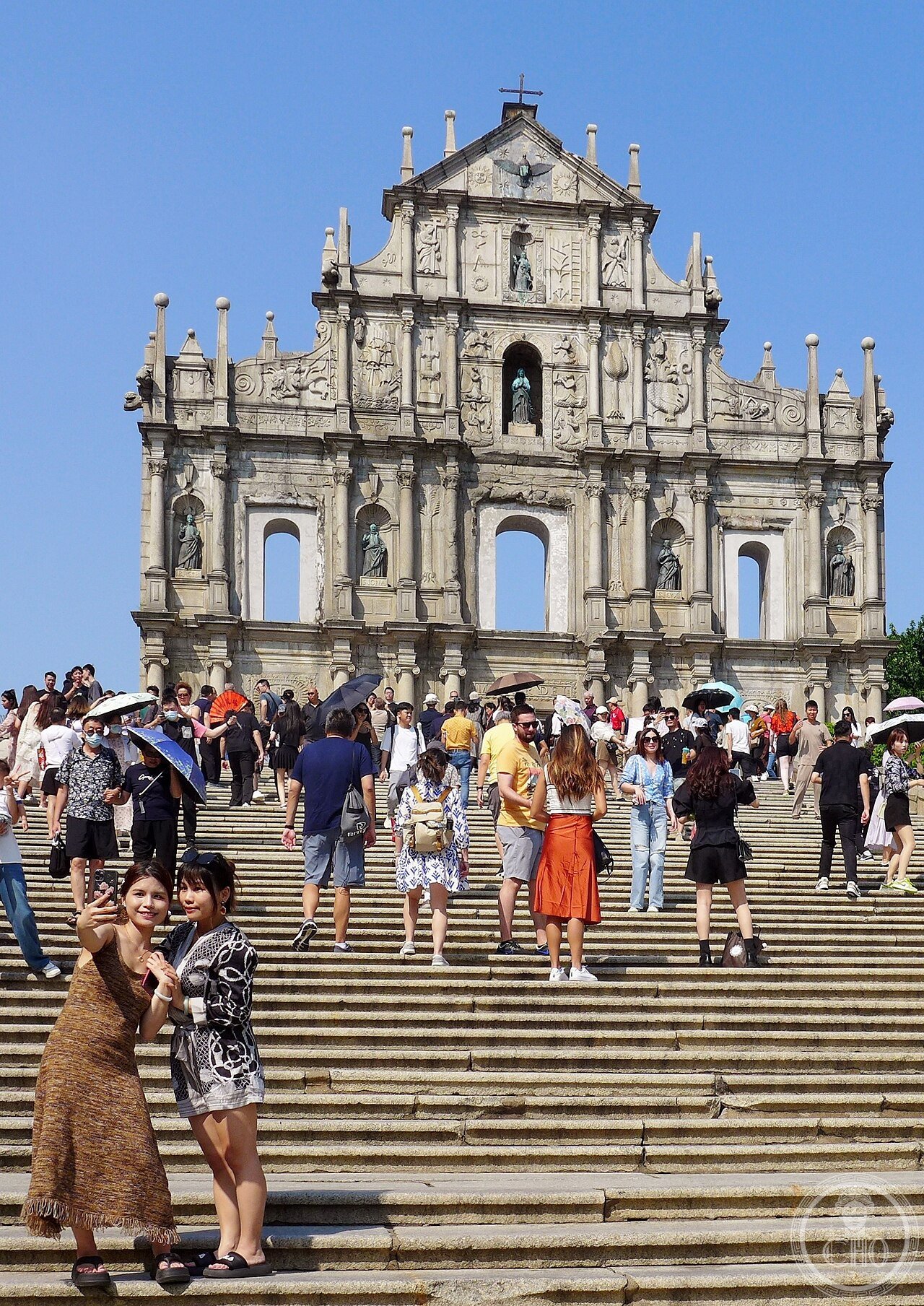
In Macau, the Jesuit church of Mater Dei was built between 1602 and 1640, with the final phase of construction dated to 1637-1640. Its famous granite façade, between about 25 and 27 metres high over five tiers and 68 steps, was carved between 1620 and 1627 by Japanese Christian exiles who had fled Japan after the expulsion edict of 1587 issued by Toyotomi Hideyoshi. They worked side by side with Chinese and other craftsmen, under the direction of the Italian Jesuit Carlo Spinola. On 26 January 1835, during a typhoon, a fire that broke out in the kitchens of the adjoining college, by then converted into a military barracks, destroyed the whole building except the façade, which today remains the only surviving trace. The carved reliefs fuse Christian, Chinese and Japanese motifs in a way then unprecedented in China. A Chinese inscription reads “the Holy Mother tramples the heads of the dragon” beside a statue of the Virgin Mary crushing a seven-headed hydra; six Chinese guardian lions decorate the base; Japanese chrysanthemums adorn the surface; and a relief of a skeleton with an arrow, on the third tier, bears an inscription close in meaning to the Latin “memento mori”, a warning against sin never before seen in China. A Portuguese merchant ship, the Latin inscription “MATER DEI” above the central door and the Jesuit symbol “IHS” on the side doors also appear. Beside the church stood St. Paul’s College, founded in 1594 by Alessandro Valignano and commonly cited as the first Western-style university in East Asia, where Jesuit missionaries such as Matteo Ricci, Johann Adam Schall von Bell and Ferdinand Verbiest were trained before going on to China, Japan and the rest of Asia, until the suppression of the order in 1762. Today only the façade stands, held up by a steel structure, while behind it are the Museum of Sacred Art and the Crypt, opened in 1996 after archaeological excavations carried out between 1990 and 1996, which hold relics of the Japanese and Vietnamese martyrs, including the Blessed Andrew of Phú Yên, and a tomb that may have belonged to Valignano himself. The site forms part of the Historic Centre of Macao, inscribed on the UNESCO World Heritage List in 2005.
About the Ruins of St. Paul’s
In Macau, the Jesuit church of Mater Dei was built between 1602 and 1640, with the final phase of construction dated to 1637–1640; its famous granite facade, standing roughly 25 to 27 metres tall across five tiers and 68 steps, was carved between 1620 and 1627 by Japanese Christian exiles, who had fled Japan after Toyotomi Hideyoshi’s 1587 expulsion edict, working alongside Chinese and other craftsmen under the direction of Italian Jesuit Carlo Spinola. On 26 January 1835, during a typhoon, a fire that broke out in the kitchens of the adjoining college, by then repurposed as a military barracks, destroyed the entire building except the facade, which survives today as the sole remaining trace. The carved reliefs fuse Christian, Chinese and Japanese motifs in a way unprecedented in China at the time: a Chinese inscription reads “the Holy Mother tramples the heads of the dragon” beside a statue of the Virgin Mary crushing a seven-headed hydra, six Chinese guardian lions decorate the base, Japanese chrysanthemums ornament the surface, and a skeleton relief holding an arrow, on the third tier, carries an inscription akin to the Latin memento mori, a warning against sin never before seen in China; a Portuguese merchant ship, the Latin inscription “MATER DEI” above the central door, and the Jesuit symbol “IHS” on the side doors also appear. Beside the church stood the College of St. Paul, founded in 1594 by Alessandro Valignano and commonly cited as the first Western-style university in East Asia, where Jesuit missionaries including Matteo Ricci, Johann Adam Schall von Bell and Ferdinand Verbiest trained before heading to China, Japan and elsewhere in Asia, until the order’s suppression in 1762. Today only the facade stands, braced by a steel support structure, with the Museum of Sacred Art and Crypt behind it, opened in 1996 after archaeological excavations carried out between 1990 and 1996, holding relics of Japanese and Vietnamese martyrs, including Blessed Andrew of Phú Yên, alongside a tomb possibly belonging to Valignano himself. The site forms part of the Historic Centre of Macau, inscribed on the UNESCO World Heritage List in 2005.
Key facts
- 1602-1640: the Jesuit church of Mater Dei is built.
- 1620-1627: the granite facade is carved by Japanese Christian exiles alongside Chinese craftsmen.
- 26 January 1835: a fire destroys the church, leaving only the facade standing.
- 1594: the adjoining College of St. Paul is founded, among East Asia’s first Western-style universities.
- 1996: the Museum of Sacred Art and Crypt opens behind the facade, holding relics of Japanese and Vietnamese martyrs.
- 2005: becomes part of the UNESCO World Heritage Site, Historic Centre of Macau.
History
The facade’s carvings, made by Japanese Christians who had fled persecution at home to work alongside Chinese artisans in Portuguese Macau, embody a genuinely three-way cultural fusion rarely matched elsewhere in colonial-era religious architecture. That this single wall survived the 1835 fire while the rest of the church and college vanished has made it, almost by accident, Macau’s most recognisable monument — a facade that now stands for a building otherwise entirely gone.
What you see
A five-tiered granite facade rises above a monumental staircase, its surface densely carved with a fusion of Christian, Chinese and Japanese imagery — a Virgin Mary trampling a dragon beside Chinese guardian lions, Japanese chrysanthemums, a memento mori skeleton, and a Portuguese ship. Behind it, steel supports brace what is now a freestanding wall, with the Museum of Sacred Art and Crypt housing martyrs’ relics in the space where the church once stood.
Practical information
- Opening hours: the facade and staircase are accessible at all times; the Museum of Sacred Art and Crypt keeps separate hours; check current times before visiting.
- Address: Rua de São Paulo, Macau, China.
Getting there
The Ruins of St. Paul’s stand in central Macau, a short walk from Senado Square, easily reached on foot within the historic centre. GPS: 22°11′51″N, 113°32′26″E.
Nearby
- Fortaleza do Monte — the adjoining 17th-century Jesuit-built fortress.
- Senado Square — the historic mosaic-paved square at the heart of Macau.
- Historic Centre of Macau — the UNESCO World Heritage colonial old town.
Sources
- Wikipedia — “Ruins of Saint Paul’s” (en.wikipedia.org).
- Macao Museum — “Museum of Sacred Art and Crypt” (macaumuseum.gov.mo).
- Cultural Heritage of Macao — official government heritage listing (culturalheritage.mo).
Find it on the map
See this place and what’s around it →📷 Become a Cultural Heritage Online photographer
Share your photos of places: they stay published under your name as the author. The more they're seen, the more you get noticed — and soon a contest will reward the most appreciated photos.
Log in or sign up free to add a photo