
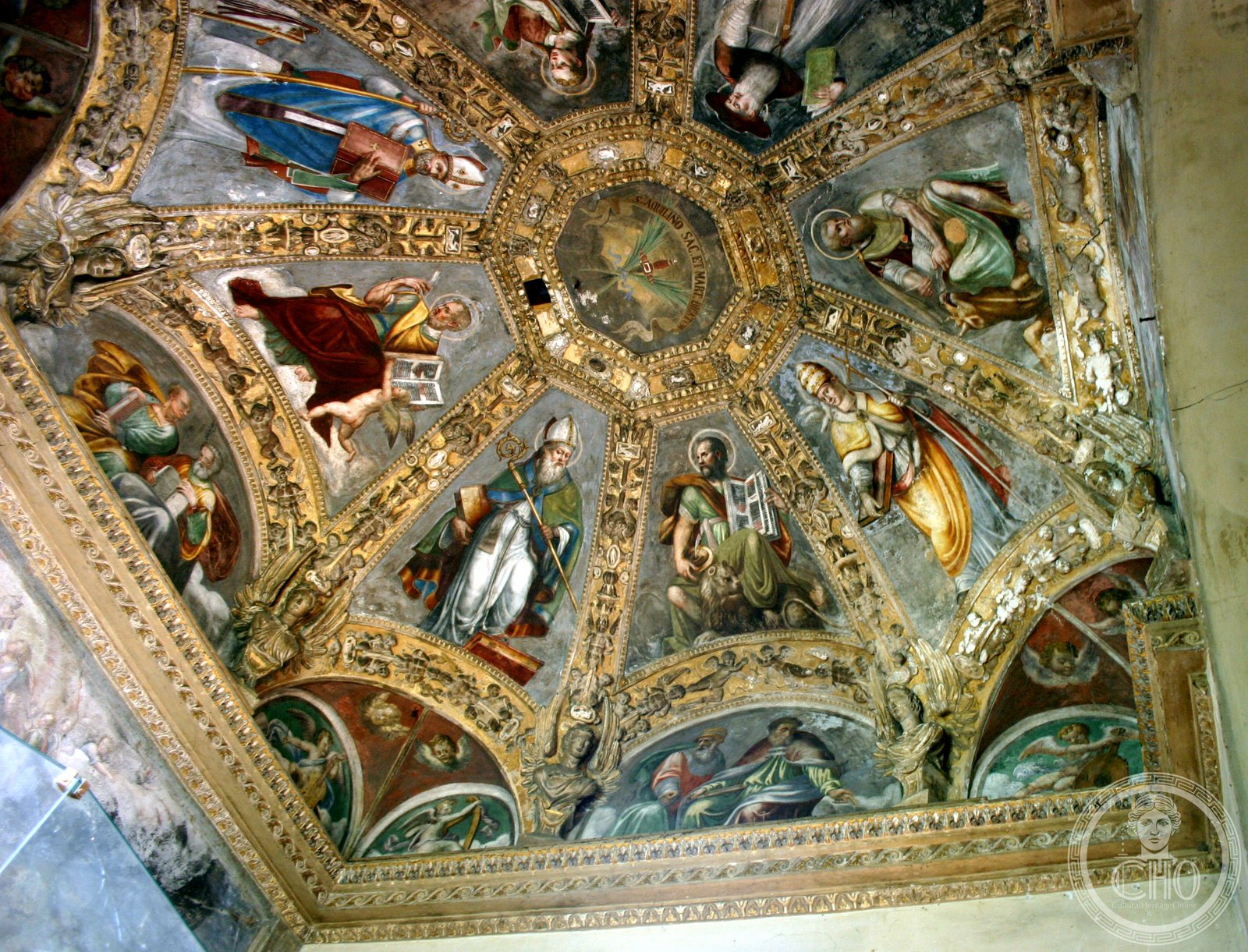
One of Milan’s oldest churches, this late-antique basilica retains its original central-plan layout beneath centuries of renovation and stands as a pioneering example of symmetrical design in early Christian architecture.
At a glance
The Basilica of San Lorenzo Maggiore represents one of the major Roman monumental complexes in Milan. Its distinctive central symmetry and preservation of the primitive late-antique plan distinguish it among Europe’s earliest Christian structures. The adjacent columns of San Lorenzo, once part of the building’s original portico, remain visible testimony to its ancient Roman heritage.
History
The basilica’s exact foundation date remains uncertain due to the absence of surviving official medieval documentation. No exhaustive written records predating the Renaissance exist. Over centuries, the building underwent repeated structural modifications and rebuilding, yet the original floor plan from the late-antique period survived largely intact.
Twentieth-century archaeological excavations on the site provided concrete evidence for understanding the basilica’s origins, replacing earlier speculative theories with more grounded hypotheses about its construction and early development.
What you see
The basilica’s most remarkable architectural feature is its central-plan design—believed to be the first of its kind in the Christian West. This symmetrical layout fundamentally departed from the linear basilica form dominating early Christian architecture elsewhere.
Despite significant external modifications over time, visitors encounter the primitive spatial organization of the late-antique period. The columns of San Lorenzo, formerly part of the portico, remain standing outside, offering direct visual evidence of Roman-period construction techniques and imperial architectural grandeur.
Cultural significance
San Lorenzo Maggiore represents a watershed moment in Christian architectural history. Its central symmetry predates similar experiments in the broader Western tradition, making it essential for understanding how early Christian communities conceived sacred space.
The basilica’s survival—both materially and spatially—provides invaluable evidence for reconstructing late-antique Milan, a major Roman city whose Christian monuments often vanished or were completely transformed. Its status as a major monument has remained constant from its construction through to the present day.
Key facts
- Address: Corso di Porta Ticinese, 35, 20123 Milan
- Coordinates: 45.4582325, 9.1815235
- Phone: 02 8940 4129
- Website: http://www.sanlorenzomaggiore.com/
Practical information
Opening hours and ticket prices change through the year, so we do not republish them here: the current ones are on sanlorenzomaggiore.com. What does not change is where it is: Corso di Porta Ticinese, 35, 20123 Milan, at 45.4582325, 9.1815235.
Getting there
The basilica is located on Corso di Porta Ticinese in Milan’s historic core. Public transport connections are available throughout the city; consult local transit maps for route options to this central address.
See the place
Sources & resources
Find it on the map
See this place and what’s around it →Historical events at this place (2)
📷 Become a Cultural Heritage Online photographer
Share your photos of places: they stay published under your name as the author. The more they're seen, the more you get noticed — and soon a contest will reward the most appreciated photos.
Log in or sign up free to add a photoIs this page about you?
This page is read by travellers and heritage enthusiasts who find it on Google. Tell us how you are connected to this place and we will take it from there.