
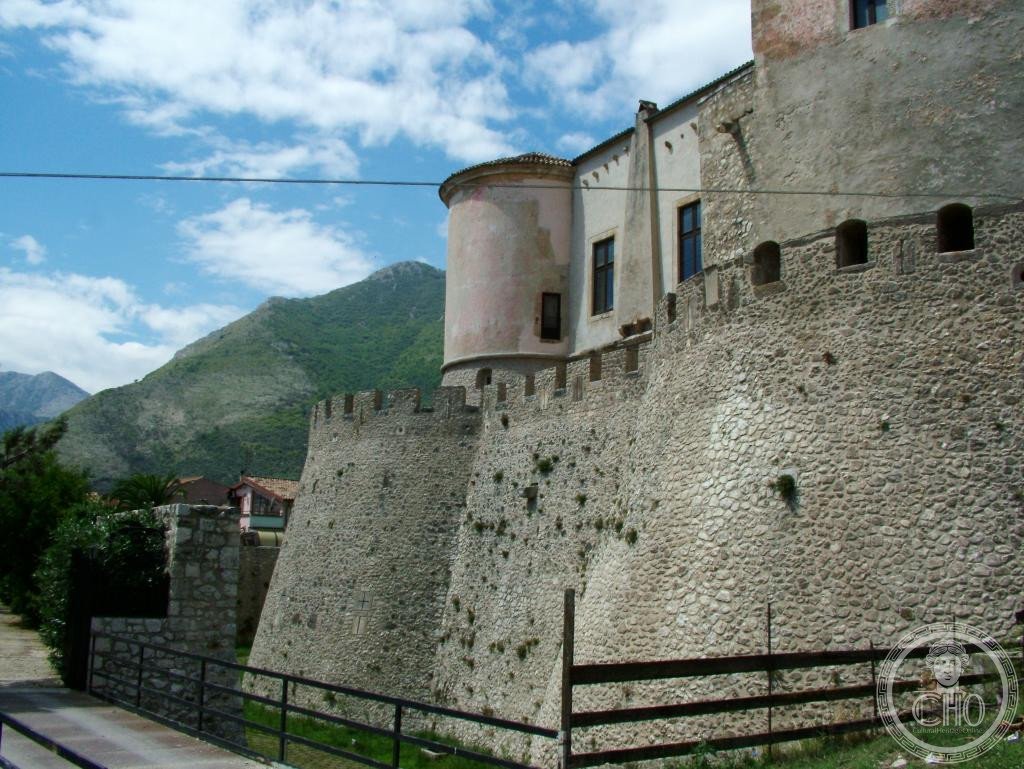
A fortress transformed from megalithic origins into a Renaissance residence, Pandone Castle stands on Venafro’s north-western edge as a layered chronicle of architectural ambition and social struggle.
At a glance
This castle began as a prehistoric fortification, evolved through Lombard and medieval phases, and reached its pinnacle as a Renaissance seat under the Pandone family. Three centuries of transformation left it a palimpsest of military necessity and aristocratic refinement.
History
The castle’s origins lie in a megalithic fortification on the Roman settlement’s fringe. Count Paldefrido established his 10th-century headquarters within a Lombard square keep, anchoring the site’s administrative importance. By the 14th century, three circular towers and crenellated walls enlarged the defensive envelope.
The Pandones, lords of Venafro, undertook a sweeping 15th-century redesign. They commissioned a vast moat on three sides—an ambitious project that mobilized the entire population. Popular resistance, driven by labourers’ harsh conditions, prevented its full completion. Access remained controlled: a western drawbridge and an eastern postern, the latter narrowly designed to admit a single mounted rider under watchful guard.
Enrico Pandone reimagined the fortress as a Renaissance villa. He added an Italian garden, constructed an airy loggia, and commissioned frescoes depicting his prized horses—transforming military architecture into courtly display.
What you see
The castle’s form reveals its complex biography. The original square keep provides the core; Lombard and medieval additions layer outward. The 14th-century towers punctuate its perimeter with Gothic verticality, while the 15th-century moat (though incomplete) still marks the landscape. Renaissance refinements—the garden layout, the portico’s elegant proportions, and traces of the fresco cycle—signal Enrico Pandone’s cultural aspirations and princely taste.
Cultural significance
Pandone Castle exemplifies the transition from feudal stronghold to Renaissance palace. Its incomplete moat speaks to the tensions between aristocratic vision and popular endurance, documenting a moment when labour resistance shaped the built environment. The castle’s iconographic programme—horses celebrating Pandone power—reveals how Renaissance lords deployed art and architecture as instruments of dynastic propaganda.
Key facts
- Address: Via Tre Cappelle, 86079, Isernia, Molise
- Coordinates: 41.4876329, 14.0445843
- Phone: 0865 904698
- Official website: http://www.castellopandone.beniculturali.it/
Practical information
Opening hours and ticket prices change through the year, so we do not republish them here: the current ones are on castellopandone.beniculturali.it. What does not change is where it is: Via Tre Cappelle, 86079, Isernia, Molise, at 41.4876329, 14.0445843.
Getting there
The castle stands on Venafro’s north-western edge. Parking and public-transport connections are best confirmed with the official website or by telephone ahead of your visit.
See the place
Sources & resources
Find it on the map
See this place and what’s around it →📷 Become a Cultural Heritage Online photographer
Share your photos of places: they stay published under your name as the author. The more they're seen, the more you get noticed — and soon a contest will reward the most appreciated photos.
Log in or sign up free to add a photoIs this page about you?
This page is read by travellers and heritage enthusiasts who find it on Google. Tell us how you are connected to this place and we will take it from there.