

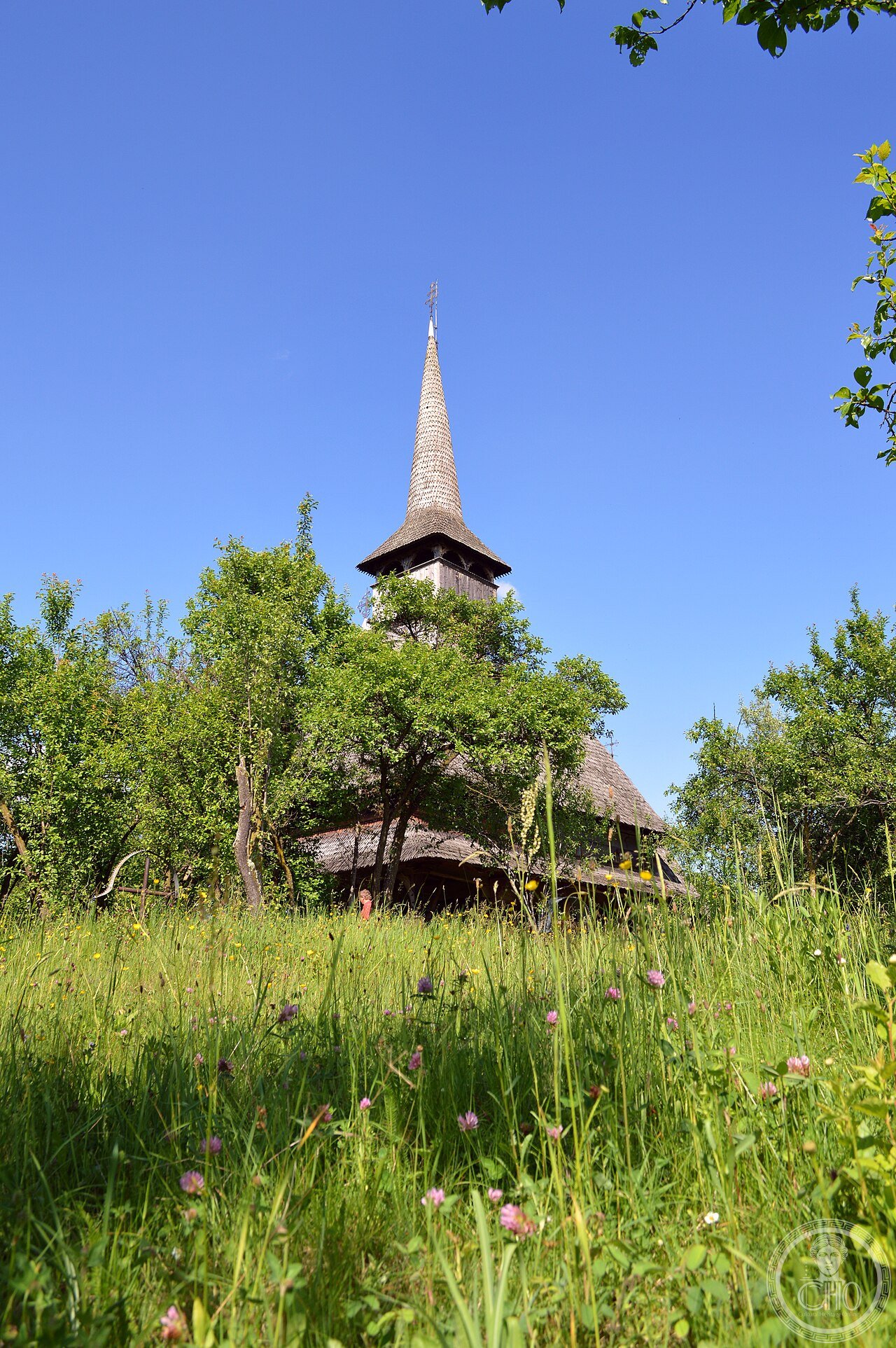
At Bârsana, in the Maramureș region of Romania, the wooden church dedicated to the Presentation of the Virgin Mary in the Temple was built around 1720. It should not be confused with the nearby and far more recent Bârsana Monastery, the «Soborul Sfinților 12 Apostoli», founded only in 1993. Some sources place the origin of the church as early as 1711, the work of the priest Ioan Ștefanca and of the villagers. Like many wooden churches of Maramureș, it did not stand on its present site from the start. It was first built at a place called Părul Călugărului, then moved to a cemetery along the Iza valley, and reached its final position in the village in 1806, becoming the parish church. Built entirely of oak logs in the traditional technique of the region, it has a rectangular plan with a two-level porch on the west side, a five-sided polygonal apse and the characteristic double-pitched shingle roof, crowned by a tall pyramidal steeple with an open arcaded gallery. The frescoes inside were painted in 1806 by Toader Hodor, from Vișeu de Mijloc, in a style touched by Baroque and Rococo, and the church also holds glass icons and old religious books. It is one of the eight component sites of the UNESCO World Heritage listing «Wooden Churches of Maramureș», inscribed in 1999. The modern monastic complex that surrounds it today, founded in 1993 and given a large wooden church of its own about 57 metres tall, among the highest in Romania, remains architecturally distinct from the historic church, even though it has become one of the main destinations for pilgrimage and religious tourism in the region.
About the Wooden Church of Bârsana
In Bârsana, in Romania’s Maramureș region, the wooden church dedicated to the Presentation of the Virgin Mary in the Temple — not to be confused with the nearby and much more recent Bârsana Monastery, the “Assembly of the Holy Twelve Apostles,” founded only in 1993 — was built, according to the most widely cited sources, around 1720, though some sources place its origin as early as 1711, the work of the priest Ioan Ștefanca and the village’s inhabitants. Like many Maramureș wooden churches, it did not stand from the start on its present site: it was originally built at a location called Părul Călugărului, then moved to a cemetery along the Iza Valley, before reaching its final position in the village in 1806, becoming the parish church. Built entirely of oak logs using the region’s traditional construction technique, it has a rectangular plan with a two-level porch on the west side, a five-sided polygonal apse, and the characteristic double-pitched wooden shingle roof, topped by a tall pyramidal-roofed steeple with an open arcaded gallery. The interior frescoes were painted in 1806 by Toader Hodor, from Vișeu de Mijloc, in a style influenced by Baroque and Rococo, and the church also holds glass icons and old religious books. The church is one of eight component sites of the UNESCO World Heritage Site “Wooden Churches of Maramureș,” inscribed in 1999. The modern monastery complex that today surrounds it, founded in 1993 and home to its own large wooden church roughly 57 metres tall, among the tallest in Romania, remains an architecturally distinct structure from the historic church, even as it has become one of the region’s main pilgrimage and religious tourism destinations.
Key facts
- c. 1720: the church is built, according to the most widely cited date (some sources say 1711).
- 1806: moved to its final village location, becoming the parish church.
- Built entirely of oak, with a two-level west porch and five-sided apse.
- 1806: interior frescoes painted by Toader Hodor of Vișeu de Mijloc.
- 1999: becomes one of eight component sites of the UNESCO “Wooden Churches of Maramureș”
- Distinct from the much larger, modern Bârsana Monastery founded nearby in 1993.
History
Like several of Maramureș’s UNESCO-listed wooden churches, this one changed location more than once before settling into its current role as parish church in 1806 — a pattern reflecting how communities in the region repositioned their timber churches as villages and cemeteries shifted over generations. Its survival alongside a much larger 1990s monastery built nearby illustrates the layered religious landscape of contemporary Maramureș, where centuries-old timber construction and late-20th-century pilgrimage architecture now stand side by side.
What you see
A steep, double-pitched shingle roof crowns a rectangular oak-log church, its tall pyramidal steeple with an open arcaded gallery rising above the surrounding orchard in the traditional Maramureș silhouette. Inside, 1806 frescoes by Toader Hodor cover the walls in a Baroque-influenced style, alongside glass icons typical of the region’s folk-religious art.
Practical information
- Opening hours: generally accessible daily; interior access may require arrangement with local caretakers; check current visiting conditions before travelling.
- Address: Bârsana, Maramureș County, Romania.
Getting there
The wooden church stands in the village of Bârsana, in the Iza Valley of Maramureș, reachable by car. GPS: 47.8206° N, 24.0556° E.
Nearby
- Bârsana Monastery — the large modern convent complex nearby, founded 1993.
- Wooden churches of Maramureș — the seven other component sites of the UNESCO listing across the region.
Sources
- Wikipedia — “Wooden churches of Maramureș” (en.wikipedia.org).
- Romanian Wikipedia — “Biserica de lemn din Bârsana” (ro.wikipedia.org).
- UNESCO World Heritage Centre — “Wooden Churches of Maramureș” (whc.unesco.org).
Find it on the map
See this place and what’s around it →📷 Become a Cultural Heritage Online photographer
Share your photos of places: they stay published under your name as the author. The more they're seen, the more you get noticed — and soon a contest will reward the most appreciated photos.
Log in or sign up free to add a photo