
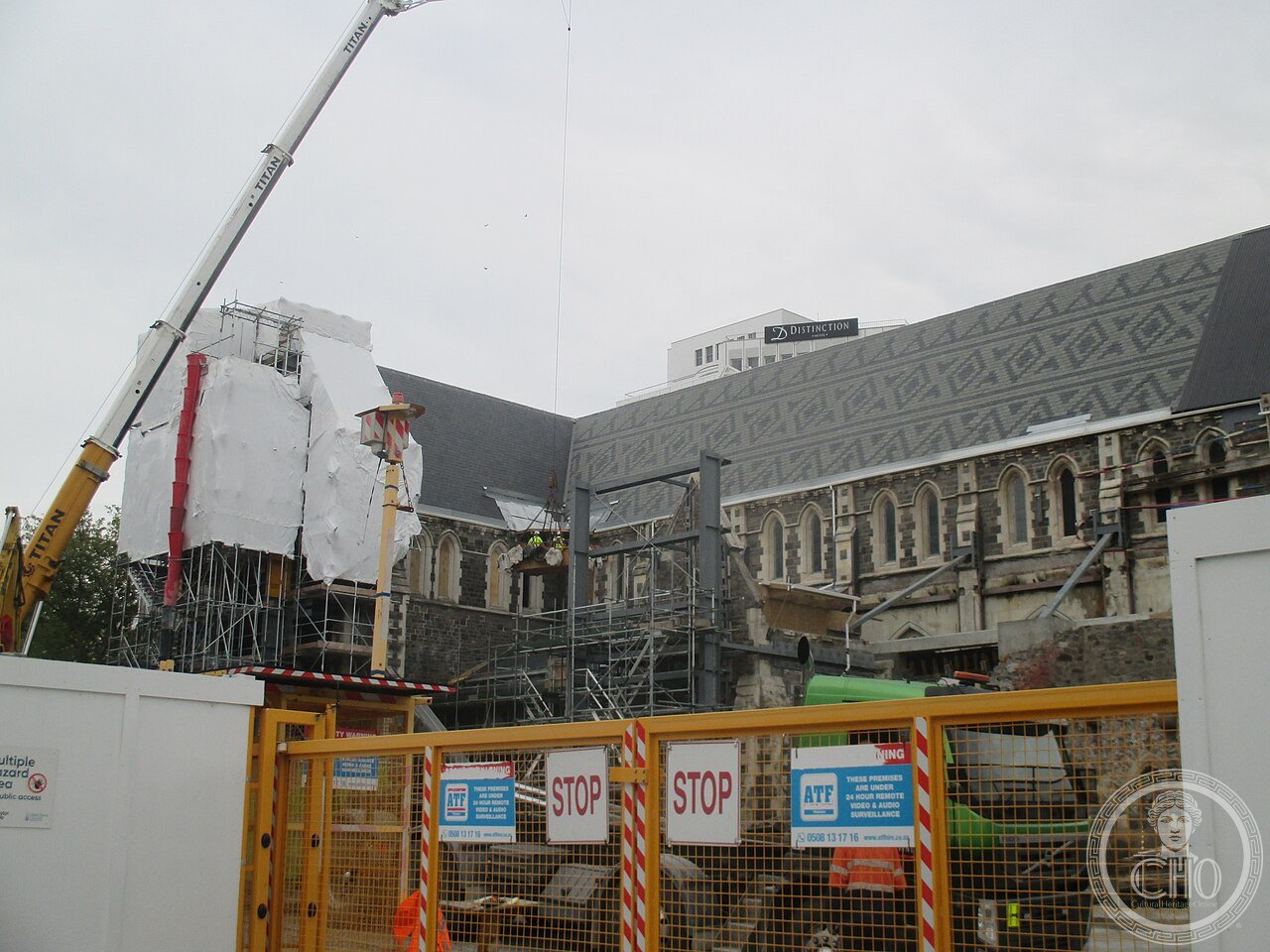
In Christchurch, in New Zealand, the Anglican cathedral was designed by the English architect George Gilbert Scott. It was his only New Zealand work, and its foundation stone was laid on 16 December 1864. The work stopped more than once for lack of money and went on under the supervision of the local architect Benjamin Woolfield Mountfort: nave, tower and spire were consecrated in 1881, while the chancel and transepts, which completed Scott’s original design, were only finished in 1904. Before 2011 the spire had already suffered earthquake damage. Its stone top, 7.8 metres high, fell in the earthquake of 1888 and was rebuilt in stone by 1891. It then lost a further 1.5 metres in the earthquake of 1901, after which it was rebuilt lower, in timber sheathed with copper rather than stone. The magnitude 6.3 earthquake of 22 February 2011 destroyed the spire, leaving only the lower part of the tower standing, damaged the west gable and brought down part of the north aisle roof. A further shock on 13 June 2011 brought down the great rose window of the west front, and the cathedral was deconsecrated on 9 November of that same year. Years of public and legal dispute followed, between the Anglican diocese, at first minded to demolish the building and replace it with a modern one, and the Great Christchurch Buildings Trust, which fought the plan in court as far as a final appeal rejected by the Supreme Court in December 2013. Only in September 2017 did the diocesan synod vote, by a majority of 55%, for restoration rather than demolition. In the meantime, from 2013, the congregation gathered in the so-called «Cardboard Cathedral», officially the Transitional Cathedral, designed free of charge by the Japanese architect Shigeru Ban with the local practice Warren and Mahoney, and built from 98 cardboard tubes, timber and shipping containers. The project to rebuild the historic cathedral, whose cost has risen to estimates of about 248 million New Zealand dollars, has been through a funding crisis, with work reported as paused around 2024 after state support was withdrawn. According to the most recent sources available, in mid-2026 work continues in stages, with around 90 million New Zealand dollars already spent and tens of millions more still to be found, and no confirmed completion date.
About ChristChurch Cathedral
In Christchurch, New Zealand, the Anglican cathedral was designed by English architect George Gilbert Scott, his only New Zealand work, with the cornerstone laid on 16 December 1864; construction, repeatedly halted for lack of funds and continued under the supervision of local architect Benjamin Woolfield Mountfort, saw the nave, tower and spire consecrated in 1881, while the chancel and transepts, completing Scott’s original design, were not finished until 1904. Even before 2011, the spire had already suffered earthquake damage: its 7.8-metre stone top collapsed in the 1888 earthquake and was rebuilt in stone by 1891, then lost a further 1.5 metres in the 1901 earthquake, after which it was rebuilt shorter, in timber sheathed with copper rather than stone. The magnitude-6.3 earthquake of 22 February 2011 destroyed the spire, leaving only the lower tower standing, damaged the west gable, and collapsed part of the north aisle roof, while a further quake on 13 June 2011 brought down the west front’s large rose window; the cathedral was deconsecrated on 9 November that year. Years of public and legal dispute followed between the Anglican Diocese, initially inclined to demolish the building and replace it with a modern design, and the Great Christchurch Buildings Trust, which opposed this in court through to a final appeal rejected by the Supreme Court in December 2013; only in September 2017 did the diocesan synod vote, by a 55 percent majority, in favour of reinstatement over demolition. In the meantime, from 2013, the congregation gathered in the so-called “Cardboard Cathedral,” officially the Transitional Cathedral, designed pro bono by Japanese architect Shigeru Ban with local firm Warren and Mahoney, built from 98 cardboard tubes, timber and shipping containers. The historic cathedral’s reinstatement project, its cost having risen to estimates around NZ$248 million, has gone through a funding crisis, with work reportedly paused around 2024 after government support was withdrawn; according to the most recent available sources, as of mid-2026 work continues in stages, with roughly NZ$90 million already spent and tens of millions more still being sought, with no confirmed completion date.
Key facts
- 1864-1904: built in stages to a design by George Gilbert Scott, his only New Zealand work.
- 1888 and 1901: earlier earthquakes already damaged and shortened the spire before 2011.
- 22 February 2011: the spire destroyed and severe structural damage caused by the Christchurch earthquake.
- 2013-2017: a legal and public dispute over demolition versus restoration, resolved in favour of restoration.
- 2013: the “Cardboard Cathedral,” designed by Shigeru Ban, opens as a temporary pro-cathedral.
- Restoration ongoing as of 2026, with no confirmed completion date.
History
ChristChurch Cathedral’s history is one of repeated seismic damage and rebuilding stretching back to the 19th century, long before the 2011 earthquake made global headlines — a pattern of loss and reconstruction that has shaped the building since its spire first fell in 1888. The years-long legal fight over its fate after 2011, resolved only in 2017 in favour of restoration, and the funding difficulties that have followed since, illustrate how contested and costly heritage reconstruction can become even after a clear decision has been made.
What you see
Gothic Revival stonework by George Gilbert Scott rises around a tower and partially rebuilt spire, the visible scaffolding and staged construction work reflecting a restoration project still underway more than a decade after the 2011 earthquake. Nearby, Shigeru Ban’s cardboard-tube Transitional Cathedral remains a striking architectural counterpoint, born of the same disaster.
Practical information
- Opening hours: access is limited during ongoing restoration work; check the cathedral’s official reinstatement project site for current visiting arrangements.
- Address: Cathedral Square, Christchurch, New Zealand.
Getting there
The cathedral stands in Cathedral Square at the heart of central Christchurch, easily reached on foot or by public transport. GPS: 43°31′52″S, 172°38′13″E.
Nearby
- Cardboard Cathedral (Transitional Cathedral) — Shigeru Ban’s temporary pro-cathedral.
- Cathedral Square — the historic central square of Christchurch.
Sources
- Wikipedia — “Christ Church Cathedral, Christchurch” (en.wikipedia.org).
- Christ Church Cathedral Reinstatement Project — official site (christchurchcathedral.org.nz).
- RNZ (Radio New Zealand) — news coverage of the reinstatement and funding.
Find it on the map
See this place and what’s around it →📷 Become a Cultural Heritage Online photographer
Share your photos of places: they stay published under your name as the author. The more they're seen, the more you get noticed — and soon a contest will reward the most appreciated photos.
Log in or sign up free to add a photo