

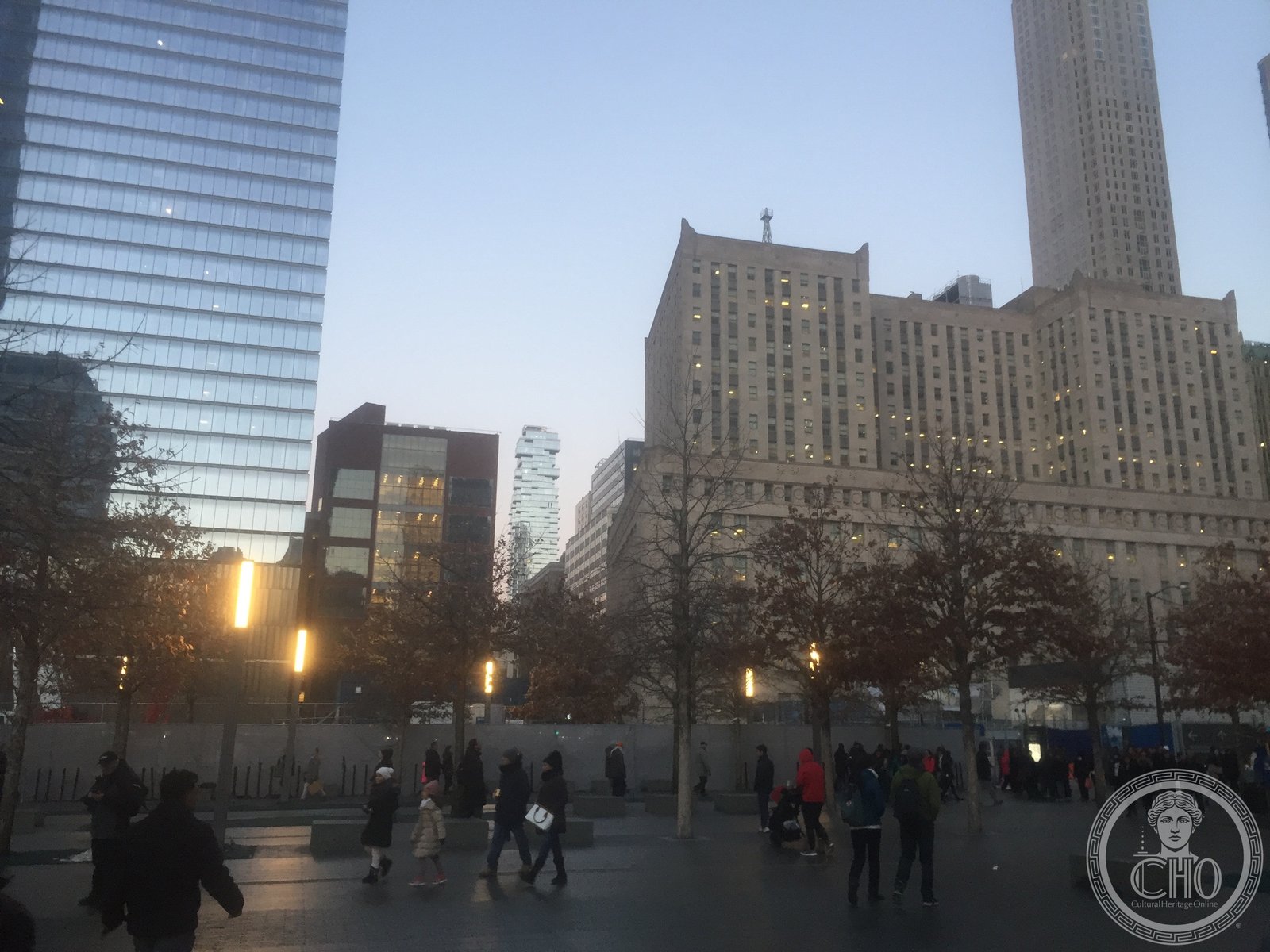
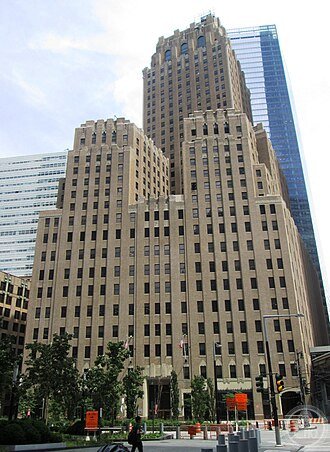
Rising thirty-two stories above Lower Manhattan at 140 West Street, the Barclay–Vesey Building stands as one of the earliest and most fully resolved Art Deco skyscrapers in the world. Completed in 1927 for the New York Telephone Company, the tower was the debut masterwork of architect Ralph Walker — a design so ahead of its time that critics had no ready label for it, calling it variously “Modernistic” or “Modern Perpendicular” because the Art Deco vocabulary had not yet entered common parlance. Walker wrapped the massive telecommunications fortress in warm brick, crowned its setback silhouette with elaborate floral and foliate ornament, and used vertical piers as both buttresses and decorative ribs to draw the eye skyward. The result was a building that looked simultaneously ancient and futuristic — a Gothic cathedral translated into the grammar of the machine age. Today the lower floors serve Verizon, while the upper floors have been converted into luxury residences, yet the exterior reads as powerfully as it did when it first redefined the Manhattan skyline nearly a century ago.
At a glance
- Type
- Office and residential tower
- Period
- 1923–1927
- Style
- Art Deco (early)
- Location
- 140 West Street, Lower Manhattan, New York City, USA
- Coordinates
- 40.714° N, 74.013° W
- Architect(s)
- Ralph Walker (Voorhees, Gmelin and Walker)
Overview
The Barclay–Vesey Building occupies a full city block bounded by West, Barclay, Vesey, and Washington Streets, immediately adjacent to the World Trade Center site. At 498 feet and 32 stories, it was purpose-built as the headquarters and switching centre for the New York Telephone Company. Its thick masonry construction gave the building extraordinary structural resilience that would prove critical seven decades after its completion.
History
Construction began in 1923 under the direction of Ralph Walker, then a relatively unknown architect at the firm of Voorhees, Gmelin and Walker. When the building opened in 1927 it was immediately celebrated in the architectural press as a landmark of the new American style. It served as the nerve centre of New York’s telephone network for decades, its basement and lower floors packed with switching equipment. On September 11, 2001, the building suffered catastrophic damage from the collapse of the adjacent World Trade Center towers. A landmark restoration effort costing 1.4 billion dollars over three years brought it back to full structural integrity. In 2016 the upper floors were converted into 157 residential condominiums under the address 100 Barclay.
Architecture & Design
Walker organised the facade around vertical brick piers that function simultaneously as structural buttresses and decorative ribs, accelerating the eye from street to setback crown. The ornamental programme draws on Aztec, Gothic, and naturalistic motifs — stylised foliage, geometric friezes, and abstracted flora — rendered in terracotta and carved stone. The building steps back in a series of setbacks mandated by New York’s 1916 zoning law, each retreat enriched with additional ornament. The lobby is equally lavish, featuring elaborate bronze metalwork and marble surfaces that announce the building’s ambitions as a civic monument as much as a corporate address.
Cultural significance
The Barclay–Vesey Building is widely credited as the catalyst that established Art Deco as the defining aesthetic of interwar Manhattan. Walker’s synthesis of decorative richness and structural logic influenced every major skyscraper that followed in the late 1920s and 1930s. Designated a New York City Landmark in 1991 and listed on the National Register of Historic Places in 2009, it remains a touchstone for architectural historians studying the emergence of the American skyscraper as a cultural form.
Visiting today
The exterior is freely visible from the street at any hour. The lobby is accessible during business hours on weekdays. The building sits one block from the 9/11 Memorial and Museum, making it a natural companion stop on any tour of Lower Manhattan’s architectural heritage. The Fulton Center transit hub is a short walk away, offering connections across the subway network.
Getting there
Subway: lines 2 and 3 to Park Place; lines A, C, and E to Chambers Street; lines 4 and 5 to Fulton Street. The building is a ten-minute walk from the Staten Island Ferry terminal at Whitehall Street. Citi Bike stations are located on adjacent blocks. Street parking is extremely limited in Lower Manhattan; public transit is strongly recommended.
Sources & resources
Gallery
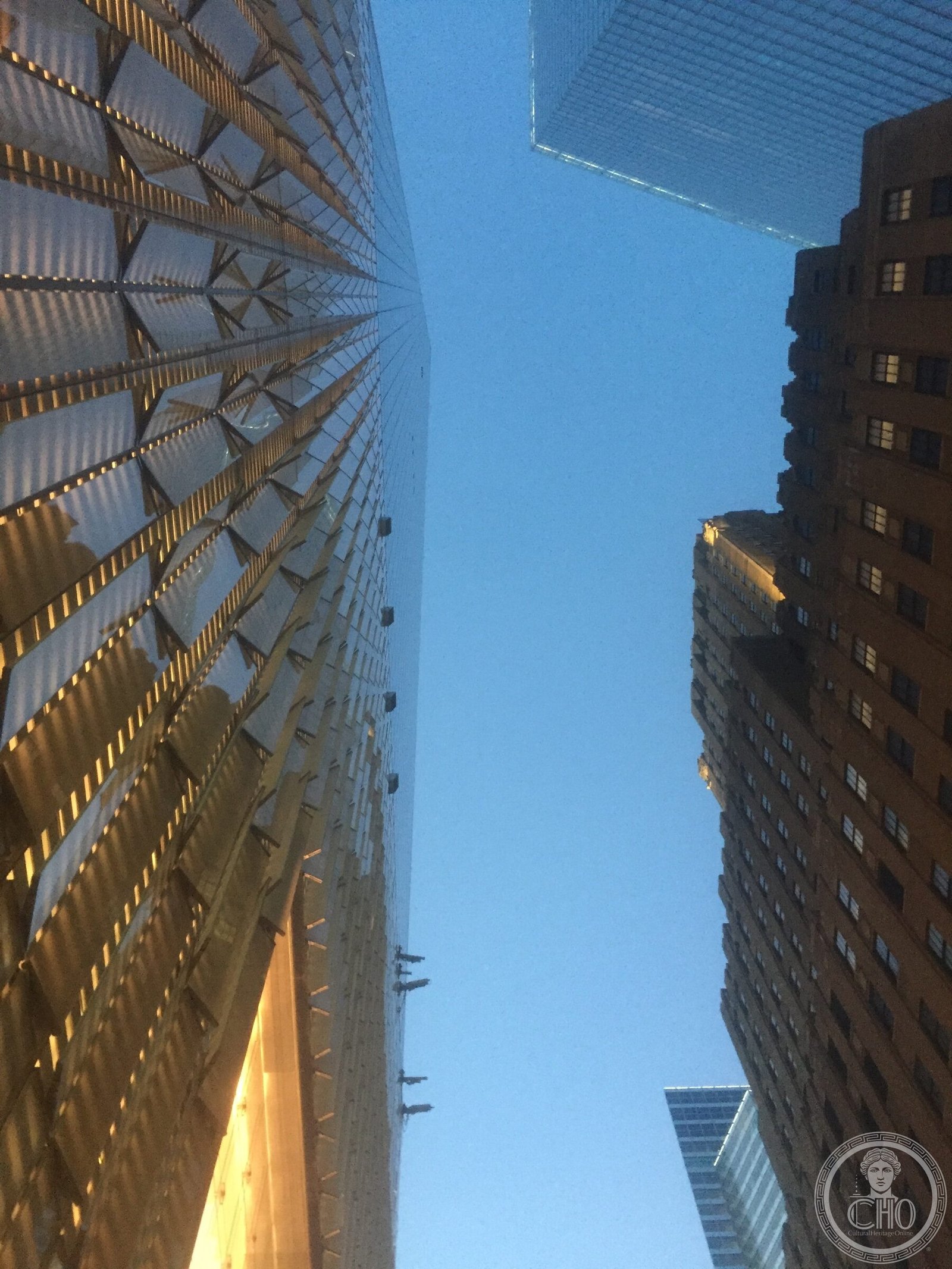
Photographs by Luigi De Marchi.
Gallery
Find it on the map
See this place and what’s around it →
Record researched and written by Luigi De Marchi for Cultural Heritage Online, 2026.
📷 Become a Cultural Heritage Online photographer
Share your photos of places: they stay published under your name as the author. The more they're seen, the more you get noticed — and soon a contest will reward the most appreciated photos.
Log in or sign up free to add a photoIs this page about you?
This page is read by travellers and heritage enthusiasts who find it on Google. Tell us how you are connected to this place and we will take it from there.