
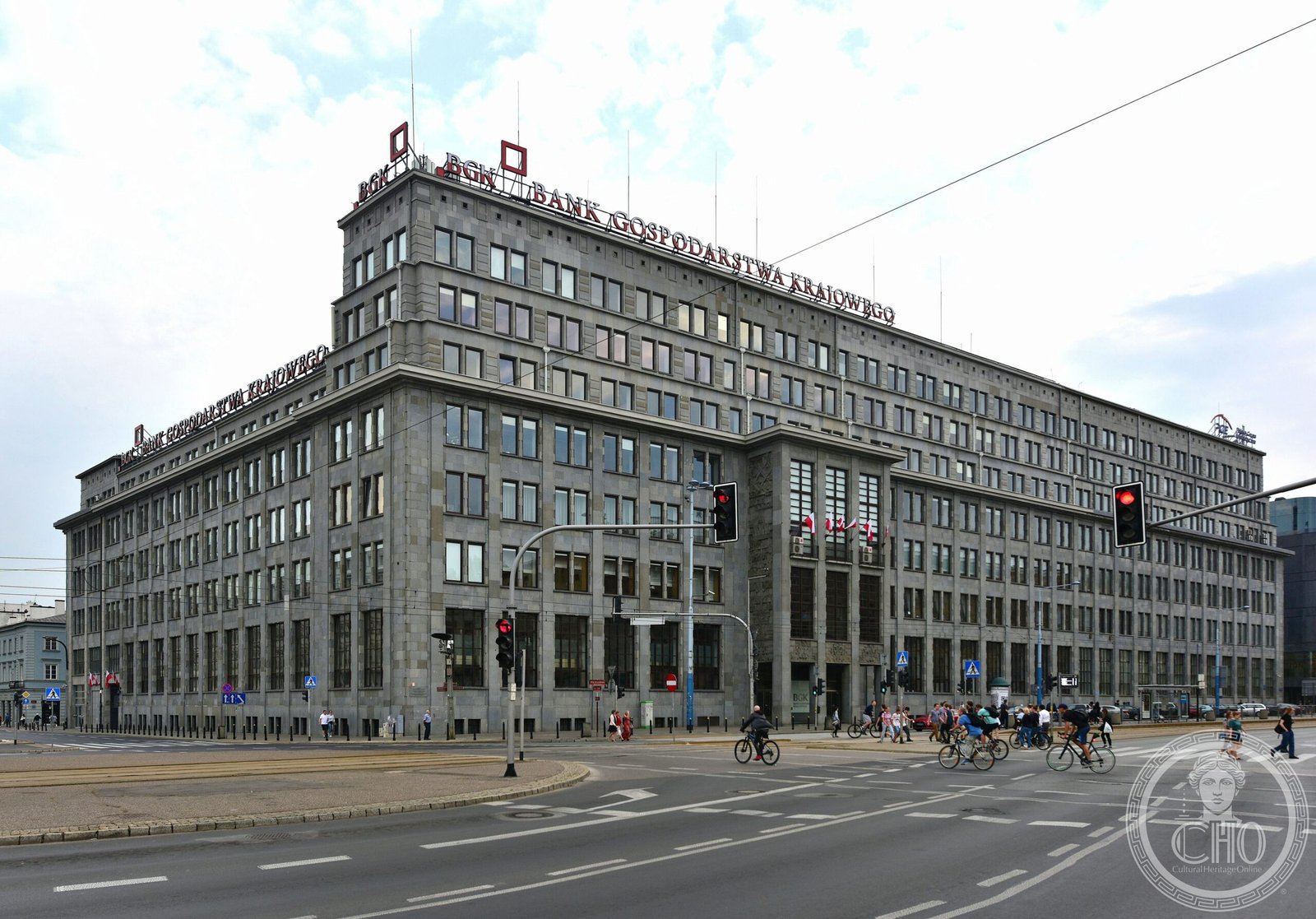
The Bank Gospodarstwa Krajowego headquarters at Aleje Jerozolimskie 7 is one of Warsaw’s finest examples of interwar Modernistic architecture — a style that blended Art Deco decorative ambition with the stripped classicism emerging across European capitals in the late 1920s. Designed by Rudolf Świerczyński and completed in 1931 for Poland’s state development bank, the building’s monumental stone facade and disciplined rhythmic bays convey institutional gravitas while its restrained ornamental programme aligns it with the international modernist current of its era. Listed as a heritage monument in 1965, it remains the active headquarters of BGK — now Poland’s national development bank — and stands as a distinguished landmark on one of Warsaw’s principal boulevards, a direct architectural link to the confidence and ambition of the Second Polish Republic.
At a glance
- Type
- Bank headquarters
- Period
- 1928–1931
- Style
- Modernistic (interwar stripped classicism with Art Deco influence)
- Location
- Aleje Jerozolimskie 7, Warsaw, Poland
- Coordinates
- 52.2297° N, 21.0112° E
- Architect(s)
- Rudolf Świerczyński
Overview
Bank Gospodarstwa Krajowego — Poland’s state development bank — was founded in 1924 and quickly became one of the country’s most important financial institutions. Its Warsaw headquarters, designed by architect Rudolf Świerczyński and built between 1928 and 1931, reflects the institutional ambitions of interwar Poland. The building occupies a prominent corner position on Aleje Jerozolimskie, Warsaw’s central east-west axis, and its measured, monumental Modernistic design communicates both permanence and authority. Today it remains the bank’s operational headquarters, a rare example of a major interwar public institution continuously occupied by its original owner.
History
Bank Gospodarstwa Krajowego was established by the Polish government in 1924 to support economic development during the Second Republic. As the institution grew into one of Poland’s largest banks, a purpose-built headquarters was commissioned from architect Rudolf Świerczyński, with construction running from 1928 to 1931. The building was formally recognised as a heritage monument in 1965 for its architectural and historical significance. During and after the Second World War, BGK’s activity was curtailed under occupation and then redirected under the communist government; the bank moved its operations away from the Aleje Jerozolimskie premises for a period before returning to its original headquarters in December 1997 following the institution’s restructuring in independent Poland.
Architecture & Design
Świerczyński’s design for the BGK headquarters belongs to the interwar Modernistic current widespread in Polish institutional architecture of the late 1920s and early 1930s. This style occupies a transitional position between the classical tradition and full modernism, sharing Art Deco’s preference for geometric ornament, bold massing, and vertical emphasis while retaining a monumental sense of order associated with civic and banking architecture. The building’s facade is articulated through carefully spaced windows, restrained stone cladding, and a contained decorative vocabulary that avoids the exuberance of high Art Deco while projecting solidity and prestige. The result is a building in direct conversation with the broader European architecture of its moment.
Cultural significance
The BGK headquarters represents the architectural confidence of the Second Polish Republic — a young state investing in institutions designed to project permanence and stability. As one of Warsaw’s better-preserved interwar institutional buildings on Aleje Jerozolimskie, it anchors an important segment of the city’s pre-war streetscape. Its monument listing in 1965, even under a communist government ideologically hostile to the pre-war order, testifies to the quality of its architecture. The building’s continuity of use by the same institution across nearly a century gives it an unusual coherence of identity rare among Warsaw’s surviving interwar structures.
Visiting today
The Bank Gospodarstwa Krajowego headquarters is an active financial institution and not open to the public for interior visits. The exterior, however, is freely accessible and makes for a rewarding stop on any architectural walk along Aleje Jerozolimskie. The facade and its relationship to the surrounding interwar streetscape are best appreciated on foot. The broader Śródmieście district contains numerous other significant interwar and reconstructed postwar buildings within easy walking distance.
Getting there
The BGK headquarters is located at Aleje Jerozolimskie 7 in central Warsaw’s Śródmieście district. The closest metro station is Centrum (Line M1), approximately 300 metres to the east. Tram and bus lines running along Aleje Jerozolimskie and Marszałkowska Street stop immediately outside. Warsaw Chopin Airport is around 7 km south of the city centre and is connected to Aleje Jerozolimskie by direct bus line 175.
Sources & resources
Find it on the map
See this place and what’s around it →Record researched and written by Luigi De Marchi for Cultural Heritage Online, 2026.
📷 Become a Cultural Heritage Online photographer
Share your photos of places: they stay published under your name as the author. The more they're seen, the more you get noticed — and soon a contest will reward the most appreciated photos.
Log in or sign up free to add a photoIs this page about you?
This page is read by travellers and heritage enthusiasts who find it on Google. Tell us how you are connected to this place and we will take it from there.