

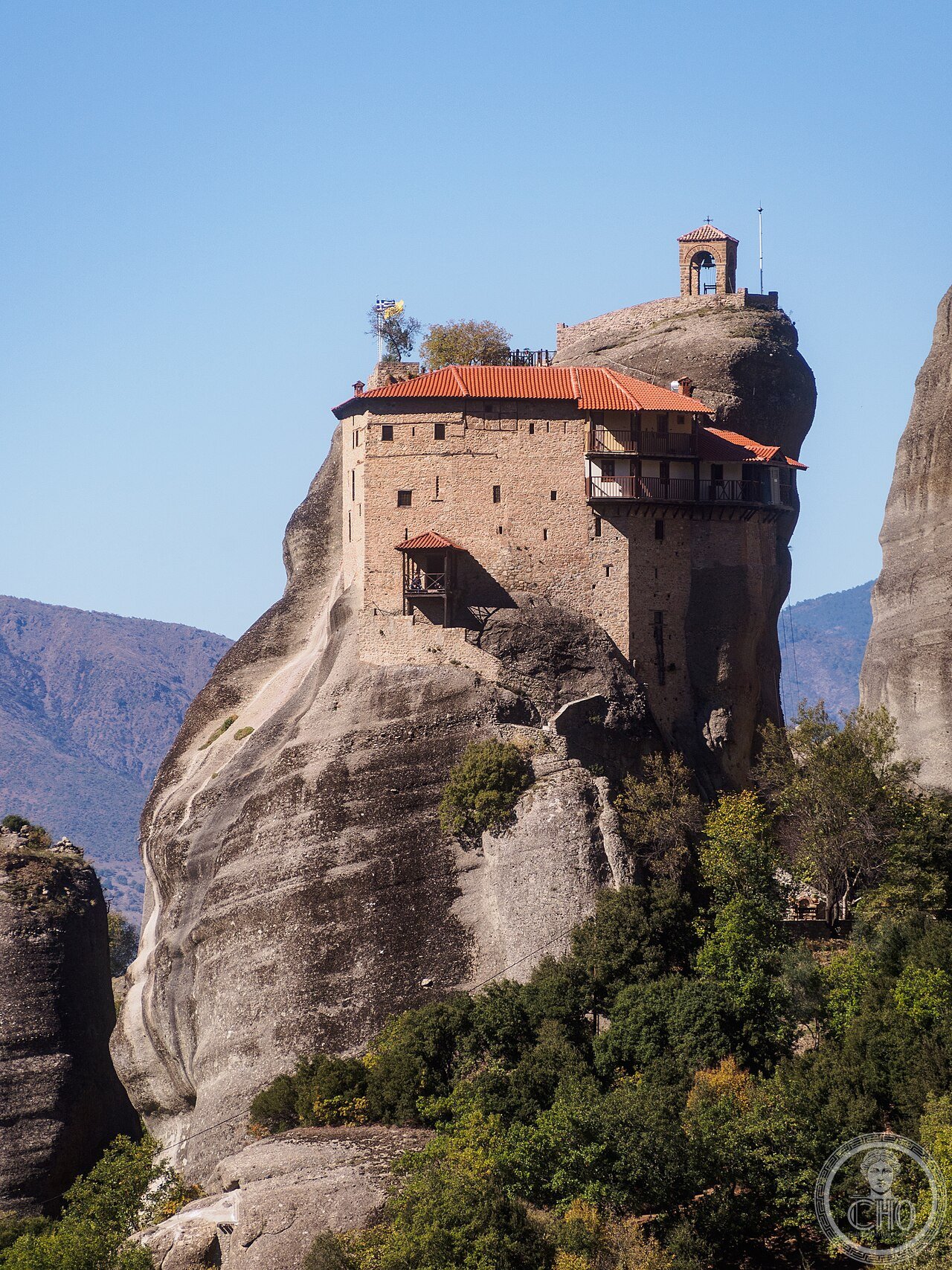
The surface of the pinnacle on which this monastery stands is so small that its builders could do nothing but stack the rooms on several levels, one above the other, linked by an internal staircase. In 1527 the Cretan painter Theophanes Strelitzas decorated the little church with frescoes bearing his first known signature, “Ch.M.” — the documented beginning of one of the most influential careers in post-Byzantine painting.
About Agios Nikolaos Anapafsas Monastery
The rock on which Agios Nikolaos Anapafsas stands was already occupied by hermits in the early 14th century, evidenced by surviving traces of frescoes in its Chapel of St. Anthony. The present monastery was founded around 1510 by Dionysius, Metropolitan of Larisa, together with Nikanoras, a priest-monk and exarch of Stagoi; the origin of the name “Anapafsas” remains uncertain, possibly deriving from the surname of an early monk or founder associated with the site. Because the rock’s summit offers only a very limited flat surface, the monastery’s builders had no choice but to construct it vertically, stacking successive levels — including an entrance-level Church of St. Anthony with its own crypt, a katholikon on the second floor, an ossuary, monks’ cells, and the chapel of St. John Prodromos — connected internally by a single staircase, giving the whole structure an unusually tall, narrow profile compared to Meteora’s other monasteries. In 1527, the Cretan painter Theophanes Strelitzas decorated the small church with frescoes that bear his earliest known signature, the monogram “Ch.M.,” making this cycle one of his first securely dated and signed works and a foundational document in tracing the development of one of the most significant painters of the post-Byzantine period. The monastery fell into decline and was effectively abandoned by around 1900, remaining in disrepair until it was restored in the 1960s by Greece’s archaeological service. Today it is part of the joint UNESCO World Heritage inscription covering Meteora’s six surviving monasteries, granted in 1988.
Key facts
- Early 14th century: hermits already occupy the rock, evidenced by surviving fresco fragments
- c. 1510: founded by Dionysius, Metropolitan of Larisa, and Nikanoras, exarch of Stagoi
- Architecture: built vertically across multiple stacked levels due to the rock’s very limited surface area
- 1527: Theophanes Strelitzas paints frescoes bearing his earliest known signature, “Ch.M.”
- c. 1900: monastery falls into abandonment and disrepair
- 1960s: restored by Greece’s archaeological service
- 1988: joins the UNESCO World Heritage inscription for Meteora’s six surviving monasteries
History
The 1527 frescoes at Agios Nikolaos Anapafsas hold outsized significance within the history of post-Byzantine art specifically because they carry the earliest known signature of Theophanes Strelitzas, an artist whose subsequent career — including his celebrated later work at Meteora’s own Great Meteoron and Stavronikita Monastery on Mount Athos — helped define the Cretan School’s mature style; this small, cramped monastery therefore preserves a documentary starting point for tracing one of the most influential individual painting careers of the entire period. The monastery’s extreme vertical construction, forced by the narrowness of its rock summit, makes it a particularly clear physical illustration of how severely the natural topography of Meteora’s individual pinnacles constrained and shaped each monastic community’s architectural possibilities.
The roughly six intervening decades between the monastery’s abandonment around 1900 and its restoration in the 1960s reflects the broader early-20th-century decline experienced across much of Meteora, as several of the complex’s smaller and more physically demanding foundations lost their resident communities before a mid-century wave of archaeological and religious interest brought sustained restoration back to the site.
What you see
The monastery’s distinctive tall, narrow, multi-level structure — entrance-level Church of St. Anthony with its crypt, a katholikon on the second floor, an ossuary, monks’ cells, and the chapel of St. John Prodromos, all connected by an internal staircase — reflects the extreme constraints of building atop such a limited rock surface. The katholikon preserves Theophanes Strelitzas’s 1527 frescoes, among the artist’s earliest securely attributed and signed works, alongside earlier 14th-century fresco fragments surviving from the site’s original hermitage phase.
Practical information
- Opening hours: open to visitors on a scheduled basis with seasonal variation; check current hours before visiting; admission fee applies; modest dress required
- Address: Ιερά Μονή Αγίου Νικολάου Αναπαυσά, Μετέωρα – Καστράκι, 422 00 Kalambaka, Greece
Getting there
Agios Nikolaos Anapafsas is reachable on foot or by car from Kastraki, in the Thessaly region, being one of the closest Meteora monasteries to the village. GPS: 39.7239° N, 21.6246° E.
Nearby
- Kastraki — the nearest village, at the base of the Meteora rocks
- Rousanou Monastery — another of the six active Meteora monasteries, nearby
- Great Meteoron Monastery — the largest and oldest of the six active Meteora monasteries
Sources
- VisitMeteora.travel — “Monastery Of Agios Nikolaos Anapafsas In Meteora” (visitmeteora.travel)
- Sacred Destinations — “Agios Nikolaos Anapafsas Monastery, Meteora, Greece” (sacred-destinations.com)
- Meteora.com — “Saint Nicholas Anapafsas Monastery” (meteora.com)
Find it on the map
See this place and what’s around it →📷 Become a Cultural Heritage Online photographer
Share your photos of places: they stay published under your name as the author. The more they're seen, the more you get noticed — and soon a contest will reward the most appreciated photos.
Log in or sign up free to add a photo