
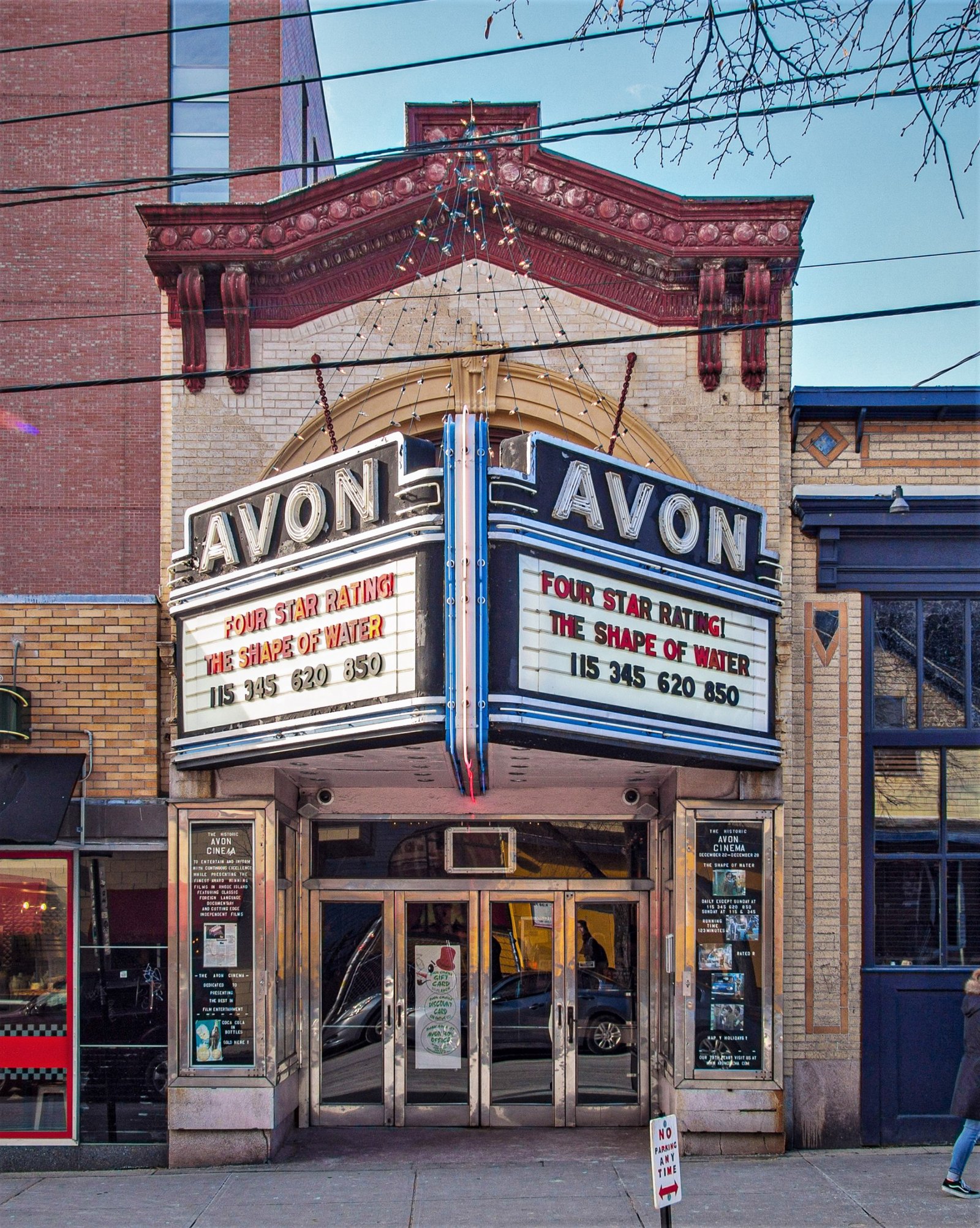
The 1938 Art Deco cinema on Thayer Street in Providence’s College Hill neighborhood has operated as an independent art house for decades—a single-screen survivor of the golden age of the American movie theater, unchanged in architectural character and undiminished in its commitment to independent and foreign film.
At a glance
The Avon Cinema at 260 Thayer Street in Providence’s College Hill district opened in February 1938 as a neighborhood movie house serving the dense residential and university district adjacent to Brown University and the Rhode Island School of Design. Its Art Deco facade presents the compact commercial register of the style: a vertical composition organized around a neon marquee, with the geometric ornament and stepped parapet that define small-scale Art Deco commercial architecture of the late 1930s. The Avon has operated continuously as an independent cinema, specializing in foreign and art-house films, and it has become an integral part of Providence’s cultural landscape. Single-screen movie houses of this vintage and character are rare survivals on the American commercial street: most were closed, subdivided, or demolished during the multiplex era of the 1970s and 1980s, and the Avon’s continued independent operation is a cultural achievement as notable as its architectural history.
Key facts
- Opened: February 1938
- Style: Art Deco
- Address: 260 Thayer Street, Providence, RI 02906
- Neighborhood: College Hill, adjacent to Brown University and RISD
- Format: Single-screen independent cinema
- Programming: Foreign and independent art-house film
- Current use: Active movie theater, operating continuously since 1938
History
The Avon Cinema opened in February 1938 on Thayer Street, the commercial spine of Providence’s College Hill neighborhood and the principal street of the district surrounding Brown University and the Rhode Island School of Design. The late-1930s timing placed the cinema at the tail end of the classic movie palace era: the great urban picture palaces of the 1920s had given way to smaller neighborhood houses designed not for the theatrical grandeur of the downtown palaces but for the daily convenience of residential audiences who could walk to an evening screening without traveling to the city center.
The Avon’s Art Deco design served both purposes simultaneously: the geometric ornament and neon signage of the facade were modern and attractive enough to draw patrons from a neighborhood that prized cultural life, while the building’s scale was calibrated for a single-screen house rather than a thousand-seat palace. The cinema took its name from the Avon River at Stratford-upon-Avon, the conventional association between the name and cultured theatrical entertainment, signaling from its opening that it aimed for an educated and art-oriented audience.
The pivot to foreign and independent film programming that defines the Avon today probably occurred sometime in the 1960s or 1970s, as the growth of Brown University and RISD created an audience for precisely this kind of programming. By the time the multiplex era eliminated most single-screen neighborhood cinemas, the Avon had found a niche audience substantial enough to sustain independent operation. It remains today one of the oldest continuously operating independent art-house cinemas in New England, and its continued presence on Thayer Street is a point of civic pride for a neighborhood that prizes its cultural institutions.
What you see
The Avon Cinema’s facade deploys Art Deco ornament in the compact format of a small commercial theater designed to announce itself on a busy pedestrian street. The vertical marquee sign is the organizing element: mounted above the entrance canopy and rising to the parapet, it carries the cinema’s name in neon lettering that was the signature advertising medium of the Art Deco era, visible from both ends of Thayer Street. The geometric ornament surrounding the marquee and framing the parapet is the abstracted, non-representational decoration that distinguished Art Deco from both the classical tradition and the organic curves of Art Nouveau, applying the machine-age aesthetic of the 1930s to a building that was, at its heart, a neighborhood entertainment venue.
The facade has been maintained in a condition that preserves the 1938 design character, making the Avon Cinema a rare intact example of small-scale commercial Art Deco on a New England urban street. College Hill’s concentration of eighteenth and nineteenth-century residential architecture makes the Avon’s 1938 Deco facade stand out as the neighborhood’s most explicitly twentieth-century commercial building.
Practical information
- Status: Active cinema; tickets available at the box office and online
- Programming: Independent and foreign film; check current schedule on the Avon Cinema website
- Exterior: Freely viewable from Thayer Street at any time; the neon signage is best at dusk and after dark
- Time needed: 5 minutes for exterior; 2 hours for a feature screening
- Combine with: Brown University campus and the RISD Museum of Art, both within 5-minute walks on College Hill
Getting there
The Avon Cinema is at 260 Thayer Street on Providence’s College Hill. From Providence Station (Amtrak/MBTA), walk uphill east on Westminster and Angell Streets for about 15 minutes. T.F. Green Providence Airport is 8 miles south. RIPTA local bus routes serve Thayer Street. Brown University’s main green is two blocks north; the RISD campus begins two blocks south. Parking is limited on College Hill; the cinema is best reached on foot from the downtown core or by RIPTA bus.
Nearby
- RISD Museum of Art — Rhode Island School of Design’s world-class collection, 2 blocks south at 20 North Main Street
- Benefit Street — Providence’s “Mile of History,” one of the finest concentrations of 18th-century Colonial and Federal architecture in the United States, one block west
- John Brown House (1786) — Federal period mansion, NRHP and National Historic Landmark, 3 blocks south at 52 Power Street
- First Baptist Church in America (1775) — the oldest Baptist congregation in America; colonial Georgian architecture on North Main Street, 10 minutes’ walk south
Sources
- Wikipedia, “Avon Cinema” — primary narrative source
- Wikimedia Commons, Avon_Cinema_(62451)_crop.jpg (CC BY-SA 4.0)
Find it on the map
See this place and what’s around it →Record researched and written by Luigi De Marchi for Cultural Heritage Online, 2026.
📷 Become a Cultural Heritage Online photographer
Share your photos of places: they stay published under your name as the author. The more they're seen, the more you get noticed — and soon a contest will reward the most appreciated photos.
Log in or sign up free to add a photoIs this page about you?
This page is read by travellers and heritage enthusiasts who find it on Google. Tell us how you are connected to this place and we will take it from there.