
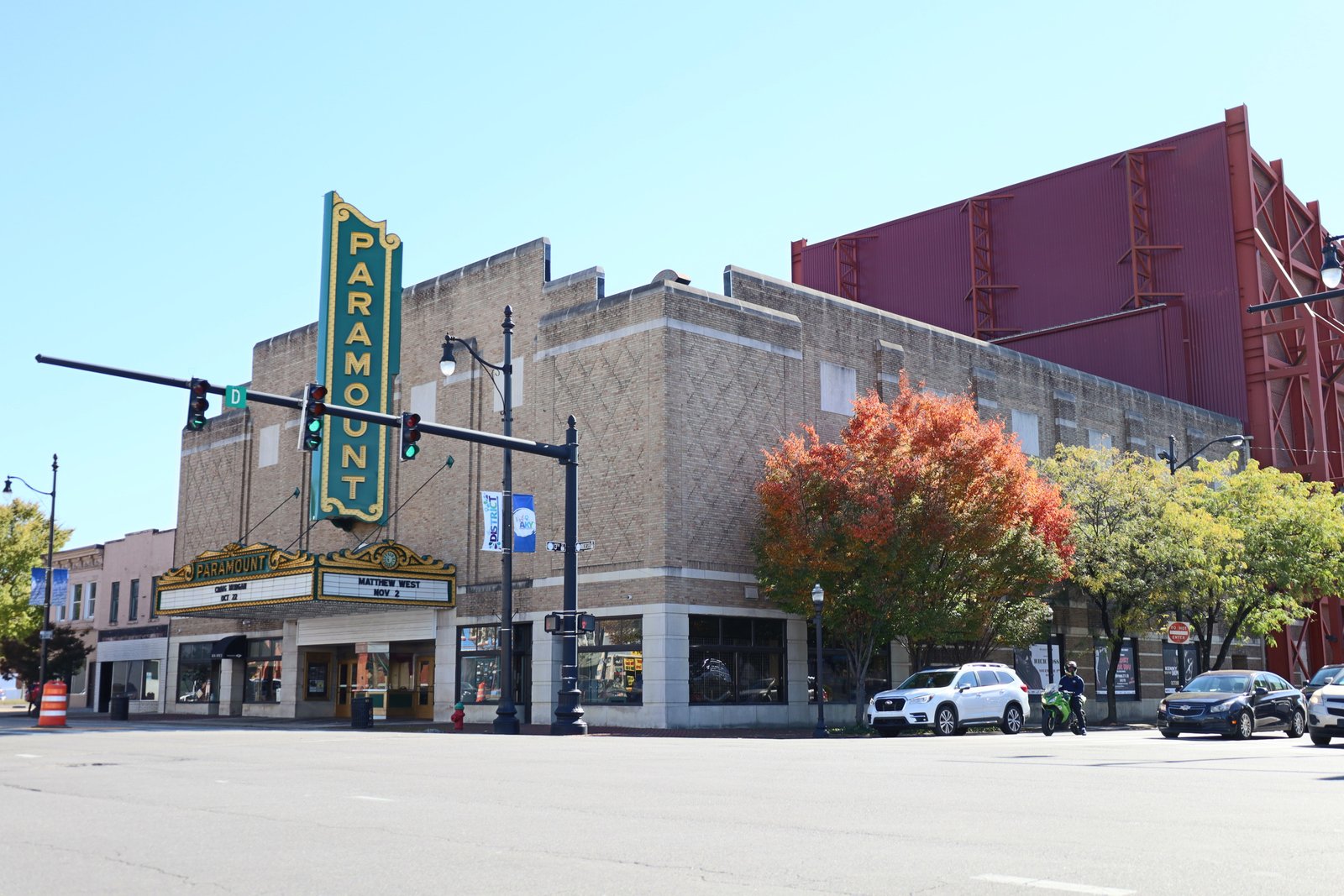
Rapp and Rapp’s 1931 Art Deco picture palace in Ashland—one of the signature works of the most prolific theater architects of the golden age of American cinema—stands as the finest performing-arts venue between Cincinnati and Charleston, still drawing audiences nearly a century after its opening night.
At a glance
The Paramount Arts Center at 1300 Winchester Avenue in Ashland, Kentucky opened on September 5, 1931 as the Paramount Theatre, a first-run movie palace commissioned by Paramount Pictures and designed by the Chicago firm of Rapp and Rapp. The building seats approximately 1,400 in an auditorium whose Art Deco interior program matches the ambition and technical refinement of the firm’s best work in larger cities. Listed on the National Register of Historic Places in 1975 as one of the earliest movie palace NRHP listings in the country, the building is operated today by the non-profit Paramount Arts Center organization as the premier performing-arts venue for northeastern Kentucky and the tri-state region where Kentucky, Ohio, and West Virginia meet. The building’s survival and continued use are exceptional achievements in a region where comparable venues of this vintage rarely escaped the conversion or demolition that claimed most American movie palaces from the 1960s onward.
Key facts
- Opened: September 5, 1931
- Architects: Rapp and Rapp (Cornelius Ward & George Leslie Rapp), Chicago
- Style: Art Deco
- Address: 1300 Winchester Avenue, Ashland, KY 41101
- NRHP: ref. 75000736, listed 30 June 1975
- Capacity: approx. 1,400 seats
- Current use: Active performing-arts venue; concerts, touring productions, film screenings
History
Rapp and Rapp were the dominant force in American movie palace design through the 1920s and 1930s, responsible for more than 400 theaters across the United States including the landmark Chicago Theatre (1921), the Paramount in Denver (1930), and the Brooklyn Paramount (1928). Their commissions for Paramount Pictures produced theaters in cities of every scale, from the great urban palaces of Chicago and New York to regional centers like Ashland, Kentucky—where the same architectural rigor and ornamental ambition they brought to flagship downtown locations was applied to a city of 30,000 people in the eastern Kentucky coalfields.
The Paramount Ashland opened in 1931 during the first year of the sound film era’s maturity: the technological revolution of synchronized sound, which had arrived with “The Jazz Singer” in 1927, had by 1931 been absorbed into the industry infrastructure, and the picture palaces of the early 1930s were designed around the complete film experience rather than the vaudeville and silent-film model of their predecessors. The Paramount served Ashland’s audiences through the Depression, the wartime years of the 1940s, the television era of the 1950s, and the multiplex conversion of the 1970s and 1980s without the closures and conversions that ended most comparable venues. Its survival into the 21st century as an active, non-profit arts center is a product of civic investment in an institution that Ashland’s community recognized as architecturally irreplaceable.
The NRHP listing in 1975 placed the Paramount among the first movie palaces to receive federal historic designation, reflecting the growing recognition within the preservation community that the picture palaces of the golden age were architectural documents of a culture that had largely disappeared. Today the Paramount Arts Center hosts a full season of programming including Broadway touring productions, concerts, and film screenings, sustaining the building’s original function in a form adapted to contemporary performing-arts expectations.
What you see
The Winchester Avenue facade presents Rapp and Rapp’s Art Deco idiom in a composition calibrated for a regional city’s main commercial street: the vertical emphasis of the theater entrance, organized around the marquee and its associated signage tower, reads from a distance that the Ashland streetscape makes possible without the compression of a major urban block. The terra cotta ornament—the material of choice for Rapp and Rapp’s theater facades throughout their career—deploys the geometric vocabulary of the late-1920s Art Deco in a program that moves from the entrance canopy upward through the stepped facade to the decorative parapet.
The interior, which retains its 1931 character through a sequence of lobby spaces and the main auditorium, is the building’s most important architectural zone: the ceiling treatment, the proscenium surround, the box configuration, and the ornamental plasterwork represent Rapp and Rapp’s mature approach to theater design at the moment when Art Deco had fully displaced all competing styles in American commercial architecture.
Practical information
- Current use: Active performing-arts venue; check Paramount Arts Center website for season schedule
- Tickets: Available online and at the box office
- Exterior: Freely viewable from Winchester Avenue; the marquee is illuminated for performances
- Tours: Building tours available; contact the Paramount Arts Center for schedule
- Time needed: 20 minutes for exterior + lobby tour; full evening for a performance
Getting there
The Paramount Arts Center is at 1300 Winchester Avenue in downtown Ashland, Kentucky, in the northeastern corner of the state where Kentucky, Ohio, and West Virginia meet at the Ohio River. The closest major airports are Huntington Tri-State (11 miles west in West Virginia) and Lexington Blue Grass Airport (120 miles west). I-64 exits at Ashland/US 60; downtown is 3 miles north. Ashland is 130 miles east of Lexington, 60 miles west of Charleston WV. The Paramount is within walking distance of the downtown Ashland commercial core.
Nearby
- Ashland Area Art Gallery — regional contemporary art in downtown Ashland, two blocks from the Paramount
- Central Park, Ashland — the city’s principal park, two blocks north of Winchester Avenue
- Huntington Museum of Art — West Virginia’s largest art museum, 12 miles west across the Ohio River in Huntington, WV
- Rapp & Rapp Ohio Valley trail — Huntington City Auditorium (1919, Rapp & Rapp) and other regional theater landmarks within an hour’s drive
Sources
- Wikipedia, “Paramount Arts Center” — primary narrative source
- National Register of Historic Places, ref. 75000736 (30 June 1975)
- Wikimedia Commons, Paramount_Arts_Center_2023a.jpg (CC BY-SA 4.0)
Find it on the map
See this place and what’s around it →Record researched and written by Luigi De Marchi for Cultural Heritage Online, 2026.
📷 Become a Cultural Heritage Online photographer
Share your photos of places: they stay published under your name as the author. The more they're seen, the more you get noticed — and soon a contest will reward the most appreciated photos.
Log in or sign up free to add a photoIs this page about you?
This page is read by travellers and heritage enthusiasts who find it on Google. Tell us how you are connected to this place and we will take it from there.