

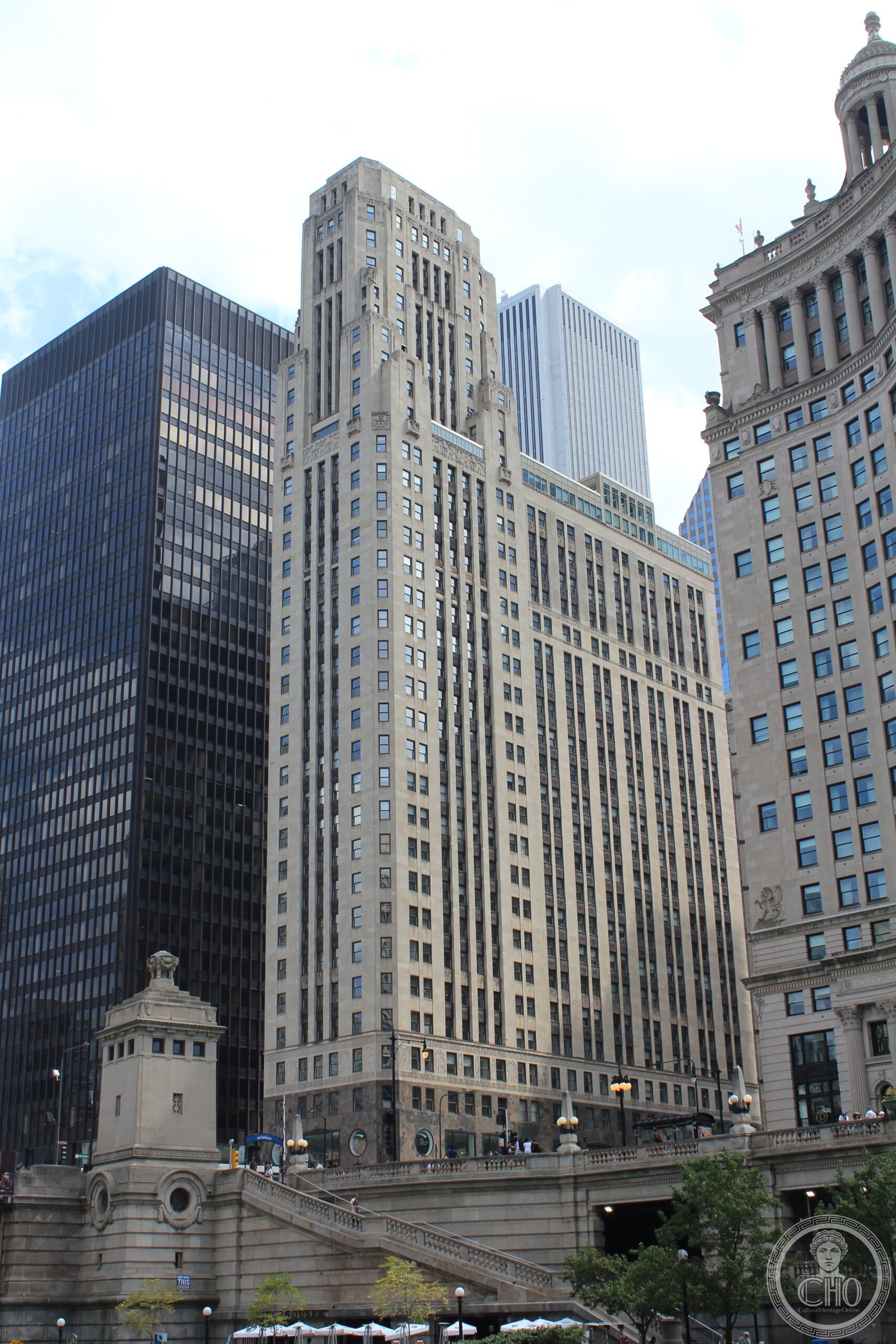
One of four buildings that define the north approach to the Michigan Avenue Bridge, this 35-story Art Deco tower by Holabird & Root rises above the Chicago River with a setback silhouette that has been part of the city’s most photographed panorama since 1928.
At a glance
The building at 333 North Michigan Avenue in Chicago was completed in 1928 to designs by Holabird & Root, the Chicago firm that carried the city’s commercial architecture into the Art Deco era after the death of Louis Sullivan and the retirement of Daniel Burnham. The tower occupies a critical site at the northeast corner of the Michigan Avenue Bridge over the Chicago River, one of four buildings that were designed and built approximately simultaneously to define the urban character of this crossing. Together they represent one of the most coherent pieces of urban design in American architecture. The 35-story tower has a distinctive stepped profile and limestone facade with Art Deco ornament concentrated at the crown and entrance portal.
Key facts
- Location: 333 North Michigan Avenue, at the Michigan Avenue Bridge, Chicago
- Architect: Holabird & Root
- Completed: 1928
- Floors: 35 stories
- Style: Art Deco with limestone facing and setback profile
- Status: Chicago Landmark
- Setting: One of four “bridge” buildings at the Michigan Avenue / Chicago River crossing
History
The Michigan Avenue Bridge, opened in 1920, was the centrepiece of Daniel Burnham’s 1909 Plan of Chicago, which envisioned a grand civic boulevard connecting the north and south sides of the city across the Chicago River. The bridge’s northern approach required buildings that would provide architectural definition to the crossing — a function recognising that the bridge itself was not merely infrastructure but the threshold of Chicago’s most prominent civic space.
Holabird & Root, the successor firm to Holabird & Roche, had established themselves as Chicago’s leading commercial architects by the mid-1920s. Their design for 333 North Michigan used the setback profile then being pioneered in New York — driven by the 1916 Zoning Resolution — to create a tower whose massing was not merely practical but visually coherent with the other three buildings at the crossing. The stepped silhouette reads as a deliberate counterpart to the Wrigley Building to the west and to the earlier structures on the bridge’s south side.
The building was designated a Chicago Landmark, recognising its role in one of the city’s most significant urban compositions and as a representative work of Holabird & Root’s early Art Deco practice. It remains an active office building and one of the most visible towers in the Michigan Avenue corridor.
What you see
The building is best seen from the Michigan Avenue Bridge itself, where 333 North Michigan rises at the northeast corner of the crossing, with the Wrigley Building directly across the river to the northwest and the London Guarantee Building across Michigan Avenue to the southeast. From this vantage point the stepped setback profile, clad in pale limestone, reads as a clean vertical composition. The Gothic spire of Tribune Tower, half a block north on the same east side of Michigan Avenue, provides a contrasting silhouette.
At street level, the entrance portal on Michigan Avenue has concentrated Art Deco relief ornament in the stone surround. The lobby retains original detailing. The north and east elevations, visible from Wabash Avenue, show the building’s relationship to the river and to the broader urban fabric of Streeterville and the Magnificent Mile extending north.
Practical information
- Access: Active office building; lobby accessible during business hours.
- Best viewing: From the Michigan Avenue Bridge, looking north in afternoon light when the pale limestone is at its most luminous.
- Time needed: 15–20 minutes for exterior and lobby; the bridge and River Walk allow a circuit of all four bridge buildings.
- Nearby: The Chicago Architecture Foundation River Cruise departs from Michigan Avenue Bridge and provides the best contextual view of all four bridge buildings.
Getting there
The building is at 333 North Michigan Avenue at the Michigan Avenue Bridge over the Chicago River. The nearest CTA stations are Grand (Red Line) three blocks north and State/Lake (Brown/Green/Orange/Purple/Pink) two blocks west. Michigan Avenue (Magnificent Mile) is easily reached on foot from Millennium Park to the south and from the Streeterville neighbourhood to the east. O’Hare International Airport (ORD) is approximately 17 miles northwest via the Blue Line CTA.
Nearby
- Tribune Tower (1925) — Raymond Hood and John Mead Howells’ Gothic skyscraper immediately across Michigan Avenue to the northeast, with stones from famous buildings embedded in the base.
- Wrigley Building (1921/1924) — The gleaming white terracotta tower at the southwest corner of the bridge crossing, one of Chicago’s most recognisable landmarks.
- London Guarantee Building (1923) — The neoclassical tower on the southeast corner of the bridge, now a hotel.
- Chicago River Walk — The waterfront promenade extending west along both banks from the bridge, one of Chicago’s most successful public space initiatives.
Sources
- Chicago Landmarks Designation Report: 333 North Michigan Avenue.
- Bruegmann, Robert. The Architects and the City: Holabird & Roche of Chicago, 1880–1918. University of Chicago Press, 1997.
- Sinkevitch, Alice, ed. AIA Guide to Chicago. Harcourt, 1993.
- Chicago Architecture Foundation. The Bridges of the Chicago River. Chicago Architecture Foundation, 2003.
- Wikipedia, “333 North Michigan Avenue,” https://en.wikipedia.org/wiki/333_North_Michigan_Avenue.
Find it on the map
See this place and what’s around it →📷 Become a Cultural Heritage Online photographer
Share your photos of places: they stay published under your name as the author. The more they're seen, the more you get noticed — and soon a contest will reward the most appreciated photos.
Log in or sign up free to add a photoIs this page about you?
This page is read by travellers and heritage enthusiasts who find it on Google. Tell us how you are connected to this place and we will take it from there.