

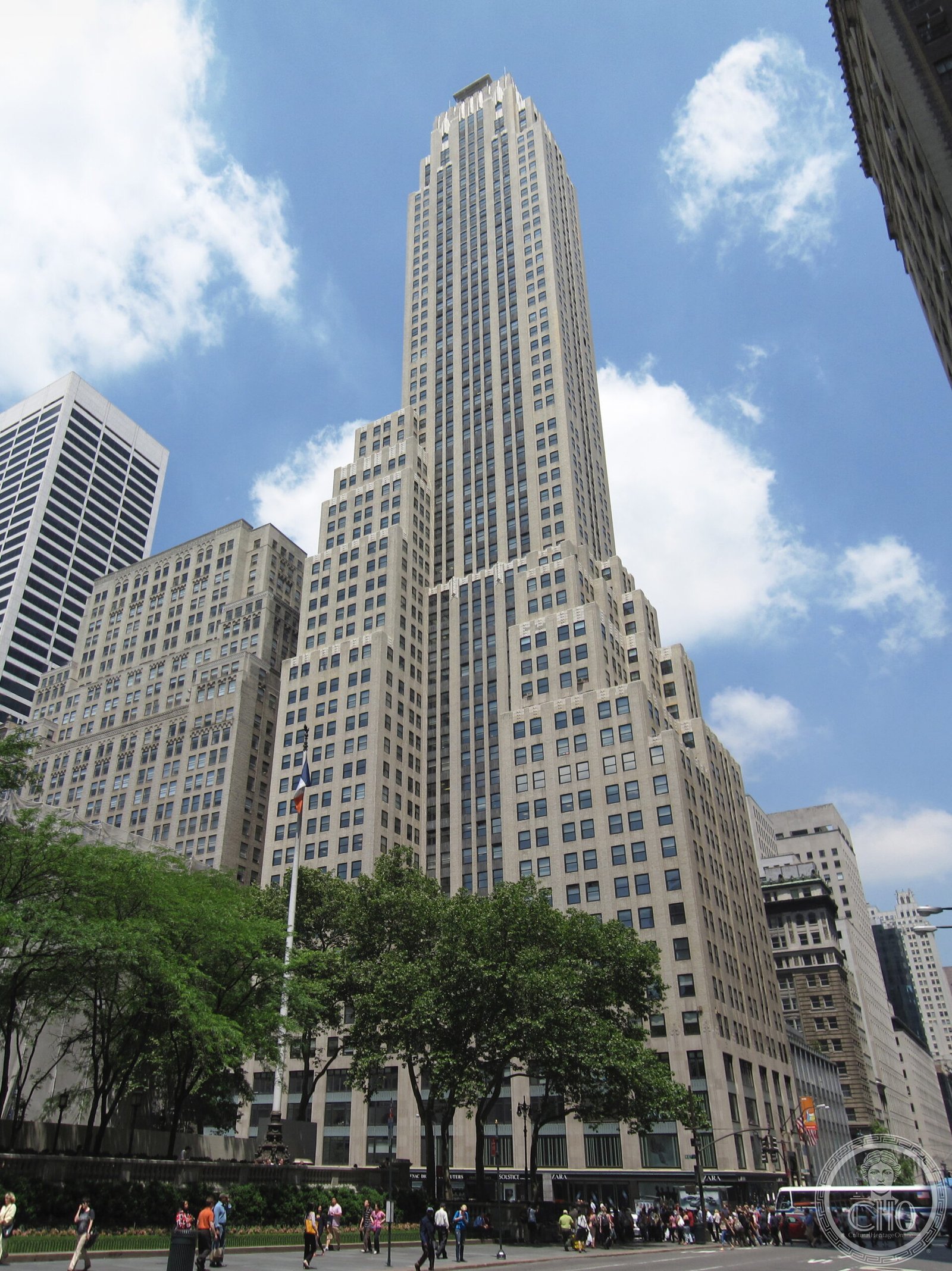
The 1931 Art Deco tower at the northwest corner of Fifth Avenue and 42nd Street, designed by Shreve, Lamb & Harmon — the architects of the Empire State Building — completes the architectural composition of one of Midtown Manhattan’s most significant intersections with a 697-foot limestone and granite setback tower.
At a glance
500 Fifth Avenue was completed in 1931 at the northwest corner of Fifth Avenue and 42nd Street, directly across from the main branch of the New York Public Library. Designed by the firm of Shreve, Lamb & Harmon, who the same year completed the Empire State Building, the 59-story tower employs the same grammar of Art Deco setbacks and limestone cladding used on the taller building, scaled to a more intimate context. The building stands at a crossing that concentrates some of the most significant architecture of the 1920s and 1930s: the Chrysler Building is visible to the northeast, the Empire State one block south, Grand Central Terminal two blocks east, and the Public Library directly across. 500 Fifth Avenue was designated a New York City Individual Landmark in recognition of its architectural quality and its role in completing this historic intersection.
Key facts
- Location: 500 Fifth Avenue, at 42nd Street, Midtown Manhattan
- Architects: Shreve, Lamb & Harmon
- Completed: 1931
- Height: 697 feet (212 m); 59 stories
- Style: Art Deco setback tower; limestone and granite cladding
- Status: New York City Individual Landmark; National Register of Historic Places
- Setting: Midtown Fifth Avenue, opposite the New York Public Library
History
The firm of Shreve, Lamb & Harmon came to prominence in the late 1920s as specialists in the practical Art Deco skyscraper. Richmond Shreve and William Lamb were the senior partners responsible for design; their method combined the formal language of Art Deco — the setback tower, the geometric ornament, the limestone or granite facade — with rigorous efficiency in structural engineering and floor-plate planning. This approach, developed across several Manhattan office buildings in the late 1920s, reached its most famous expression in the Empire State Building (1931).
500 Fifth Avenue was commissioned and designed roughly contemporaneously with the Empire State Building, occupying the same firm’s resources at the height of the late-1920s construction boom. The building went up fast, in the manner of the period; the 1929 stock market crash slowed many projects but not those already under construction or deeply committed. The decision to place a 59-story tower at this corner — adjacent to the Public Library’s three-block lawn to the south and Grand Central’s air rights to the east — reflected the confidence in Manhattan’s office market that characterised the last years of the pre-Depression building cycle.
The building’s position at 42nd Street and Fifth Avenue made it visible from Bryant Park to the south and from the Bryant Park–42nd Street–Fifth Avenue pedestrian environment, one of the highest-traffic urban intersections in the United States. Its limestone cladding has maintained its appearance well, and the building has remained in continuous office use since completion.
What you see
The tower is most effectively read from Bryant Park, the lawn behind the New York Public Library, where the Fifth Avenue facades of both 500 Fifth Avenue and the library form the northern edge of the park’s visual field. From this vantage, the setback profile of 500 Fifth Avenue is visible above the library’s cornice line. The corner tower element, which holds the 42nd Street and Fifth Avenue elevations together, is the principal visual focus.
At street level, the entrance on Fifth Avenue and the corner treatment show the Art Deco ornamental vocabulary in the stone carving and metalwork of the portal. The Midtown environment — with the Chrysler Building to the northeast, the Empire State to the south, the Public Library to the east, and the Bryant Park greenery filling the corner — gives 500 Fifth Avenue a context that explains both why it was built and why its modest ornamental programme succeeds: it does not try to compete with any single neighbor but contributes to the overall quality of the crossing.
Practical information
- Access: Office building; lobby accessible during business hours.
- Best viewing: From Bryant Park (west side of the library) looking north along Fifth Avenue, for the full tower profile.
- Combination: Pair with the New York Public Library (1911, Carrère & Hastings) opposite, and walk one block to Grand Central Terminal for the full 42nd Street Art Deco corridor.
- Time needed: 15 minutes for exterior; 1.5 hours if combining with the library and Grand Central.
Getting there
500 Fifth Avenue is at the corner of Fifth Avenue and 42nd Street in Midtown Manhattan. The nearest subway stations are 42nd Street/Bryant Park (7/B/D/F/M, one block east) and 5th Avenue/42nd Street (7, adjacent). Grand Central-42nd Street (4/5/6/7/S) is two blocks east. The building is a five-minute walk from Times Square to the west and from Grand Central Terminal to the east.
Nearby
- New York Public Library (1911) — The Stephen A. Schwarzman Building, one of the great Beaux-Arts public buildings in the United States, directly opposite on Fifth Avenue between 40th and 42nd Streets.
- Chrysler Building (1930) — William Van Alen’s Art Deco masterpiece with the stainless steel crown, three blocks east along 42nd Street at Lexington Avenue.
- Empire State Building (1931) — Shreve, Lamb & Harmon’s taller sibling, eight blocks south on Fifth Avenue at 34th Street.
- Grand Central Terminal (1913) — Warren & Wetmore’s Beaux-Arts railway palace, two blocks east on 42nd Street, with its celebrated concourse and constellation ceiling.
Sources
- New York City Landmarks Preservation Commission. 500 Fifth Avenue Designation Report. NYC LPC.
- Stern, Robert A. M., Gregory Gilmartin, and Thomas Mellins. New York 1930. Rizzoli, 1987.
- Sabbagh, Karl. Skyscraper. Macmillan, 1989. (Shreve, Lamb & Harmon method)
- Willis, Carol. Form Follows Finance: Skyscrapers and Skylines in New York and Chicago. Princeton Architectural Press, 1995.
- Wikipedia, “500 Fifth Avenue,” https://en.wikipedia.org/wiki/500_Fifth_Avenue.
Find it on the map
See this place and what’s around it →📷 Become a Cultural Heritage Online photographer
Share your photos of places: they stay published under your name as the author. The more they're seen, the more you get noticed — and soon a contest will reward the most appreciated photos.
Log in or sign up free to add a photoIs this page about you?
This page is read by travellers and heritage enthusiasts who find it on Google. Tell us how you are connected to this place and we will take it from there.