
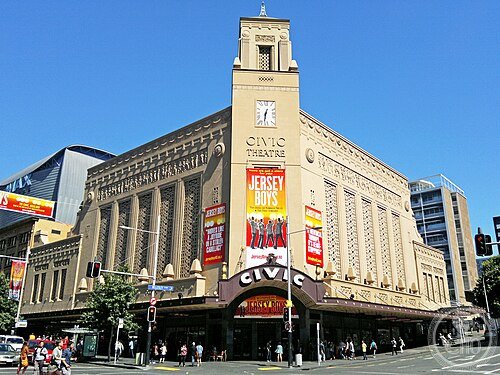
When the Auckland Civic Theatre opened on 20 December 1929, audiences stepped not into a conventional auditorium but into an enchanted outdoor world: a Moorish garden under a night sky alive with drifting clouds and twinkling stars. The Civic is one of only a handful of surviving atmospheric cinemas in the world and the finest in the Southern Hemisphere. Its extraordinary interior blends Indian temple motifs with Spanish Colonial arcades and Moorish minarets, all orchestrated to dissolve the boundary between interior and exterior space. Designed by Charles Bohringer and William T. Leighton, the theatre seats 2,378 and remains the largest in New Zealand. Following a landmark NZD 41.8 million restoration, it reopened in 1999 and continues to host opera, ballet, concerts, and film.
At a glance
- Type
- Atmospheric cinema / performing arts theatre
- Period
- 1929
- Style
- Atmospheric / Art Deco Eclectic
- Location
- 267 Queen Street, Auckland, New Zealand
- Coordinates
- 36.85° S, 174.76° E
- Architect(s)
- Charles Bohringer and William T. Leighton
Overview
The Auckland Civic Theatre stands on Queen Street in central Auckland, its terracotta facade announcing one of the city’s most beloved cultural institutions. Built as a picture palace during the golden age of cinema, the Civic was designed to transport audiences into a world of fantasy. Its atmospheric style, a uniquely American invention of the 1920s, used theatrical lighting and exotic architecture to simulate watching a film beneath an open sky. Today managed by Auckland Live, it serves as the city’s premier venue for large-scale performing arts and remains the largest surviving atmospheric cinema in Australasia.
History
The Civic opened in December 1929, weeks after the Wall Street Crash, yet its lavish interiors made it an immediate sensation. During World War II the underground Wintergarden ballroom became a major entertainment hub for American GIs stationed in Auckland, cementing the theatre’s place in the city’s social memory. Post-war decades brought decline: changing audience tastes and competition from newer venues left the Civic underused and at risk of demolition. A spirited public campaign saved it, and in 1997 a comprehensive conservation project began. The restored theatre reopened on 20 December 1999, exactly seventy years after its first night, to widespread celebration.
Architecture & Design
The Civic’s interior is an exercise in controlled fantasy. The foyer draws on Indian temple architecture: seated Buddhas flank the entrance, twisted columns rise to domed ceilings, and the decorative programme borrows freely from Mughal ornamental traditions. The auditorium is modelled on a Moorish garden: turrets, minarets, and tiled roofs line the walls, while carved balustrades and arcades suggest a palatial open courtyard. Overhead, the celebrated star ceiling uses sophisticated theatrical lighting to project a deep-blue night sky complete with slowly drifting clouds and hundreds of twinkling stars, creating the sensation of sitting in an open-air amphitheatre. The illusion remains among the most sophisticated atmospheric theatre effects in the world.
Cultural significance
The Auckland Civic Theatre is the largest surviving atmospheric cinema in Australasia and one of the finest examples anywhere in the world. It represents a distinctive episode in the history of popular entertainment architecture, when cinema-going was conceived as total sensory escape. The building is a Category I listed heritage structure under the New Zealand Heritage List and a defining element of Auckland’s cultural identity, beloved by generations of New Zealanders.
Visiting today
The Auckland Civic Theatre is an active performing arts venue and cinema. Events are programmed year-round by Auckland Live; tickets are available through the Auckland Live website. Heritage tours of the interior, including the star ceiling and Wintergarden, are offered periodically. The building at 267 Queen Street is fully accessible. The surrounding precinct includes the Aotea Centre and the Auckland Town Hall.
Getting there
The theatre is at 267 Queen Street, a five-minute walk from Britomart transport interchange, which serves trains and ferries from across the Auckland region. Numerous bus routes stop on Queen Street directly outside. The nearest car parking buildings are on Wellesley Street West and Victoria Street. The Civic is also within the central Auckland SkyBus corridor for connections to the international airport.
Sources & resources
Find it on the map
See this place and what’s around it →📷 Become a Cultural Heritage Online photographer
Share your photos of places: they stay published under your name as the author. The more they're seen, the more you get noticed — and soon a contest will reward the most appreciated photos.
Log in or sign up free to add a photoDo you manage this place?
This page is read by travellers and heritage enthusiasts who find it on Google. Keep it accurate — and make it work for you. Free for non-profit heritage institutions.