
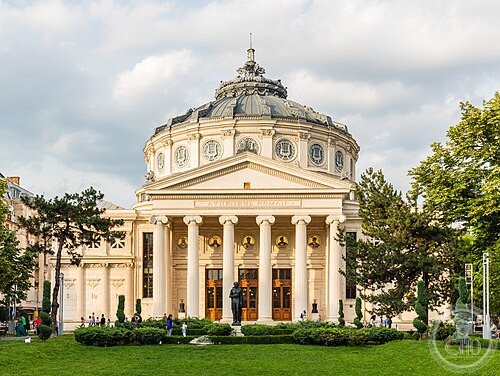
Rising from the centre of Bucharest behind a colonnaded portico, the Romanian Athenaeum is the most recognisable cultural monument in Romania — a circular, domed concert hall whose construction was partly funded by a nationwide public subscription campaign whose rallying cry, “Donate one leu for the Ateneu!”, became a byword for civic pride. Designed by French architect Albert Galleron and inaugurated in 1888, the building blends Neoclassical rigour with richly ornamented interiors, including a celebrated 75-metre fresco that wraps the main hall and depicts the sweep of Romanian history from Roman Dacia to the modern era. Today it is home to the George Enescu Philharmonic Orchestra and host of the biennial George Enescu International Festival, cementing its role as the living heart of Romanian musical life. Inscribed on the European Heritage Label in 2007, it remains a place where architecture, memory, and performance converge.
At a glance
- Type
- Concert Hall
- Period
- 1865 founded; 1888 inaugurated; completed 1897
- Style
- Neoclassical / Eclectic
- Location
- Strada Benjamin Franklin 1–3, Bucharest, Romania
- Coordinates
- 44.4413° N, 26.0973° E
- Architect(s)
- Albert Galleron (French architect)
Overview
The Romanian Athenaeum stands at the northern end of Calea Victoriei in Bucharest, its Greek-Revival portico and shallow dome forming an instantly recognisable silhouette. Founded in 1865 as a cultural society by Constantin Esarcu, Ion Ghica, and V. A. Urechia, the institution needed decades of fundraising before Albert Galleron’s design could be realised. The result is a building of rare civic dignity: a circular auditorium seating 794, ringed by 52 loges, its walls encircling one of the most important concert-hall interiors in Central and Eastern Europe. The Athenaeum hosts the George Enescu Philharmonic Orchestra and every two years opens its doors to performers from across the world for the George Enescu International Festival, a celebration of Romania’s most famous composer.
History
The Athenaeum grew from a cultural and scientific society established in 1865 to promote Romanian arts and learning. For two decades the society operated without a permanent home, relying on temporary venues. In the 1880s, architect Albert Galleron drew up plans for a purpose-built hall on land formerly belonging to the Văcărescu family. A public subscription drive — “Dați un leu pentru Ateneu” — raised vital funds from across the country. The building was inaugurated on February 14, 1888, though final works continued until 1897. A decisive moment came on December 29, 1919, when the hall hosted the conference at which Romanian leaders ratified the unification of Bessarabia, Transylvania, and Bukovina with the Romanian Old Kingdom, creating Greater Romania. A major restoration, jointly funded by the Romanian government and the Council of Europe Development Bank, was completed in 1992.
Architecture & Design
Galleron’s design is a compact synthesis of Neoclassical and Eclectic influences adapted to a circular plan. The principal facade features a six-column Ionic portico surmounted by a bas-relief frieze and crowned by a low drum and dome. Inside, the auditorium is circular in form, enveloped by two tiers of loges decorated with gilded plasterwork and red velvet. The most extraordinary element is the painted frieze by Costin Petrescu, a continuous 75-by-3-metre panorama encircling the hall at upper-gallery level. Completed between 1933 and 1938, it depicts episodes from Romanian history spanning the Roman conquest of Dacia through the formation of Greater Romania in 1918 — an entire national narrative encoded in a single unbroken arc of pigment and plaster.
Cultural significance
The Athenaeum is not merely a concert hall; it is the primary site of Romanian national memory rendered in stone and paint. Its role in the 1919 unification vote transformed it into a civic monument as much as a cultural one. As home to the George Enescu Philharmonic and host of the biennial George Enescu International Festival, it anchors Romania’s place within the European classical music canon. Its inscription on the European Heritage Label in 2007 recognised the building’s significance not only to Romania but to the shared heritage of the continent. For Romanians, attending a concert here carries weight beyond the music — it is an act of continuity with the civic fundraisers of the 1880s who built it from popular subscription.
Visiting today
The Athenaeum is an active concert venue; the best way to experience the interior is to attend a performance by the George Enescu Philharmonic Orchestra, which holds regular seasons throughout the year. Tickets are affordable by Western European standards and can be purchased at the box office or online. Guided daytime tours of the building are occasionally offered; check the Athenaeum’s official website for current schedules. The foyer and exterior are freely accessible during events. Dress code is smart casual for evening concerts. Photography is generally permitted in public areas before performances begin.
Getting there
The Athenaeum is centrally located on Strada Benjamin Franklin in the Floreasca-Dorobanți area, within easy walking distance of Piața Romană and Piața Victoriei. The nearest metro station is Piața Romană (M2 line), approximately 400 metres away. Numerous tram and bus routes serve Calea Victoriei nearby. Taxis and ride-hailing apps (Bolt, Uber) are widely available across Bucharest. The building is not easily accessible by car for drop-off due to the surrounding pedestrianised zone, but parking is available on surrounding streets.
Sources & resources
Find it on the map
See this place and what’s around it →📷 Become a Cultural Heritage Online photographer
Share your photos of places: they stay published under your name as the author. The more they're seen, the more you get noticed — and soon a contest will reward the most appreciated photos.
Log in or sign up free to add a photoIs this page about you?
This page is read by travellers and heritage enthusiasts who find it on Google. Tell us how you are connected to this place and we will take it from there.