
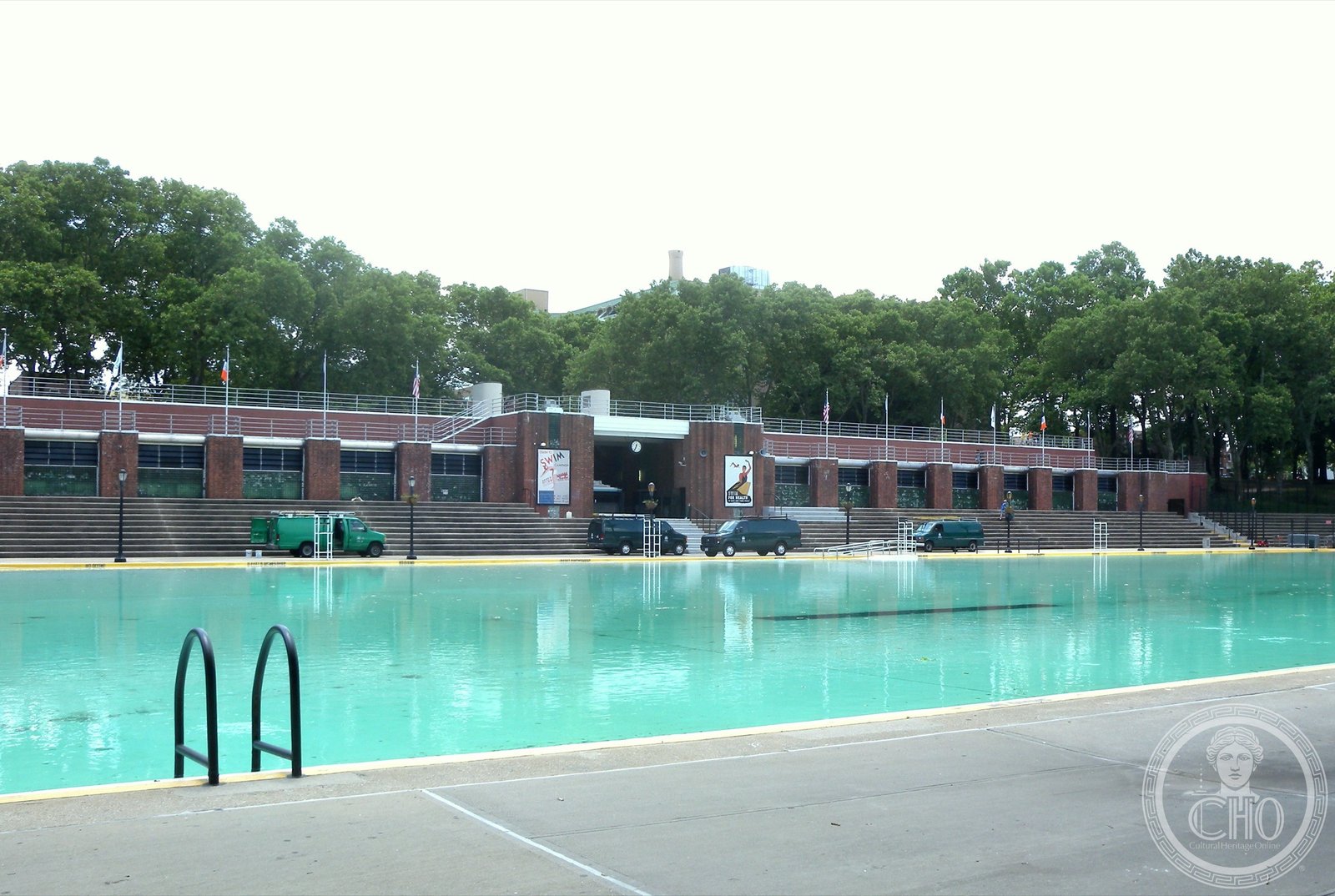
The largest and most architecturally distinguished of New York's eleven WPA outdoor pools, opened in 1936, with Art Moderne concrete pavilions framed by the Hell Gate Bridge and the Triborough Bridge.
At a glance
In the summer of 1936, New York City opened eleven outdoor swimming pools simultaneously — the most ambitious single-season expansion of public recreational infrastructure in American municipal history. Astoria Park Pool, in the Queens neighborhood of Astoria, was the largest: a concrete basin stretching more than 330 feet long, surrounded by Art Moderne changing houses, entrance pavilions, and spectators' bleachers designed by Aymar Embury II, the principal architect of the WPA pool program. The pool site is one of the most dramatically positioned in New York: the Hell Gate Bridge arch rises directly overhead to the north, and the Triborough Bridge approaches frame the eastern horizon. Restored and reopened in 2012, it remains an active public pool every summer, still operating under its original Art Deco structures.
Key facts
- Opened: July 1936 (as part of New York's eleven WPA pools)
- Architect: Aymar Embury II (WPA pool program principal architect)
- Address: 19th Street and Hoyt Avenue North, Astoria, Queens, NY 11105
- GPS: 40.7818°N, -73.9297°W
- Status: National Register of Historic Places (New York City WPA pools listing)
- Style: Art Moderne / WPA Federal Moderne
- Current use: Active public pool (NYC Parks, seasonal)
History
Robert Moses, who combined the roles of NYC Parks Commissioner and chairman of multiple state authorities, orchestrated the eleven-pool campaign as a demonstration of what New Deal federal funding could accomplish in a single construction season. The pools were publicly framed as a democratizing gesture — open to all New Yorkers regardless of income, in a city where access to swimming had historically depended on private club membership or proximity to beaches. Aymar Embury II (1880–1966), an architect best known for his work on the Triborough Bridge and Henry Hudson Bridge structures, was tasked with designing a consistent Art Moderne architectural language across all eleven sites.
Astoria Park Pool was the largest of the eleven, chosen for its elevated site overlooking the Hell Gate channel where the East River meets Long Island Sound. Construction proceeded through 1935 and into 1936; Mayor Fiorello La Guardia and Robert Moses presided over the openings that July. The pool attracted tens of thousands of bathers in its first weeks.
The pool operated continuously through the postwar decades, fell into disrepair by the 1980s, and underwent major renovation in the early 2010s. It reopened in 2012 with restored WPA-era structures, new mechanical systems, and a renewed community identity as one of the city's most historically significant public pools. The NYC Parks Department lists it on the National Register as part of the New York City WPA pools historic district.
What you see
The pool is entered through a formal gatehouse pavilion on 19th Street — a low, flat-roofed concrete structure with horizontal window banding and geometric ornamental moldings at the entrance arch. The vocabulary is unmistakably WPA Federal Moderne: no historic allusion, no applied ornament beyond the relief panels, everything expressed in the material logic of reinforced concrete. The changing houses flanking the pool basin are two-story concrete blocks with the same horizontal banding — functional as much as decorative, with the banded surfaces reducing the visual weight of large utilitarian volumes.
Inside the pool deck, the diving structure at the deep end rises in stepped concrete platforms — the original 1936 construction, still in use. Looking north from the pool deck, the view is anchored by the Hell Gate Bridge (1916), whose massive steel arch dominates the sky above the pool at close range. To the east, the Triborough Bridge's main span and approach towers (1936, Othmar Ammann) complete a view of three decades of New York infrastructure engineering visible simultaneously from a single vantage point. On summer afternoons when the pool is in operation, the scale of the Embury structures — built for five thousand bathers — becomes apparent: the pool deck is genuinely large.
Practical information
- Season: Open approximately late June through Labor Day (NYC Parks seasonal schedule)
- Admission: Free (public NYC Parks pool)
- Hours: Check NYC Parks website for daily hours (typically 11 a.m.–7 p.m.)
- Swimwear required for entry into the pool area; lockers available
- Off-season: The park grounds and views of the bridges are accessible year-round
Getting there
From Midtown Manhattan, take the N or W subway to Astoria–Ditmars Boulevard (the last stop on the line), then walk south on 31st Street and west to the park — approximately 10 minutes on foot. The pool is within Astoria Park, which fronts the East River and Hell Gate from Shore Boulevard. By car, exit the Grand Central Parkway at 21st Street in Astoria and follow signs to the park.
Nearby
- Hell Gate Bridge (1916) — the massive steel arch railroad bridge visible immediately north of the pool; a National Register structure designed by Gustav Lindenthal
- Triborough Bridge / RFK Memorial Bridge (1936) — the multi-span suspension bridge visible to the east from the pool deck; Othmar Ammann, engineer
- Isamu Noguchi Museum — 2 miles southwest in Long Island City; the sculptor's studio and gallery, one of the finest artist museums in the US
Sources
- New York City Landmarks Preservation Commission — WPA pools documentation
- National Register of Historic Places — NYC WPA Swimming Pools nomination
- NYC Parks Department — Astoria Park Pool history
- Gutman, Marta: A City for Children: Women, Architecture, and the Charitable Landscapes of Oakland, 1850–1950 (contextual)
Find it on the map
See this place and what’s around it →Record researched and written by Luigi De Marchi for Cultural Heritage Online, 2026.
📷 Become a Cultural Heritage Online photographer
Share your photos of places: they stay published under your name as the author. The more they're seen, the more you get noticed — and soon a contest will reward the most appreciated photos.
Log in or sign up free to add a photo