

Designed to look like an ocean liner run aground on a San Francisco beach, this 1939 WPA bathhouse is the most audaciously marine building in Streamline Moderne Art Deco — and its original WPA murals remain on the walls.
At a glance
The Aquatic Park Bathhouse stands at the foot of Hyde Street in San Francisco’s North Beach neighborhood, overlooking the curved beach and swimming lagoon of Aquatic Park. Built in 1939 by the Works Progress Administration (WPA) and designed by architect William Mooser Jr., the building is a landmark of Streamline Moderne — the Art Deco idiom that borrowed forms from ships, aircraft, and the aesthetics of speed. The bathhouse functions as a semicircular concrete ship, its curved balconies and horizontal banding reading as decks from the beach. It now serves as the visitor center and exhibition space for the San Francisco Maritime National Historical Park, operated by the National Park Service, and its original WPA-era murals by Hilaire Hiler and others are still visible inside.
Key facts
- Completed: 1939.
- Architect: William Mooser Jr.
- Builder: Works Progress Administration (WPA).
- Style: Streamline Moderne (Art Deco); the building’s form deliberately evokes an ocean liner.
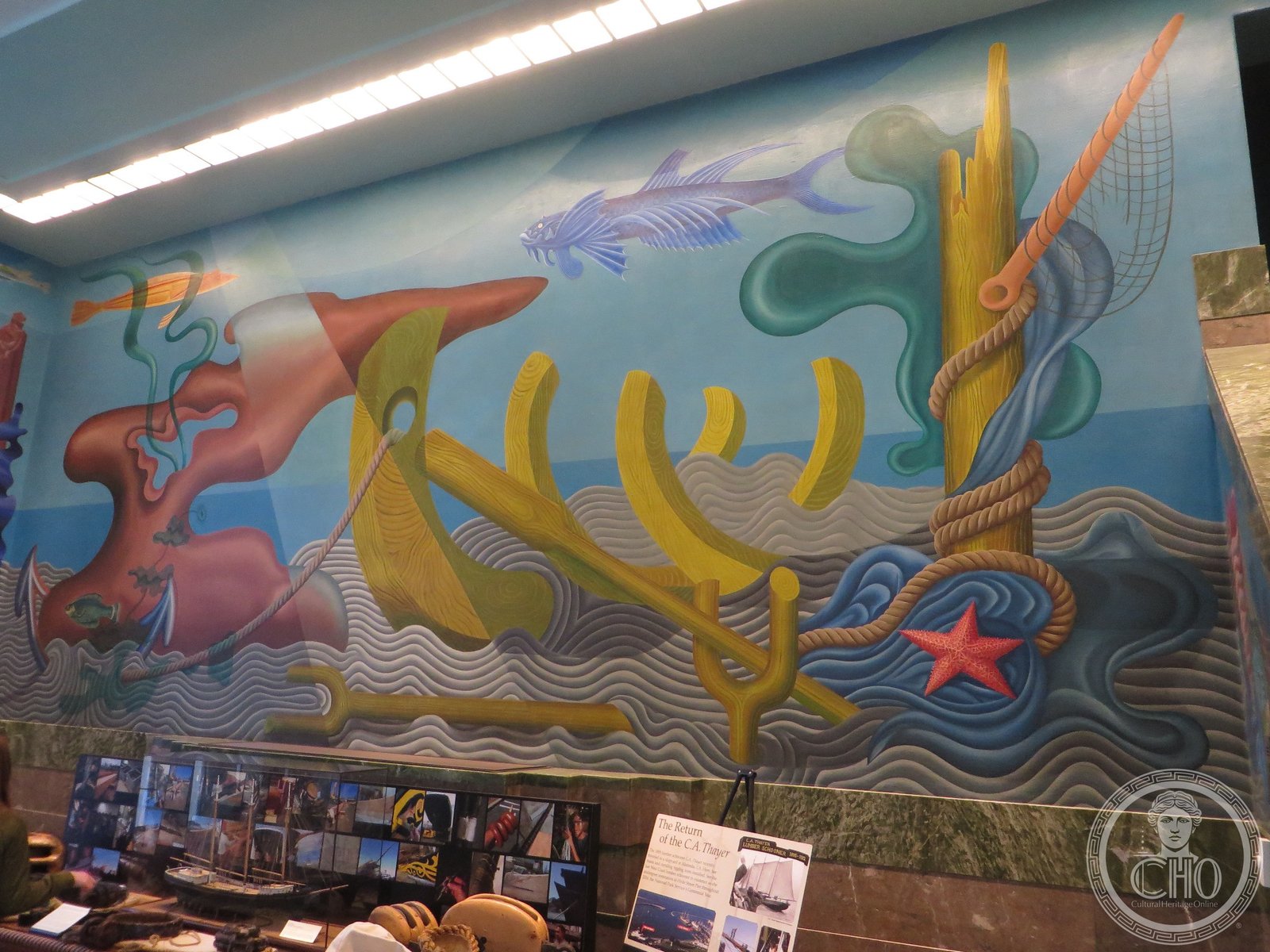
- Interior murals: WPA-commissioned murals by Hilaire Hiler (a marine mythology mural cycle) and others, completed 1939–1942.
- Current use: San Francisco Maritime National Historical Park visitor center and museum.
- Address: 900 Beach Street, San Francisco, CA 94109.
History
The Aquatic Park project was conceived in the mid-1930s as a public swimming and recreation facility for San Francisco — a beach-and-lagoon complex that would give working families access to the bay waterfront previously dominated by industrial piers. The WPA provided the labor and much of the funding; the city provided the land and the design oversight. William Mooser Jr., working within the WPA’s built architecture program, chose to make the bathhouse explicitly oceanic: a concrete structure whose curved forms, horizontal decks, and porthole windows would announce its function from a distance as clearly as a literal ship.
The building’s murals were commissioned as part of the Federal Art Project, the WPA division that employed visual artists during the Depression. Hilaire Hiler, a Paris-trained American painter and writer, created the dominant mural cycle — a marine mythology mural cycle — a sprawling underwater fantasia of sea creatures, Neptune figures, and marine mythology rendered in his signature flat-color style. Other FAP artists contributed smaller panels and decorative elements throughout the interior. The murals were completed between 1939 and 1942 and have been restored several times since, preserving one of the most intact WPA interior programs in California.
The bathhouse functioned as a public swimming facility until the 1970s, when the National Park Service assumed management and converted it to museum use. It is now the principal visitor center for the San Francisco Maritime National Historical Park, which encompasses the Hyde Street Pier and its fleet of historic vessels.
What you see
From the beach at Aquatic Park, the building reads as a white concrete ship anchored in the shallows — which is precisely what Mooser intended. The curved facade extends in a gentle arc facing the water, its three stories of horizontal bands punctuated by circular porthole windows and curved balconies that project like bridge wings over the beach. The nautical metaphor is not casual decoration: every design element reinforces it, from the rounded corners that suggest a ship’s hull to the stair towers at each end that function as smokestacks in the overall composition.
Inside, the Hiler mural cycle occupies the main hall — a room that runs the full width of the building at ground level, its curved walls covered in the artist’s underwater panorama. The creatures are stylized in the manner of Art Deco illustration — flattened, patterned, brilliant in color — and the overall effect is of being submerged in an imaginary deep-sea world, which was of course the intention. The Maritime National Historical Park’s exhibits occupy the upper floors, surrounding the visitor with models, charts, photographs, and artifacts of San Francisco’s maritime history.
Practical information
- Hours: Daily 10 am–4 pm (verify current hours with NPS, nps.gov/safr).
- Admission: Free to enter the bathhouse; fee applies to board the Hyde Street Pier vessels.
- Location: 900 Beach Street, at the end of Hyde Street, San Francisco.
- Swimming: Aquatic Park beach is open for open-water swimming year-round; the bay is cold (55–65°F) and popular with the Dolphin Club and South End Rowing Club, two historic San Francisco cold-water swimming organizations.
Getting there
The bathhouse is at the foot of Hyde Street, accessible via the Powell-Hyde cable car line (terminus at Hyde and Beach Streets, one block east). MUNI bus lines 19 and 47/49 serve the area. From downtown San Francisco, the walk from Fisherman’s Wharf is approximately 10 minutes along Beach Street. Parking in the immediate area is extremely limited; cable car, bus, or bicycle is strongly recommended.
Nearby
- Hyde Street Pier Historic Ships — The NPS-operated pier immediately east of the bathhouse, with six historic vessels open to visitors including the 1886 square-rigger Balclutha.
- San Francisco Art Institute, Chestnut Street — Acclaimed art school in North Beach with a Diego Rivera mural in its main gallery; approximately 15 minutes on foot from the bathhouse.
- Alcatraz Island — Federal penitentiary (1934–1963), now an NPS site; ferry service from Pier 33 at Fisherman’s Wharf, approximately 10 minutes from the bathhouse by foot.
- The Cannery (1907), Levi’s Plaza area — Historic Del Monte fruit cannery converted to a retail and restaurant complex in the 1960s; brick industrial architecture at the edge of Fisherman’s Wharf.
Sources
- National Park Service, San Francisco Maritime National Historical Park, nps.gov/safr.
- San Francisco Landmark Preservation Advisory Board, Aquatic Park Bathhouse designation documentation.
- Wikipedia, “Aquatic Park Historic District (San Francisco),” en.wikipedia.org/wiki/Aquatic_Park_Historic_District_(San_Francisco).
- Federal Art Project / WPA California records, Smithsonian Archives of American Art.
Find it on the map
See this place and what’s around it →Record researched and written by Luigi De Marchi for Cultural Heritage Online, 2026.
📷 Become a Cultural Heritage Online photographer
Share your photos of places: they stay published under your name as the author. The more they're seen, the more you get noticed — and soon a contest will reward the most appreciated photos.
Log in or sign up free to add a photoIs this page about you?
This page is read by travellers and heritage enthusiasts who find it on Google. Tell us how you are connected to this place and we will take it from there.