
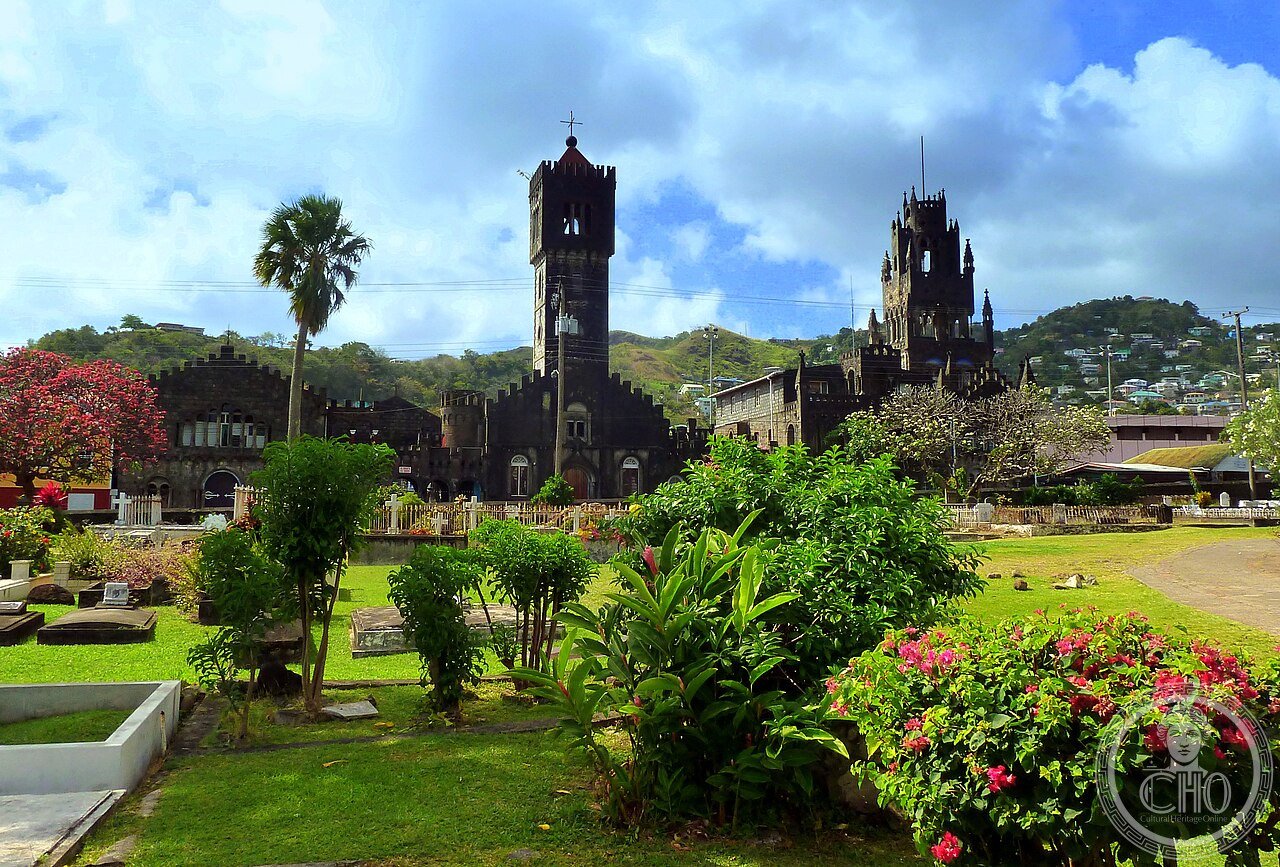
In Kingstown, the capital of Saint Vincent and the Grenadines, the French Jesuit priest Joseph Antoine Rendon arrived in 1815 to rebuild the Catholic presence on the island after decades of British repression. In 1823 he built and had consecrated the first church, in wood, on the site of the present cathedral. A tropical storm in 1875 severely damaged the wooden building and destroyed the adjoining cemetery. Father Farrelly rebuilt it in 1877, adding the bell tower, the towers and an enlarged sanctuary, while Father Collins later added a rectory and a school on acquired land. Between 1919 and 1946 (diocesan sources place the Benedictine administration of the parish between 1919 and 1957), the Belgian Benedictine monk Dom Charles Verbeke directed the great renovation that gave the cathedral its present eclectic appearance, described by the diocese itself as a combination of Flemish, Moorish, Venetian, Byzantine and Romanesque styles, not Gothic or Baroque, as some unreliable tourist sources sometimes wrongly report. A further two-wing extension was added in 1930, bringing the building, built according to some secondary sources in dark volcanic rock, to the essentially final form seen today. Among its best-known features are the “Tower of Our Lady”, about 30 metres high, which offers a view over the harbour, a courtyard with fountains, and panels of the Stations of the Cross collected, according to tradition, in Europe during the nineteenth century. The building’s capacity is not documented in any source. French Jesuit missionaries were present at Barrouallie as early as around 1653, while the formal French colonisation of the island dates from 1719. The Catholic clergy, who had returned with French immigrants from Martinique around 1710, were forced to leave when the British took control; the diocese places the expulsion in 1784, after the Treaty of Versailles of 1783, a break of about thirty years before the Catholic revival marked by Rendon’s arrival in 1815. On 17 March 1970 the Reverend Anthony Hampden Dickson was appointed bishop of the newly established diocese of Bridgetown-Kingstown, and the church of Kingstown became a co-cathedral. The diocese of Kingstown was later erected separately, according to Wikipedia and other sources on 23 October 1989 by Pope John Paul II, although the diocese’s official website instead gives January 1990, with full cathedral status acquired on 22 January of that year, a discrepancy between the sources that remains unresolved. The first bishop was Robert Rivas; the present bishop is Monsignor Gerard Maximin County, in office since 22 December 2015 and consecrated on 20 February 2016. The diocese, a suffragan of the archdiocese of Castries, in Saint Lucia, comprises six parishes. The only specific damage to the cathedral documented by the sources remains that of the storm of 1875. No damage specifically to the building is documented from the hurricane of 1898 or from the eruptions of the La Soufrière volcano in 1902 and 2021, which struck the city in general. No papal visit is documented, nor any confirmed heritage protection status for the building in the sources consulted.
About the Cathedral of the Assumption
In Kingstown, the capital of St. Vincent and the Grenadines, French Jesuit priest Joseph Antoine Rendon arrived in 1815 to rebuild the Catholic presence on the island after decades of British suppression, and in 1823 built and had consecrated the first church, a wooden building, on the site of today’s cathedral. A tropical storm in 1875 severely damaged the wooden building and destroyed its adjoining burial ground; Father Farrelly rebuilt it in 1877, adding the steeple, towers and an enlarged sanctuary, while Father Collins later added a presbytery and school on additional acquired land. Between 1919 and 1946 (diocesan sources place Benedictine administration of the parish 1919-1957), Belgian Benedictine monk Dom Charles Verbeke directed the major renovation that gave the cathedral its present eclectic look, described by the diocese itself as combining Flemish, Moorish, Venetian, Byzantine and Romanesque elements — not Gothic or Baroque, as some lower-quality tourism sources mistakenly claim.
Key facts
- 1823: the first wooden church built on the site by Father Joseph Rendon.
- 1875: a tropical storm destroys the wooden church and its burial ground.
- 1919-1930s: Dom Charles Verbeke layers in Flemish, Moorish, Venetian, Byzantine and Romanesque elements.
- 1970: the church becomes co-cathedral of the newly combined Diocese of Bridgetown-Kingstown.
- 1989/1990: the Diocese of Kingstown erected separately (sources disagree on the exact date).
- 22 December 2015: Bishop Gerard Maximin County appointed, the current bishop.
History
Built in successive stages across more than a century by different priests and builders, each adding their own preferred style, the Cathedral of the Assumption’s genuinely eclectic architecture is not a legend but a documented fact of its layered construction — from Rendon’s 1823 wooden church, through Farrelly’s 1877 rebuild, to Dom Charles Verbeke’s Flemish-Moorish-Byzantine renovation completed by the 1930s. Its history traces a Catholic community expelled from the island in 1784 and only re-established by Rendon three decades later, on an island whose Catholic minority remains small within a British-colonial religious landscape.
What you see
A genuinely mixed architectural vocabulary — Flemish, Moorish, Venetian, Byzantine and Romanesque elements layered together by successive builders — gives the cathedral a silhouette that contrasts sharply with the rest of Kingstown, its roughly 30-metre “Madonna Tower” offering harbor views. A courtyard with fountains and Stations of the Cross panels reportedly gathered from Europe in the 19th century furnish grounds built, according to secondary sources, from dark local volcanic rock.
Practical information
- Opening hours: generally open daily outside services; check current hours before visiting.
- Address: central Kingstown, St. Vincent and the Grenadines.
Getting there
The cathedral stands in central Kingstown, easily reached on foot from the city’s main commercial district. GPS: 13°09′32″N, 61°13′40″W.
Nearby
- Central Kingstown — the capital’s main commercial and administrative district.
Sources
- Wikipedia — “Assumption Cathedral, Kingstown” and “Roman Catholic Diocese of Kingstown” (en.wikipedia.org).
- Diocese of Kingstown — official site (catholicsvg.org).
- GCatholic.org — Diocese of Kingstown.
Find it on the map
See this place and what’s around it →📷 Become a Cultural Heritage Online photographer
Share your photos of places: they stay published under your name as the author. The more they're seen, the more you get noticed — and soon a contest will reward the most appreciated photos.
Log in or sign up free to add a photo