
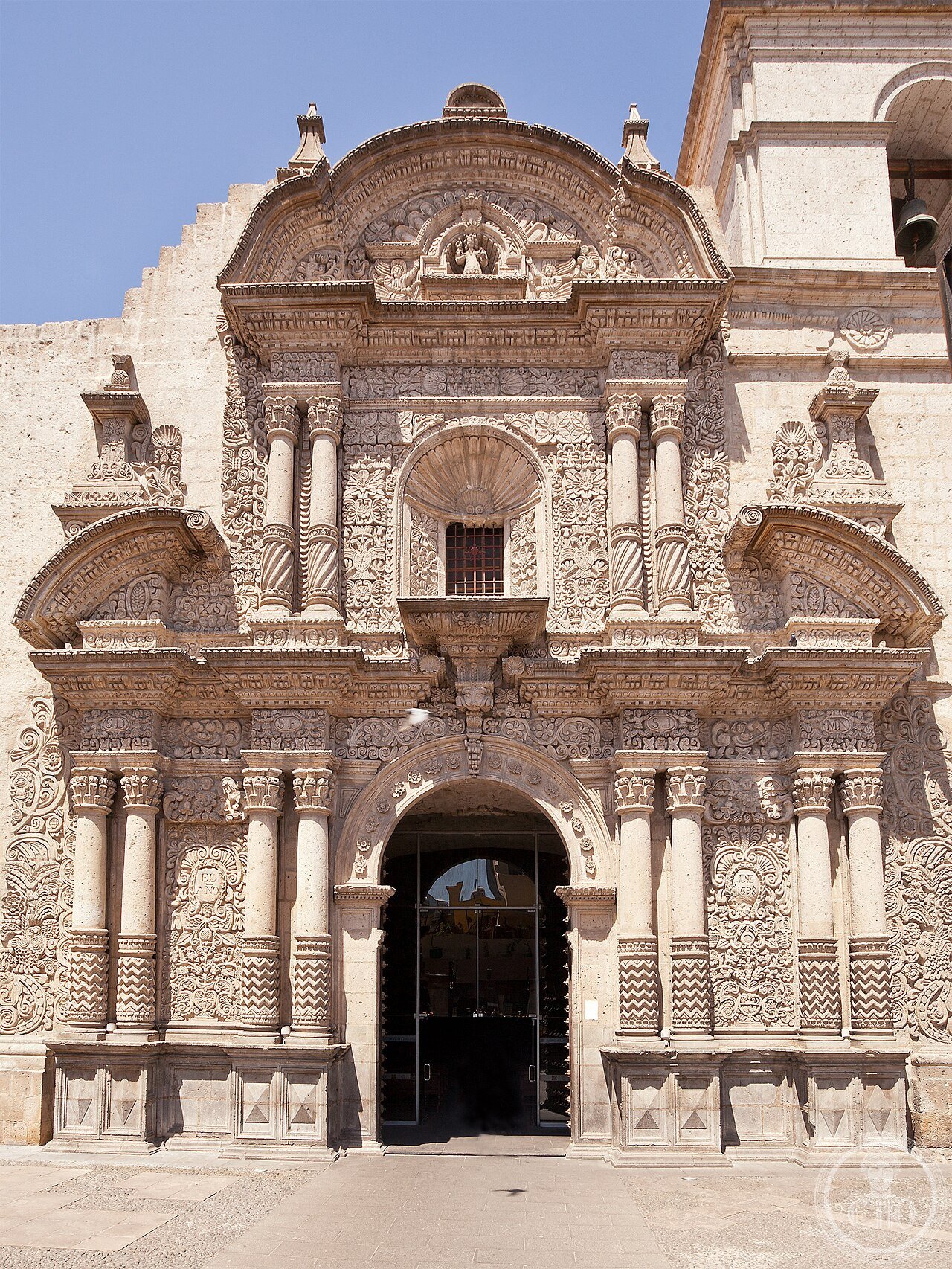
On the Plaza de Armas of Arequipa, in Peru, construction of the present church of the Society of Jesus began in 1590, after a first attempt, started in 1578 by the architect Gaspar Báez, was destroyed by the earthquake of 1582. A second earthquake, in 1687, damaged the building again, and its elaborate main façade was rebuilt and completed in 1698. The church is built entirely of sillar, the porous white volcanic stone, easy to carve, that gives Arequipa its nickname of “White City”. The façade is considered one of the fundamental examples, if not the example par excellence, of the so-called mestizo Baroque: a style that fuses European Baroque architectural structure with Andean and Indigenous decorative motifs, including tropical flora and fauna and figures such as mermaids, carved in low relief by criollo and Indigenous stonemasons who brought their own visual sensibility into it. Next to the church is the Chapel of St. Ignatius of Loyola, of the 17th century, popularly nicknamed the “Sistine Chapel of Arequipa”: its dome and walls are entirely covered with frescoes depicting an Amazonian jungle scene, with vines, tropical flowers, fruit and brightly coloured birds, a reflection of the Jesuit missionary presence in the Amazon. Together with the rest of the historic centre, the church forms part of the UNESCO World Heritage site “Historic Centre of the City of Arequipa”, inscribed in December 2000. The adjoining cloisters, of the 18th century, today house craft shops, jewellers and alpaca and vicuña boutiques.
About La Compañía de Arequipa
On Arequipa’s Plaza de Armas in Peru, construction of the current Church of the Society of Jesus began in 1590, after an earlier attempt, started in 1578 by the architect Gaspar Báez, was destroyed by the 1582 earthquake; a further earthquake in 1687 damaged the building again, and its elaborate main facade was rebuilt and completed in 1698. The church is built entirely of sillar, the porous white volcanic stone, easy to carve, that gives Arequipa its nickname “the White City.” The facade is regarded as one of the foundational, if not the definitive, examples of mestizo Baroque art: a style fusing European Baroque architectural structure with Andean and Indigenous decorative motifs, including tropical flora and fauna and figures such as mermaids, carved in low relief by criollo and Indigenous stonemasons who incorporated their own visual sensibilities into the Spanish architectural forms. Adjoining the church stands the 17th-century Chapel of Saint Ignatius of Loyola, popularly nicknamed “the Sistine Chapel of Arequipa”: its dome and walls are entirely covered in murals depicting an Amazonian jungle scene, with vines, tropical flowers, fruit and brightly coloured birds, reflecting the Jesuit order’s missionary presence in the Amazon. The church forms part, together with the rest of the historic centre, of the UNESCO World Heritage Site “Historic Centre of the City of Arequipa,” inscribed in December 2000. The adjoining 18th-century cloisters today house craft shops, jewellers and alpaca and vicuña boutiques.
Key facts
- 1590: construction of the present church begins, after an earlier attempt was destroyed by earthquake in 1582.
- 1698: the elaborate main facade rebuilt and completed after 1687 earthquake damage.
- Built of sillar, the white volcanic stone giving Arequipa its “White City” nickname.
- A landmark example of mestizo Baroque architecture and decoration.
- Chapel of Saint Ignatius of Loyola: a 17th-century Amazonian jungle-themed painted interior.
- 2000: becomes part of the UNESCO World Heritage Site “Historic Centre of the City of Arequipa”
History
La Compañía’s carved facade stands as one of the clearest surviving expressions of mestizo Baroque art, a colonial-era style in which Indigenous and criollo stonemasons reshaped European Baroque forms according to their own Andean visual traditions, producing a distinctive artistic language found nowhere else in quite the same form. The adjoining Chapel of Saint Ignatius’s jungle-themed murals extend this same fusion into paint, connecting Arequipa’s highland Jesuit community visually to the order’s missionary reach across the Amazon basin.
What you see
The church’s white sillar facade, completed in 1698, displays dense Baroque relief carving blending European architectural framing with Andean decorative motifs, a hallmark of the mestizo Baroque style. Inside, gilded altarpieces lead toward the adjoining Chapel of Saint Ignatius, its dome and walls covered in vivid murals of an Amazonian jungle scene unlike anything else in Arequipa’s colonial-era architecture.
Practical information
- Opening hours: generally open daily with seasonal variation; admission fee applies for some chapel areas; check current hours before visiting.
- Address: Plaza de Armas, Arequipa, Peru.
Getting there
La Compañía de Arequipa stands on the southeast corner of the Plaza de Armas, easily reached on foot within the historic centre. GPS: 16.4000° S, 71.5367° W.
Nearby
- Arequipa Cathedral — the city’s main cathedral, on the same square.
- Santa Catalina Monastery — the famous walled convent complex, a short walk away.
- Plaza de Armas de Arequipa — the historic city’s main square.
Sources
- Wikipedia (Spanish) — “Iglesia de la Compañía (Arequipa)” (es.wikipedia.org).
- UNESCO World Heritage Centre — “Historic Centre of the City of Arequipa” (whc.unesco.org).
- Encyclopaedia Britannica — “Latin American art — The Mestizo style” (britannica.com).
Find it on the map
See this place and what’s around it →📷 Become a Cultural Heritage Online photographer
Share your photos of places: they stay published under your name as the author. The more they're seen, the more you get noticed — and soon a contest will reward the most appreciated photos.
Log in or sign up free to add a photo