
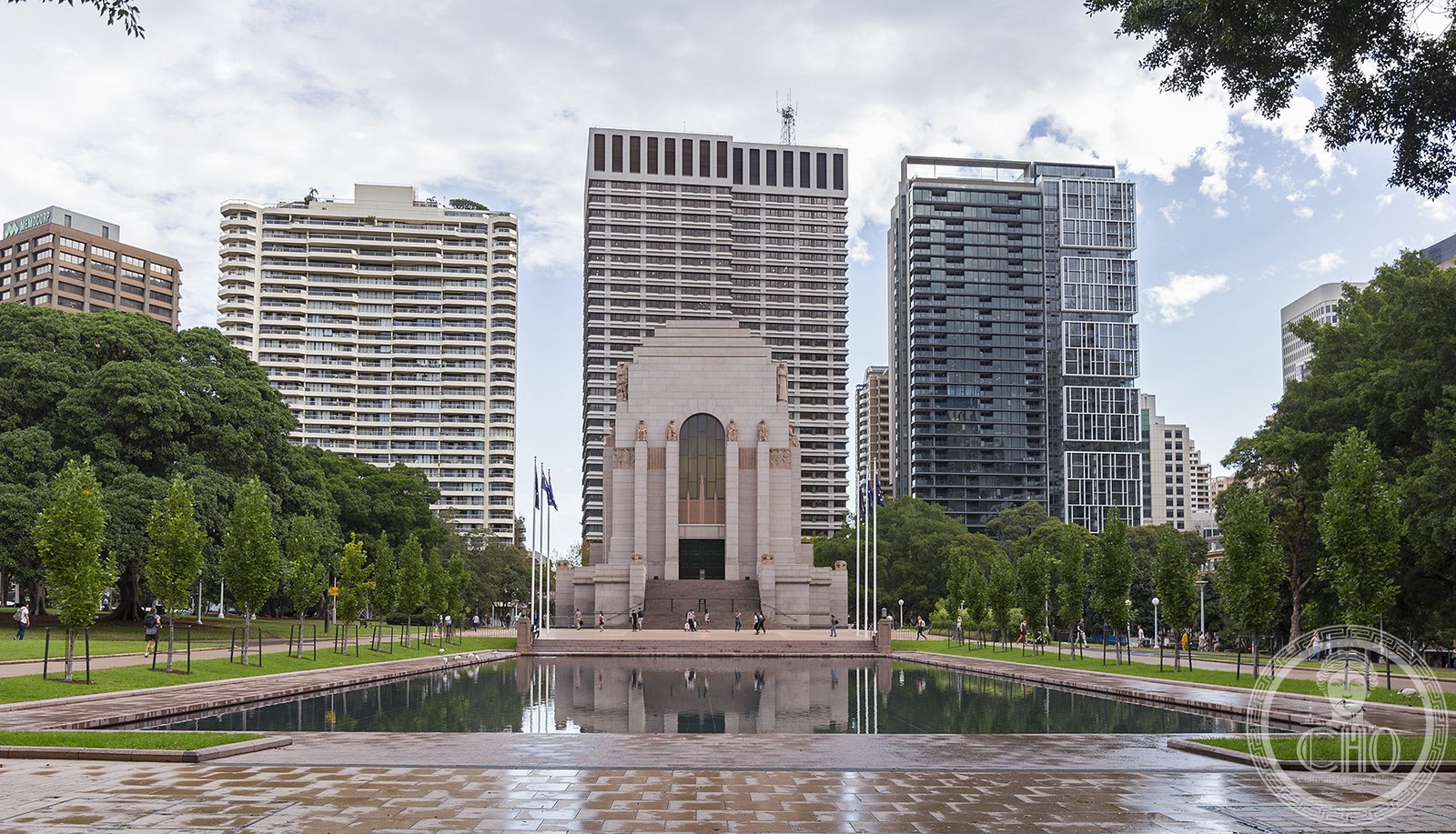
The Anzac War Memorial stands at the southern end of Hyde Park in Sydney, New South Wales, as Australia’s foremost Art Déco commemorative monument. Designed by architect C. Bruce Dellit and sculptor Rayner Hoff, the memorial was built between 1932 and 1934 and unveiled on 24 November 1934 before an estimated crowd of 100,000 people. Originally conceived to honour the Australian Imperial Force personnel lost in the First World War, it has since expanded in scope to commemorate all Australians who served in any conflict. Described by heritage authorities as the epitome of Art Déco in Australia, the memorial is listed on the New South Wales State Heritage Register. A major centenary extension, completed in 2018 at a cost of approximately 40 million Australian dollars, added significant new gallery and ceremonial space beneath the original building.
At a glance
- Type
- War memorial and museum
- Period
- 1932–1934 (unveiled 24 November 1934); centenary extension 2018
- Style
- Art Déco
- Location
- Hyde Park South, near Liverpool Street, Sydney CBD, NSW, Australia
- Coordinates
- 33.8756° S, 151.2108° E
- Architect(s)
- C. Bruce Dellit (architect); Rayner Hoff (sculptor)
Overview
The Anzac War Memorial occupies the southern end of Hyde Park, Sydney’s oldest public parkland, forming a visual terminus to the park’s central axis. The structure is composed of reinforced concrete clad externally in pink granite and incorporates a Pool of Reflection flanked by poplar trees to its north. Internally, the Hall of Silence at the centre of the building contains Rayner Hoff’s monumental bronze sculpture called Sacrifice, one of the most powerful works in Australian public art. The ceiling of the hall is inlaid with 120,000 gilded plaster stars, each representing a New South Wales man or woman who enlisted for service in the First World War. The 2018 underground extension substantially increased the memorial’s exhibition and ceremonial capacity.
History
Fundraising for a memorial to mark the First World War began on 25 April 1916, the first anniversary of the Gallipoli landing. A design competition was held; C. Bruce Dellit’s Art Déco scheme was selected. Construction proceeded from 1932, and the completed memorial was unveiled on 24 November 1934 in a ceremony attended by an estimated 100,000 people. Over subsequent decades, the memorial’s commemorative scope broadened to include all Australian conflicts. In 2018, following years of planning, the Centenary of Anzac extension project was completed, delivering a new lower ground floor with dedicated galleries, a Hall of Service, and improved visitor facilities, at a cost of approximately 40 million Australian dollars.
Architecture & Design
C. Bruce Dellit’s design for the memorial is a landmark of Australian Art Déco, combining the idiom’s characteristic geometry with deep symbolic content. The exterior presents a ziggurat-inspired stepped roofline in pink granite, lending the building a profile simultaneously ancient and modern. The interior is organised around the Hall of Silence, which rises through the full height of the original structure. Rayner Hoff’s bronze Sacrifice dominates the space: a heroic figural group depicting a fallen soldier on a shield held by three allegorical female figures. The vaulted ceiling above is studded with 120,000 gilded stars. Complex relief sculptures by Hoff extend across the building’s interior and exterior surfaces, creating a unified monument in which architecture and sculpture are inseparable.
Cultural significance
The Anzac War Memorial is considered the defining Art Déco monument in Australia and an outstanding example of architect-sculptor collaboration in the international modernist tradition. Its listing on the New South Wales State Heritage Register in 2010 formalised a significance long recognised by heritage specialists. For Australians, it carries profound emotional weight as the primary place of remembrance for those lost in the First World War and in subsequent conflicts. The annual Anzac Day commemorations held at the memorial on 25 April draw thousands of participants and are among the most significant public ceremonies in New South Wales, reinforcing the building’s role as a focal point of collective memory.
Visiting today
The Anzac War Memorial is open daily (excluding Christmas Day) and admission is free. The building houses permanent and temporary exhibitions exploring the experiences of Australian servicemen and women across multiple conflicts. The Hall of Silence and Rayner Hoff’s sculpture remain the central focus of any visit. A dedicated education programme serves school groups and visiting delegations. The Pool of Reflection in the adjacent Hyde Park landscape provides a quiet place for individual contemplation. The centenary-extension galleries, accessed from the lower ground floor, provide additional exhibition and ceremonial space.
Getting there
The Anzac War Memorial is located at the southern end of Hyde Park, Sydney CBD, near the corner of Elizabeth Street and Liverpool Street. Museum Station on the T8 Airport and South line is the closest heavy rail stop, with a short walk through Hyde Park to the memorial. St James Station on the same line also provides access via the park’s northern entrance. Multiple bus routes serve Elizabeth Street and Liverpool Street. The memorial is within comfortable walking distance of Central Station and the Town Hall precinct, making it easily reachable from all parts of the city.
Sources & resources
Find it on the map
See this place and what’s around it →Record researched and written by Luigi De Marchi for Cultural Heritage Online, 2026.
📷 Become a Cultural Heritage Online photographer
Share your photos of places: they stay published under your name as the author. The more they're seen, the more you get noticed — and soon a contest will reward the most appreciated photos.
Log in or sign up free to add a photoIs this page about you?
This page is read by travellers and heritage enthusiasts who find it on Google. Tell us how you are connected to this place and we will take it from there.