

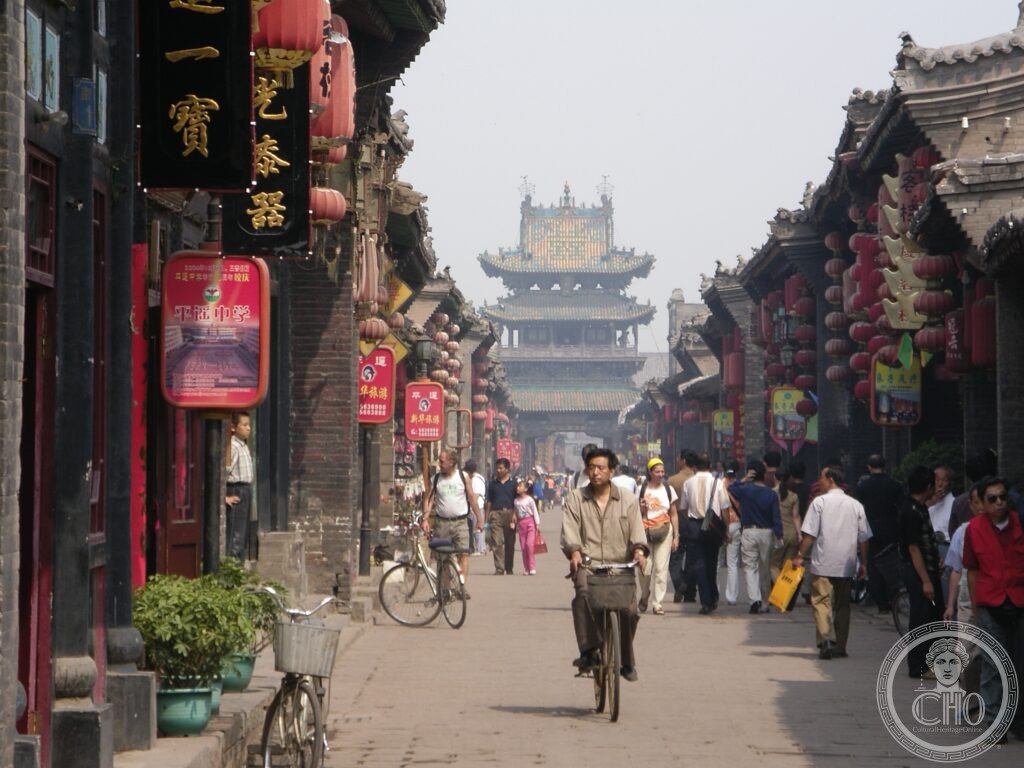
The most completely preserved walled city from the Ming dynasty in China and the unlikely financial capital of 19th-century imperial China. Ping Yao (平遥), a county town of 40,000 people in Shanxi Province, contains the most intact surviving Ming-dynasty city wall, street plan, and courtyard house fabric in China, and was the birthplace of the piaohao draft banking system that handled half the empire’s financial transactions for most of the 19th century.
At a glance
Ping Yao lies in the Fen River valley of Shanxi Province, 90 km south of Taiyuan (the provincial capital) and 610 km south-west of Beijing. The walled city is approximately 2.25 km east to west and 1.78 km north to south. It is completely surrounded by its Ming-dynasty walls and contains a population of approximately 40,000 (the residential population inside the walls). The essential visit covers the wall walk (6 km circuit), three or four of the principal historical monuments (the Rishengchang bank, the Yamen, the City God Temple, the Confucian Temple), and a walk along the South Street commercial axis. A half-day is sufficient for the highlights, a full day allows for the best courtyard house hotels and a complete exploration.
Key facts
- The city walls (1370 AD, Ming dynasty; current extent from 1563 AD enlargement): the best-preserved ancient city walls in China. The walls have a total circuit of 6,163 metres (approximately 6 km) and stand 12 metres high with a base width of approximately 8 metres. They were built by the first emperor of the Ming dynasty (the Hongwu Emperor) and subsequently modified and enlarged in 1370–1382. The walls have 72 watchtowers (symbolically corresponding to the 72 disciples of Confucius), 6 main gates (each with a defensive barbican), and 3,000 crenellations (corresponding to the 3,000 disciples of Confucius in the broader tradition). The entire wall circuit can be walked (a 6 km walk at the top of the wall offering continuous views over the old city roofscape and the surrounding Fen River plain). The wall is in remarkable condition for its age, having been maintained continuously from the Ming dynasty to the present.
- The Rishengchang Exchange Shop (日升昌票号, 1823): the birthplace of Chinese banking and the first institution offering inter-city money transfer in China. The Rishengchang (Rising Sun Prosperity) draft bank was founded in 1823 by Lei Lutai (雷履泰), a shrewd manager of the Xiyucheng Dye Shop (a Ping Yao commercial house with branches throughout China). In response to the dangers of transporting large quantities of silver (the standard currency of the Qing dynasty) across bandit-infested roads, Lei devised a system of “flying money” (feiqian, 飛錢): a depositor would deliver silver to the Rishengchang branch in one city and receive a draft certificate (piaohao). The certificate could be redeemed for silver at any other Rishengchang branch. The system eliminated the need to transport physical silver and allowed merchants and the government to transfer funds rapidly. The concept spread: by 1850 there were approximately 22 piaohao banks in Ping Yao and hundreds of branches throughout China. At their peak (approximately 1870–1890), the Ping Yao piaohao banks collectively handled approximately 50% of all financial transactions in China (the Qing government relied on them to transfer provincial tax revenues to Beijing). The Rishengchang building is preserved as a museum of Chinese financial history.
- The County Yamen (平遥县衙, founded 1346; current buildings 17th–19th century): the oldest and most completely preserved county government office in China. The Yamen (衙門, the official residence and office of the county magistrate) was the physical embodiment of Chinese imperial administration at the local level. The Ping Yao Yamen was founded in 1346 (Yuan dynasty) on the site of an earlier office and rebuilt and expanded in the Ming and Qing dynasties. It is the only county-level Yamen in China to survive intact with its complete complement of buildings (the gate complex, the drum tower, the court of public hearing, the magistrate’s private apartments, the granary, the prison, and the rear garden). The building complex allows visitors to understand the entire operation of a Chinese county administration in the Qing dynasty period.
- The Confucian Temple (文庙, 1163, Northern Song dynasty): one of the oldest intact Confucian temples in China, with the tallest surviving Ming-dynasty Confucian temple tower (Kuixing Tower, 17 metres). The Confucian Temple (Wenmiao) was established in 1163 and has been continuously maintained. The current main hall (Dacheng Hall) dates from the Song dynasty. The front courtyard has a forest of ancient cypress trees.
- Heritage: UNESCO World Heritage Site, Ancient City of Ping Yao, inscribed 1997.
- GPS: 37.1928° N, 112.1763° E.
History
Ping Yao was founded as a settlement in the Western Zhou dynasty (approximately 800 BC). The first walls are recorded in documents of the Zhou period. The current stone and brick walls date from 1370 (first year of the Hongwu reign, Ming dynasty). The city was enlarged and the walls rebuilt in their current form between 1370 and 1382. The financial revolution of the piaohao banking system began 1823 with the Rishengchang. The city reached its commercial peak approximately 1870–1906. The piaohao system collapsed when the Qing dynasty fell in 1912, modern banking arrived, and the Ping Yao merchants could not adapt. The city declined economically. Paradoxically, the economic decline preserved the urban fabric (there was no capital for demolition and rebuilding). UNESCO inscription 1997.
What you see
Begin at the South Gate (the main entrance from the new city, passing through the double gate barbican — a defensive structure requiring attackers to pass through two successive gates with a killing ground between). Walk the South Street (Ming Qing Jie, the main commercial axis running north from the South Gate to the Market Tower/Shilou; the street is lined with traditional Shanxi merchant buildings — two-storey brick-and-tile siheyuan facades with elaborately carved wooden shopfronts — and is the most photogenic streetscape in the city). The Market Tower (Shilou, the octagonal watch tower at the crossing of the main north-south and east-west axes, used both as a market bell tower and as a watchtower). The Rishengchang Exchange Shop (follow signs east from South Street; the original 19th-century bank interior, with the vault room, the manager’s office, the safe deposit room, and the ledgers and account books of the 19th-century financial transactions, is preserved). The County Yamen (the complete magistrate’s office compound in the western part of the city). And the wall walk (the most rewarding single experience: the entire 6 km circuit takes approximately 1.5 hours at walking pace).
Practical information
- Admission: a combined ticket (全景门票) covers approximately 20 attractions inside the walls including the wall walk, all major temples, the Yamen, and the Rishengchang bank. Approximately ¥150 RMB (approximately €20). The ticket is sold at the South Gate and at other entrance points. The wall walk and the South Street commercial area are additional outdoor spaces freely accessible. Overnight accommodation inside the walls is strongly recommended (several excellent traditional courtyard house hotels, the best of which are converted piaohao banker residences with carved wooden courtyards). The best light for photography is early morning before 8am or late afternoon after 4pm.
- Getting there: from Beijing by high-speed train: approximately 2h to Taiyuan South Station (there is no direct train to Ping Yao; take the high-speed from Beijing West to Taiyuan South, then the slower train to Ping Yao station, total approximately 3h 30min). From Taiyuan by train: approximately 1h on slower trains to Ping Yao station (the old train station is just outside the old city wall — a 5-minute walk to the South Gate). From Xi’an: approximately 3h by high-speed train to Taiyuan, then 1h to Ping Yao. By car from Taiyuan: 90 km (1h via G5 expressway).
- The Shanxi merchant heritage circuit: Ping Yao is the anchor of a heritage circuit in Shanxi Province that covers the residence of the famous Wang Family (Wangjiazhuang; 25 km east of Ping Yao; the most elaborate traditional courtyard house complex in Shanxi, built by the Wang family of merchants during the Qing dynasty over 250 years; comprising 123 courtyards, 1,118 rooms, and more than 5,000 woodcarvings, stone carvings, and brick carvings), the Qiao Family Compound (Qiaojiayuan, Qi County; 30 km north of Ping Yao; the residence of the Qiao family of piaohao bankers; used as the primary filming location for Zhang Yimou’s “Raise the Red Lantern” (大红灯笼高高挂, 1991), the most internationally celebrated Chinese film of the decade).
Getting there
From Beijing by high-speed train to Taiyuan (2h), then slow train to Ping Yao (1h). From Xi’an to Taiyuan (3h), then 1h. Car from Taiyuan (90 km, 1h). GPS: 37.1928, 112.1763.
Nearby
- Yungang Grottoes, Datong. 370 km north of Ping Yao (3h by train via Taiyuan). The most important Buddhist cave art site in China and one of the three great rock-carved Buddhist complexes of the world (alongside Ajanta in India and Longmen in Luoyang). The Yungang Grottoes (云冈石窟) were excavated between 460 and 525 AD at the behest of the Northern Wei emperor Wenchengdi. There are 53 major caves and approximately 51,000 figures. The largest cave contains a Buddha image 14 metres high. Cave 20 (the most photographed; the seated Buddha of Cave 20, 13.7 metres high, is one of the supreme masterpieces of Chinese Buddhist sculpture, combining the Gandharan sculptural tradition imported from Central Asia via the Silk Road with the emerging Chinese stylization of the Northern Wei period). UNESCO WHS 2001. See separate CHO place card.
- Longmen Grottoes, Luoyang. 490 km south of Ping Yao (4h by train via Zhengzhou or Xi’an). The Tang-dynasty continuation of the great Chinese Buddhist rock-carved tradition. The Longmen Grottoes (龙门石窟) were carved between 495 and 900 AD on the limestone cliffs flanking the Yi River near Luoyang. They contain approximately 100,000 Buddhist figures in 2,345 caves and niches. The Fengxian Temple (completed 676 AD) is the largest and most important complex, housing the colossal 17.14-metre-high Vairocana Buddha flanked by bodhisattvas, disciples, and heavenly kings in one of the finest ensemble sculptural compositions of Tang-dynasty art. The figure was commissioned by Empress Wu Zetian (624–705 AD, the only woman in Chinese history to have ruled as emperor in her own name) and the face of the central Buddha is traditionally said to be a portrait of the Empress. UNESCO WHS 2000. See separate CHO place card.
- Mount Wutai (五台山), Shanxi. 250 km north-east of Ping Yao (3h by car). The most sacred mountain in Chinese Buddhism and the residence of Mañjuśrī (the Bodhisattva of Wisdom) in the Chinese Buddhist tradition. The Wutai mountain complex (five table-top peaks; the highest, Beitai, is 3,061 metres) has been a site of Buddhist pilgrimage since the 4th century AD. It contains approximately 53 Buddhist monasteries (including some of the oldest surviving timber-framed buildings in China) clustered around the village of Taihuai. Foguang Temple (857 AD, Tang dynasty) is the oldest and best-preserved wooden structure in China. UNESCO WHS 2009.
Sources
- Wikipedia, Pingyao. Rishengchang Exchange Shop. Piaohao, accessed June 2026.
- UNESCO, Ancient City of Ping Yao, WHS reference 812, inscribed 1997.
- Randall Peerenboom, China’s Long March toward Rule of Law, Cambridge University Press, 2002 (Chinese legal and administrative context).
- Andrea McElderry, Shanghai Old-Style Banks (Ch’ien-chuang), 1800–1935, Michigan Papers in Chinese Studies, 1976.
Find it on the map
See this place and what’s around it →📷 Become a Cultural Heritage Online photographer
Share your photos of places: they stay published under your name as the author. The more they're seen, the more you get noticed — and soon a contest will reward the most appreciated photos.
Log in or sign up free to add a photo