
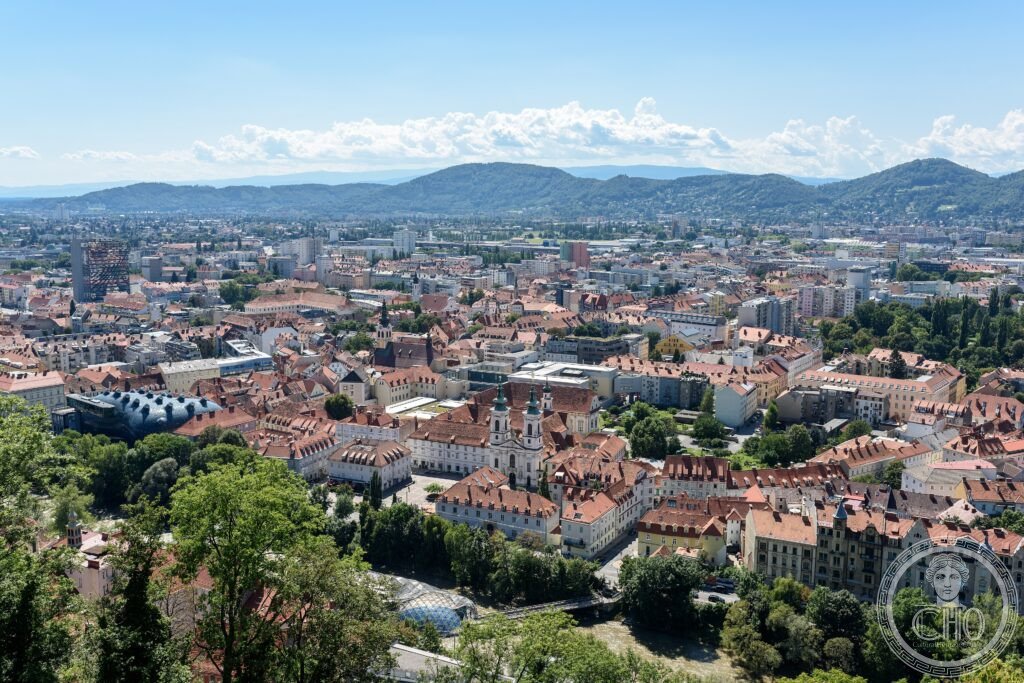
Austria’s most architecturally layered historic city and the largest surviving Renaissance city centre in the German-speaking world. Graz, the capital of Styria and Austria’s second city, rose to prominence as the residence of the Inner Austrian branch of the Habsburg dynasty in the 16th century. The 1 km² Altstadt (Old Town) accumulated a dense sequence of Gothic, Renaissance, and Baroque buildings that includes the finest Renaissance courtyard in Austria (the Landhaus) and the most extraordinary armory in the world (the Landeszeughaus, with 32,000 pieces of weapons and armour intact).
At a glance
Graz (population approximately 300,000) is the capital of the Austrian province of Styria (Steiermark) and Austria’s second-largest city, 200 km south-west of Vienna. The historic centre (the Altstadt, inscribed on the UNESCO list) covers approximately 1 km² on the left (west) bank of the Mur river, dominated by the Schlossberg hill (a natural basalt hill 473 metres high, rising directly above the old town). The city has an active university population (approximately 65,000 students) that gives it a more youthful energy than Austria’s other heritage cities. It also has an excellent restaurant scene and an important contemporary art museum (the Kunsthaus Graz, known as the “Friendly Alien” for its biomorphic blob shape, by Peter Cook and Colin Fournier, 2003).
Key facts
- The Landhaus (1557–1565): the most important Renaissance secular building in Austria and the seat of the Styrian Parliament since its construction. The Landhaus was built between 1557 and 1565 by the Italian architect Domenico dell’Allio for the Styrian Estates (the Styrian Landtag, or provincial parliament, which required a permanent building after decades of meeting in temporary locations). The building takes the form of a large Renaissance palace around an arcaded courtyard (the cortile). The courtyard (the Innenhof) is the finest Renaissance courtyard in the German-speaking world: three storeys of loggia arches in Tuscan, Ionic, and Corinthian orders surround the rectangular space. In summer the courtyard is used for open-air concerts and theatrical performances. The Styrian parliament has occupied the building continuously since 1565 (over 460 years of unbroken parliamentary use). The Landhaus also houses the magnificent Rüstkammer (the original weapons collection of the Styrian Estates, now absorbed into the adjacent Landeszeughaus).
- The Arsenal / Landeszeughaus (1642–1645): the largest surviving Renaissance arsenal in the world and the most extraordinary military collection in Europe. The Landeszeughaus was built between 1642 and 1645 by the architect Antonio Solar during a period of intense warfare with the Ottoman Empire, to stockpile weapons and armour for the defence of Styria. The building is four storeys tall with approximately 5,000 m² of storage space. It houses approximately 32,000 weapons and pieces of armour including: approximately 3,000 suits of full plate armour for cavalry (the most complete collection of 17th-century full plate armour in the world), 7,500 firearms (including extraordinary decorated firearms of the 16th and 17th centuries), 3,000 swords, and 550 artillery pieces (including a mortar claimed to be the largest 17th-century mortar in the world). The arsenal was completely filled and then sealed after the peace with the Ottomans in 1699. When the Empress Maria Theresa ordered the arsenal contents to be melted down and used for the industrial revolution (1749), the Styrian Estates refused. The contents have remained essentially unchanged since 1699, making the Landeszeughaus a time capsule of Central European military technology of the 17th century.
- The Schlossberg and the Clock Tower (Uhrturm, first documented 1265): the symbol of Graz and one of the most distinctive architectural quirks in Europe. The Schlossberg (castle hill; the original castle was demolished by Napoleon in 1809 under the terms of the Treaty of Schönbrunn, except for the Clock Tower and the Bell Tower which Graz’s citizens paid a ransom to preserve) is a dramatic basalt hill rising 123 metres above the old city. At the summit stands the Uhrturm (Clock Tower), a squat cylindrical tower with an enormous clock face on which the hour and minute hands are the opposite of what one would expect: the larger (longer) hand indicates the hours and the smaller (shorter) hand indicates the minutes. This apparently illogical arrangement dates from the original construction of the clock as a single-hand clock (showing hours only; the minute hand was added later but was made the smaller one to avoid covering the original large hour hand).
- The Mausoleum of Emperor Ferdinand II (1614–1636): the finest early Baroque building in Graz and one of the most important early Baroque religious buildings in the Habsburg lands. Ferdinand II (Holy Roman Emperor r. 1619–1637) was the most important patron of the Counter-Reformation in the Habsburg lands. He had been Archduke of Inner Austria (with Graz as his capital) before becoming Holy Roman Emperor. He commissioned the mausoleum from the Mannerist-turned-Baroque architect Giovanni Pietro de Pomis starting in 1614. The building combines a funerary church (with an interior in the full Baroque style: ceiling fresco, gilded stucco, coloured marble columns) with a mausoleum crypt housing the remains of Ferdinand II and his relatives. The exterior dome and the gateway portico are the finest early Baroque forms in Graz.
- Heritage: UNESCO World Heritage Site, City of Graz. Historic Centre and Schloss Eggenberg, inscribed 1999 (Eggenberg Palace added 2010).
- GPS: 47.0707° N, 15.4395° E.
History
The Schlossberg has been fortified since at least the 12th century. Graz became the capital of the Duchy of Styria in the 12th century. It was residence of the Inner Austrian branch of the Habsburgs (Archdukes of Inner Austria: Ferdinand I, later Holy Roman Emperor; Maximilian, later Archduke; Ferdinand II, later Holy Roman Emperor; Ferdinand III) from 1564 to 1619. The Landhaus was built 1557–1565. The Arsenal 1642–1645. The Mausoleum 1614–1636. The Eggenberg Palace 1625–1673. The Baroque transformation of the city continued through the 17th and early 18th centuries. Napoleon besieged the Schlossberg in 1809 and demolished the castle (retaining only the Clock Tower and Bell Tower after the citizens paid a ransom in cash). UNESCO inscription 1999.
What you see
The Hauptplatz (main square) is the geographical and commercial centre of the old town. From here walk Herrengasse north to the Landhaus (identified by the loggia facade visible from the street; the Innenhof courtyard is open and free to visit during business hours). Walk east on Herrengasse to the Landeszeughaus (Arsenal; the entrance is on the Herrengasse; the four-storey interior with arms stacked to the ceiling is one of the most visually dramatic rooms in Europe; allow 1 hour). North of the Hauptplatz: the Cathedral of Graz (Dom; 15th-century Gothic exterior; rich Baroque interior including a famous painted altar by the Master of Graz and the only surviving coffin panels from a medieval triumphal processional coffin). The Mausoleum of Ferdinand II (adjacent to the Dom; the most interesting Baroque interior in the city). Then take the Schlossberglift (glass elevator through the rock) or Schlossbergbahn (funicular) to the Schlossberg for the Clock Tower and the panoramic view over the old city.
Practical information
- Admission: the Landeszeughaus Arsenal: approximately €12 adult (the single most important attraction; essential; book in advance in summer). The Schlossberg: the open-air areas are free. The funicular and lift cost approximately €3 (but there are also free stairs). The Landhaus courtyard is free to visit during business hours. Eggenberg Palace (in a park 10 min by tram from the centre): approximately €14 adult for palace + apartments + park. A combined Styrian Universalmuseum ticket covers several of the major collections. Good restaurants and wine bars concentrated on the Mehlplatz and Färbergasse. The Schilcher wine (a rosé made from the Blauer Wildbacher grape, grown only in western Styria, and producing a brilliantly acidic wine with a vivid raspberry-pink colour unlike any wine in Austria or Germany) is the regional speciality.
- Getting there: from Vienna by train: approximately 2h 30min by Railjet (several daily services from Vienna Hauptbahnhof to Graz Hauptbahnhof). By car from Vienna: 200 km south-west via A2 (2h). From Salzburg by train: approximately 3h. From Zagreb (Croatia): approximately 2h by train. From Ljubljana (Slovenia): approximately 3h by train. Graz has an international airport (Graz Airport; approximately 15 min by bus from the centre) with direct flights to several European cities.
- The Styrian Wine Road and the South Styrian Vineyard Landscape: the hills south of Graz (the Südsteirische Weinstraße, South Styrian Wine Road) constitute the most scenically striking wine-growing landscape in Austria. The landscape of undulating vine-covered hills (locally described as the “Austrian Tuscany”) produces the Sauvignon Blanc, Welschriesling, and Morillon (Chardonnay) wines that are Styria’s most critically acclaimed. The wine road village of Gamlitz and the hamlet of Kitzeck im Sausal (the highest wine-growing village in Austria, 560 metres altitude) are the most popular destinations on the circuit. The Buschenschank (a traditional Styrian wine tavern allowed to sell only its own wine plus simple cold food — cold meats, smoked meats, cheese, bread) is the best way to experience South Styrian viticulture.
Getting there
From Vienna by Railjet train (2h 30min). By car from Vienna (200 km, 2h via A2). From Salzburg (3h). From Ljubljana (3h). GPS: 47.0707, 15.4395.
Nearby
- Eggenberg Palace (Schloss Eggenberg). 4 km west of Graz old town (10 min by tram, line 1). The most important Baroque palace in Styria and one of the finest Baroque palace complexes in Austria. Eggenberg Palace was built between 1625 and 1646 for Hans Ulrich von Eggenberg (Duke of Krumau, President of the Inner Austrian Government, and the most powerful man in Styria after the Emperor). The architect was Pietro de Pomis (the same architect as the Mausoleum of Ferdinand II). The palace is famous for its symbolism of cosmic order: 365 windows (one for each day of the year), 24 state rooms (one for each hour of the day), 4 towers (one for each season), and 31 doorways in the main apartment (the days of the longer months). The state apartments (the grandest rooms are the Planetary Room, the Gold Room, and the hunting trophy room with 250+ years of Eggenberg trophies) are among the finest Baroque interiors in Styria. UNESCO WHS (as an extension of the historic centre inscription) 2010.
- Klagenfurt am Wörthersee. 90 km south-west of Graz (1h by car or train). The capital of Carinthia (Kärnten) and the most important city on the Wörthersee (the largest lake in Austria, 20 km long and 4 km wide, with water temperatures reaching 28°C in summer; the Austrian Riviera). The historic centre of Klagenfurt (a 16th-century Renaissancestadt planned on a grid) is anchored by the Lindwurm fountain (1593; the most important Renaissance fountain in Austria; carved from a single block of chlorite schist weighing 37 tonnes; representing a mythological dragon killed by the founder of Klagenfurt). The Carinthian Landesmuseum has one of the most important prehistoric collections in Austria (including the Hallstatt period finds from the Carinthian lakes).
- Maribor, Slovenia. 55 km south of Graz (45 min by car or train). The second-largest city of Slovenia and an important wine city. Maribor (German: Marburg an der Drau) stands at the confluence of the Drava river and the wine-producing hills of Podravska. The Old Vine (Stara trta) in Maribor is officially the oldest still-productive grapevine in the world (approximately 400 years old; a Modra kavčina vine near the Drava; certified as “The Oldest Vine in the World” by Guinness World Records). The castle of Maribor (Mariborski Grad, 15th century) houses the Maribor Regional Museum. The city is also the location of the A1 Men’s Slalom World Cup ski race on the Pohorje mountain (the “Golden Fox” race).
Sources
- Wikipedia, Graz. Landhaus, Graz. Landeszeughaus. Mausoleum of Ferdinand II, Graz. Uhrturm, Graz, accessed June 2026.
- UNESCO, City of Graz. Historic Centre and Schloss Eggenberg, WHS reference 931, inscribed 1999 / extended 2010.
- Burkhard Wöess, Graz. A Guide to the Historic City Centre, Styrian Provincial Museum, 2008.
- Jochen Ramharter, Das Landeszeughaus in Graz, Universalmuseum Joanneum, 2012.
Find it on the map
See this place and what’s around it →
📷 Become a Cultural Heritage Online photographer
Share your photos of places: they stay published under your name as the author. The more they're seen, the more you get noticed — and soon a contest will reward the most appreciated photos.
Log in or sign up free to add a photo