

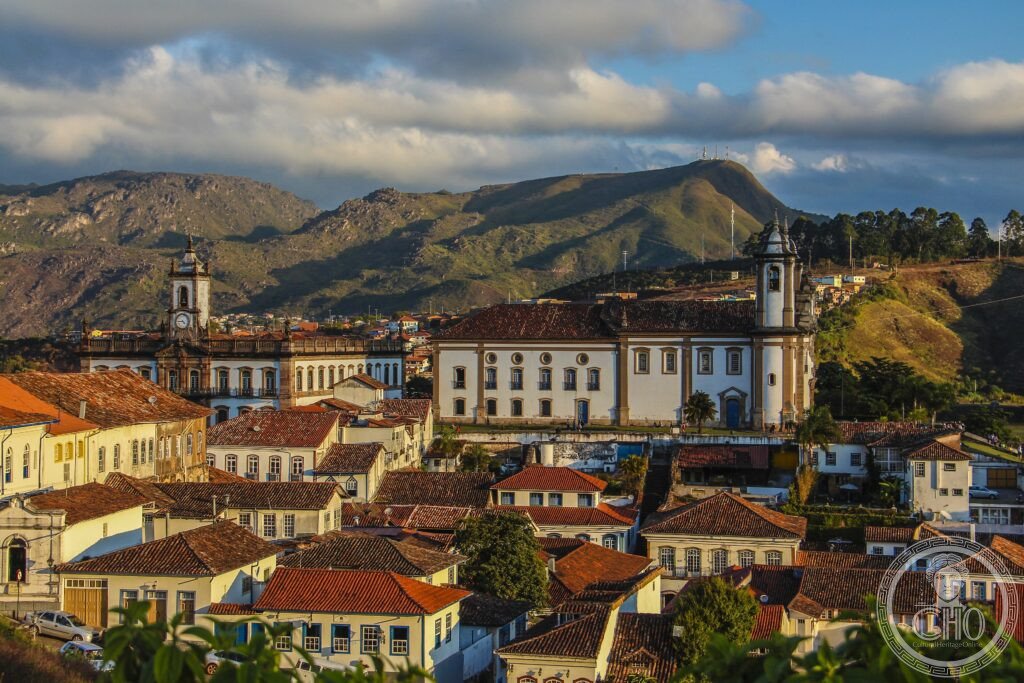
The most spectacular colonial Baroque city in the Americas and the greatest monument to the Brazilian gold rush. Ouro Preto (Black Gold), capital of the Brazilian province of Minas Gerais during its gold and diamond heyday (c. 1698–1780), accumulated the wealth of the richest ore deposits in 18th-century South America and spent it on 13 extraordinary Baroque churches, executed in the native dark soapstone (pedra-sabão) by the genius of Aleijadinho. An Afro-Brazilian sculptor who worked despite advancing leprosy and left the finest colonial sculptural programme in the western hemisphere.
At a glance
Ouro Preto (population approximately 75,000) is 100 km south of Belo Horizonte and 500 km north of São Paulo, in the Serra do Espinhaço mountains of Minas Gerais at an altitude of approximately 1,100 metres. The historic centre is compact (the essential churches, squares, and museums are within 1–2 km of the central Praça Tiradentes) but the terrain is extremely steep. Comfortable walking shoes with grip are essential. The city is easily reached from Belo Horizonte (the capital of Minas Gerais) and makes an ideal base for exploring the surrounding historic gold towns of Mariana, Tiradentes, Congonhas, and Diamantina.
Key facts
- The Brazilian gold rush (c. 1695–1800): the largest gold rush in history until the California gold rush of 1848. Gold was first discovered in the streams of the Serra do Espinhaço mountains by the Bandeirantes (Portuguese-Brazilian explorers and slavers) approximately 1695. The news spread rapidly. By 1710 approximately 30,000 people had arrived in the region (now Minas Gerais — “General Mines”). By 1750 the population of the Minas Gerais captaincy was approximately 300,000 (making it the most populous region of Brazil). The gold town of Ouro Preto (originally called Vila Rica, “Rich Town”) grew to approximately 80,000–100,000 inhabitants by 1750, making it larger than any city in North America, larger than any city in Portugal, and comparable in population to Paris or London in the same period. The royal fifth (quinto). The 20% tax on all gold production payable to the Portuguese Crown. Financed the rebuilding of Lisbon after the 1755 earthquake and the construction of the Mafra Palace (the Portuguese equivalent of Versailles, 1717–1735). The Brazilian gold rush produced approximately 1,000 tonnes of gold between 1695 and 1800, making it the single most important gold source in the world during that period.
- Aleijadinho (Antônio Francisco Lisboa, c. 1738–1814): the most important artist of colonial Brazil and one of the most remarkable figures in the history of sculpture. Antônio Francisco Lisboa was born in Ouro Preto as the illegitimate son of a Portuguese carpenter-architect and an African slave. He was educated in his father’s workshop and became the dominant sculptor and architect of 18th-century Minas Gerais. Approximately at age 40, he developed a progressive neurological disease (probably leprosy; his nickname “Aleijadinho” = the little cripple, refers to the deformities that progressively deprived him of the use of his fingers and eventually his hands; he had his tools strapped to the stumps of his hands to continue working). Despite this affliction, he produced the most ambitious sculptural programmes in the Americas. His principal works include the soapstone façade sculpture of the Church of São Francisco de Assis in Ouro Preto (1766–1794; the tympanum above the central portal, showing the Virgin and Child with St Francis, is the masterpiece of colonial Brazilian figurative sculpture), the 12 soapstone prophets and the 64 cedar wood passos (processional scenes from the Passion of Christ) at the Sanctuary of Bom Jesus de Matosinhos in Congonhas (80 km north of Ouro Preto; UNESCO WHS as part of the same inscription; the 12 prophets on the terrace of the sanctuary are the finest sculptural ensemble in the Americas).
- The Church of São Francisco de Assis (1766–1794 AD): Aleijadinho’s masterpiece and the single most important building in colonial Brazil. The Church of São Francisco de Assis in Ouro Preto was designed by Aleijadinho (the façade, towers, and sculptural programme) and painted by Mestre Ataíde (Manuel da Costa Ataíde, 1762–1830, the most important painter of colonial Minas Gerais). The façade is carved in soapstone (the grey-green soft stone available locally) with a distinctive curvilinear outline that has been compared to Rococo and Baroque European prototypes but is fundamentally original. The twin bell towers are cylindrical (an unusual form in Baroque architecture) with conical caps. The interior trompe-l’oeil ceiling by Ataíde (showing the Virgin surrounded by angels, with the faces of the angels identifiably of mixed African, indigenous, and European descent — a deliberate and politically charged choice in a society built on African slavery) is the masterpiece of colonial Brazilian mural painting.
- The Inconfidência Mineira (1789 AD): Brazil’s first independence movement, organized in Ouro Preto. The Inconfidência Mineira (Minas Conspiracy) was a plot (1789) by a group of Minas Gerais intellectuals, priests, merchants, and military officers (inspired by the American Revolution of 1776 and the French Enlightenment) to declare independence from Portugal and establish a republic. The plot was betrayed before it could be carried out. The conspirators were arrested. The ringleader Tiradentes (Joaquim José da Silva Xavier, c. 1746–1792, a dentist and militia officer — his nickname “Tiradentes” = tooth-puller) was the only one executed (the others were exiled to Africa). Tiradentes was hanged, drawn, and quartered on 21 April 1792 in Rio de Janeiro. The Museu da Inconfidência in Ouro Preto (in the former Casa de Câmara e Cadeia, 1748, on the Praça Tiradentes) preserves documents, personal effects, and weapons from the conspiracy. Tiradentes Day (21 April) is a Brazilian national holiday.
- Heritage: UNESCO World Heritage Site, Historic Centre of the City of Ouro Preto, inscribed 1980 (one of the first 12 inscriptions on the World Heritage List).
- GPS: -20.3855° N, -43.5036° W.
History
Gold was found in the Tripuí stream near what is now Ouro Preto approximately 1698. The first permanent settlement (Arraial de Ouro Preto) was established approximately 1700. The Captaincy of Minas Gerais was created 1720 with Ouro Preto (then Vila Rica) as its capital. The peak gold production was approximately 1720–1760. The Inconfidência Mineira conspiracy was organized and suppressed in 1789. The capital of Minas Gerais was transferred to the newly built city of Belo Horizonte in 1897. After the capital transfer, Ouro Preto became a quiet university town (the Escola de Minas, founded 1876 in the former Palace of the Governors, remains an active engineering school). The colonial buildings were preserved partly by poverty (no capital to demolish and rebuild) and partly by growing awareness of their historical importance. UNESCO inscription 1980 was the first in Latin America.
What you see
Begin at the Praça Tiradentes (the central square, irregular in plan as all Ouro Preto spaces are; flanked by the Museu da Inconfidência, the Governor’s Palace/Escola de Minas, and the Igreja Nossa Senhora do Pilar). The Church of São Francisco de Assis (15 min downhill on Rua São Francisco de Assis; the essential stop; study the soapstone façade sculpture from the street before entering for the Ataíde ceiling; allow 45 min). The Igreja Nossa Senhora do Rosário dos Pretos (the “Black Church”, built by Ouro Preto’s African slave community in their own time, using oval church forms — a distinctive local variation of Baroque unusual in colonial Brazil). The Church of Nossa Senhora do Pilar (central; the most ornate interior in Ouro Preto, with approximately 400 kg of gold leaf covering the Baroque woodwork — the most extreme example of colonial Brazilian “gilded cage” Baroque). The Museu do Oratório (small museum in a colonial house, with an excellent collection of private portable oratories — miniature domestic altarpieces common in 18th-century Minas Gerais).
Practical information
- Admission: most churches charge a small entry fee (R$5–20 BRL; approximately €1–4). The Museu da Inconfidência approximately R$25. The best combined ticket approach is to focus on the three or four highest-priority churches and the Inconfidência museum in a day. Early morning (before 9am) is the best time to visit the Igreja São Francisco de Assis (before the tourist groups arrive). The city is busiest in Carnival (February) and in the winter months (June–August in the Southern Hemisphere), when the cool mountain climate makes Ouro Preto a popular escape from the coastal heat.
- Getting there: from Belo Horizonte by bus: approximately 1h 45 min (frequent service from the Rodoviária Novo (Terminal Rodoviário) in Belo Horizonte; buses run approximately every 30 min in peak hours). By car from Belo Horizonte: 100 km south-east via BR-356 (1h 30 min; the road is winding and spectacular). There is no direct train service from Belo Horizonte to Ouro Preto (a 19th-century steam train runs on weekends from Ouro Preto to the colonial city of Mariana, 12 km east — a scenic and historically interesting journey).
- The Minas Gerais colonial cities circuit: Ouro Preto is the most important but not the only colonial city in Minas Gerais. Mariana (12 km east; the first city in Minas Gerais, with a complete 18th-century colonial cathedral), Tiradentes (170 km south-west; smaller and more perfectly preserved; the finest colonial street plan in Minas Gerais), and Congonhas (80 km north; the Sanctuary of Bom Jesus de Matosinhos with Aleijadinho’s 12 soapstone prophets and 64 cedar Passion scenes; the most important sculpture ensemble in the Americas) together constitute one of the great heritage circuits of South America. All four are within a 200 km radius of Ouro Preto.
Getting there
From Belo Horizonte by bus (1h 45min). By car from Belo Horizonte (100 km, 1h 30min via BR-356). Steam train to Mariana (12 km, weekends only). GPS: -20.3855, -43.5036.
Nearby
- Congonhas and the Prophets of Aleijadinho. 80 km north-west of Ouro Preto (1h by car). The single most important work of sculpture in the Americas and Aleijadinho’s crowning achievement. The Sanctuary of Bom Jesus de Matosinhos at Congonhas (UNESCO WHS 1985, inscribed on the same list as Ouro Preto) has: on the stepped terrace in front of the sanctuary church, 12 monumental soapstone prophets (Hosea, Joel, Amos, Obadiah, Jonah, Nahum, Habakkuk, Zephaniah, Haggai, Zechariah, Malachi, and Amos again — their attributes and poses are derived from the biblical texts with unusual iconographic precision) carved by Aleijadinho approximately 1800–1805, when his disease had already deprived him of his fingers. The prophets (approximately 1 metre tall, on stone pedestals of 2 metres) are the finest single group of monumental sculpture produced in the Americas before the 20th century. In the six chapels of the Via Sacra below the terrace, 64 life-size cedar wood passos (figures representing scenes from the Passion of Christ — the Arrest in the Garden, the Trial before Pilate, the Carrying of the Cross, the Crucifixion, the Descent from the Cross, and the Burial) were carved by Aleijadinho and his workshop 1796–1799.
- Tiradentes (the colonial town). 170 km south-west of Ouro Preto (2h by car). The most perfectly preserved small colonial town in Minas Gerais and arguable the most beautiful colonial townscape in Brazil. Tiradentes (named after the executed martyr of the Inconfidência, who was from this town) has a population of approximately 8,000 but preserves its 18th-century colonial street plan, cobbled streets, and stone-and-stucco colonial houses in a state of exceptional completeness. The Igreja Matriz de Santo Antônio (1710 AD, the most important colonial church in the city; the gilded interior has approximately 100 kg of gold; the façade was redesigned under the influence of Aleijadinho) is the architectural centrepiece. The surrounding Serra de São José provides the rural Minas Gerais setting that complements the colonial urban fabric.
- Belo Horizonte. 100 km north-west of Ouro Preto (1h 30 min by car). The modern capital of Minas Gerais and the base for exploring the colonial circuit. Belo Horizonte was purpose-built in 1897 (replacing Ouro Preto as the state capital) and designed by the engineer Aarão Reis as a rational grid city. It has the best cultural infrastructure in Minas Gerais (the Museu de Arte da Pampulha, in the Niemeyer complex commissioned by Juscelino Kubitschek in 1943, is one of the most important early works of Oscar Niemeyer; the Conjunto Arquitetônico da Pampulha — the Lagoa da Pampulha with the Igreja de São Francisco de Assis by Niemeyer/Burle Marx, the Casino/Museum of Art by Niemeyer, and the Golf Club by Niemeyer — is UNESCO WHS 2016 as “Modern Urban Ensemble of Pampulha” and the first UNESCO listing for a 20th-century Brazilian building complex).
Sources
- Wikipedia, Ouro Preto. Aleijadinho. Inconfidência Mineira. Church of Saint Francis of Assisi, Ouro Preto, accessed June 2026.
- UNESCO, Historic Centre of the City of Ouro Preto, WHS reference 124, inscribed 1980.
- Neil Harris, Aleijadinho: Prophet of Brazil, MIT Press, 2006.
- John Hemming, Red Gold: The Conquest of the Brazilian Indians, Harvard University Press, 1978 (gold rush context).
Find it on the map
See this place and what’s around it →📷 Become a Cultural Heritage Online photographer
Share your photos of places: they stay published under your name as the author. The more they're seen, the more you get noticed — and soon a contest will reward the most appreciated photos.
Log in or sign up free to add a photo