

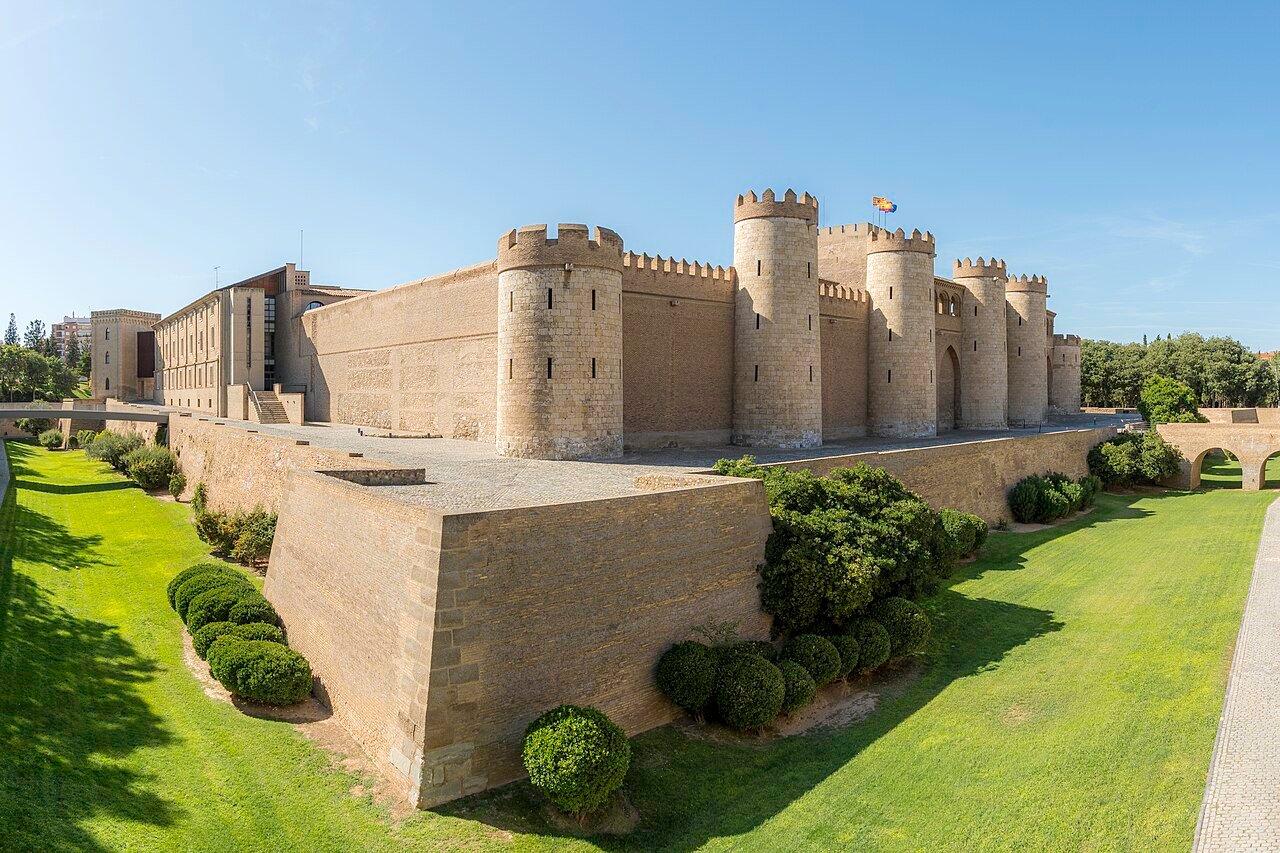
A palace between two worlds: Islam and Christian Aragon
Built in the 11th century as an Islamic pleasure palace for the Taifa rulers of Zaragoza, the Aljafería later became the seat of the Aragonese monarchy and, for a time, the Inquisition. Nowhere else in Europe does a single building bear such layered testimony to coexisting civilisations.
UNESCO recognition: the Mudéjar Architecture of Aragon
The Aljafería was inscribed on the World Heritage List in 1986 as part of the Mudéjar Architecture of Aragon — a collective site grouping the finest examples of this uniquely Spanish hybrid style where Islamic craftsmen worked for Christian patrons. It is the most celebrated example of the group.
The Islamic troubadour palace: Al-Yabr al-Maqarr
Erected under Ahmad I ibn Sulayman al-Muqtadir (r. 1049–1082), the palace featured a central garden with a rectangular pool, ornate stucco work, and a small mosque whose prayer room survives intact. The intricate geometric carvings and polylobed arches rival contemporary work at Córdoba and Seville.
Royal court of the Crown of Aragon
After the Christian Reconquista (1118), the Aragonese kings transformed the palace into their principal residence. Peter IV (r. 1336–1387) added the Gothic royal apartments and a Throne Room whose timber ceiling blends Islamic and European motifs. Isabella and Ferdinand held court here during the Spanish Inquisition.
Architecture and decoration: stucco, geometry, and light
The palace is celebrated for its interweaving of architectural grammars: horseshoe arches of the Islamic section, early Gothic vaulting of the medieval wing, and Renaissance additions of the 16th century. The surviving mosque (oratory of Al-Muqtadir) retains exceptional stucco panels considered among the finest Taifa-period ornament in existence.
From prison to parliament: a turbulent modern history
After centuries as a military barracks and later a prison — where the composer Francisco de Goya was briefly held — the palace underwent a major restoration in the 1980s. Today it houses the Aragonese regional parliament (Cortes de Aragón) while remaining open to visitors.
Visiting the Aljafería today
The palace is located on the western edge of Zaragoza’s city centre, easily reached on foot or by tram. Guided visits include the Islamic garden, mosque, and royal apartments. The Aragonese parliament sessions can sometimes be observed from the public gallery. Entry is free on weekends for EU citizens.
A bridge across centuries in the Ebro Valley
Zaragoza sits at the heart of the Ebro river valley, where Roman, Visigoth, Islamic, and Christian cultures layered their mark across two millennia. The Aljafería stands as the most eloquent reminder that Spain’s medieval identity was forged in the creative tension between these worlds — a living monument to convivencia.
Find it on the map
See this place and what’s around it →
📷 Become a Cultural Heritage Online photographer
Share your photos of places: they stay published under your name as the author. The more they're seen, the more you get noticed — and soon a contest will reward the most appreciated photos.
Log in or sign up free to add a photo