

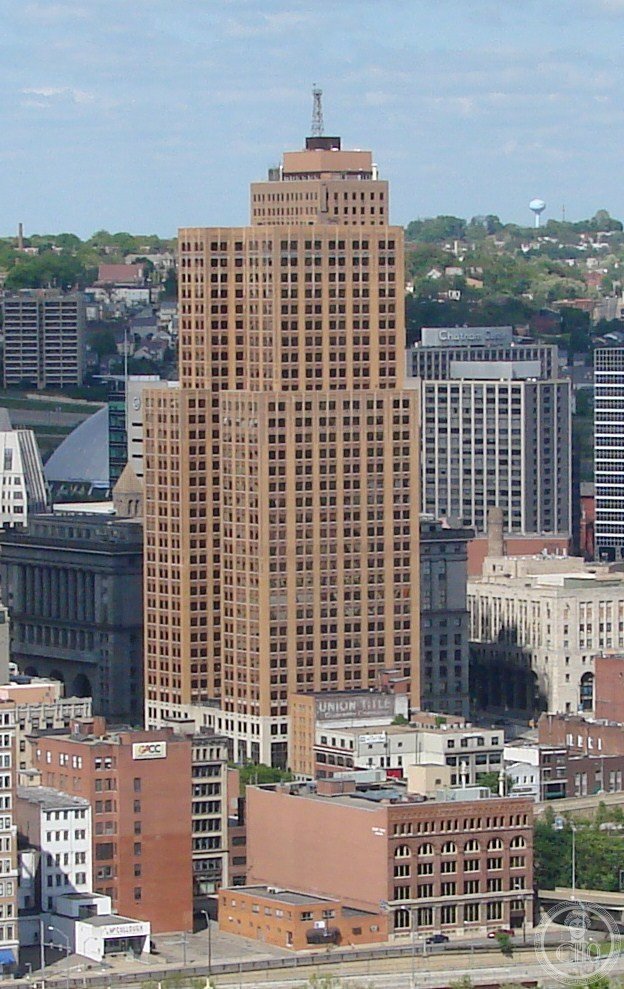

Henry Hornbostel’s 40-story Art Deco tower at 330 Grant Street is best known for a singular civic gesture: a rooftop beacon that has transmitted “Pittsburgh” in Morse code since 1929, spelling out the city’s name visible to pilots crossing the Allegheny plateau.
At a glance
Completed in 1929 at 330 Grant Street, the Grant Building is a 40-story Art Deco tower designed by Henry Hornbostel, one of Pittsburgh’s most productive architects of the early twentieth century. The building’s setback massing and vertically emphasised limestone facade are characteristic of the period’s commercial skyscraper production, but the Grant Building carries one detail that sets it apart from every other tower in the city: a rooftop beacon that flashes “Pittsburgh” in Morse code. The beacon has been operational since the building opened and has become one of Pittsburgh’s most quietly beloved civic symbols. Listed on the National Register of Historic Places in 2004.
Key facts
- Completed: 1929
- Architects: Henry Hornbostel and Eric Fisher Wood
- Height: 40 stories, 485 ft (148 m)
- Style: Art Deco; setback tower
- Address: 330 Grant Street, Pittsburgh, PA 15219
- Signature feature: Rooftop beacon transmitting “Pittsburgh” in Morse code since 1929
History
Henry Hornbostel (1867–1961) was the defining architectural presence in early twentieth-century Pittsburgh. His practice shaped the Carnegie Mellon University campus, the Pittsburgh City-County Building, and numerous commercial and civic commissions across western Pennsylvania. The Grant Building commission in the late 1920s came at the height of both Hornbostel’s career and Pittsburgh’s industrial and financial confidence — the city’s steel and manufacturing wealth sustaining a skyscraper building programme that rivalled those of Chicago and New York.
The building opened in 1929, the year the American economy began its long Depression contraction. Like the Koppers Building nearby, it entered service into a changed economic climate, yet survived and remained continuously occupied. Its rooftop beacon — transmitting “Pittsburgh” in Morse code — was part of the original programme and was likely designed to be visible to the small aircraft then beginning to use Allegheny County Airport. The message has continued through successive owners and decades of changing tenancy.
The National Register of Historic Places listing in 2004 recognised the building’s architectural quality and its urban role in Pittsburgh’s Grant Street corridor, an ensemble of late 1920s Art Deco towers that survives largely intact. The Grant Building is the southernmost and tallest of this group — its setback profile anchoring the corridor’s southern approach.
What you see
The Grant Building’s facade is organised around vertically continuous window piers that run from the setback zone to the roofline, framing narrow spandrel panels of carved limestone ornament. The massing steps back in the upper floors following standard Deco practice influenced by the 1916 New York zoning law’s setback provisions, which had established the stepped tower as the dominant commercial form across American cities. The building’s skin is relatively spare compared to its neighbours — Hornbostel emphasised the structural logic of the vertical piers over elaborate surface ornament, giving the Grant Building a slightly more austere reading than the Koppers Building a few blocks north.
The lobby at 330 Grant Street retains original marble walls and geometric metalwork consistent with the Deco corporate interior typology. Looking up Grant Street from the south, the building’s setback profile and the cluster of towers — Koppers and Gulf visible above it — give a condensed version of what Pittsburgh’s late 1920s skyline must have looked like at its peak. After dark the rooftop beacon is the building’s most vivid architectural statement: the slow Morse-coded “Pittsburgh” invisible to pedestrians below but tracked, over the decades, by thousands of pilots on approach to Pittsburgh’s airports.
Practical information
- Access: Lobby open weekdays during business hours; exterior visible at all times; rooftop beacon best seen from aircraft or elevated viewpoints after dark
- Best view: Looking north from 3rd Avenue along Grant Street; from across the Monongahela River toward downtown
- Time needed: 20 minutes exterior; lobby 5–10 minutes
- GPS: 40.4375° N, 79.9975° W
- Nearest transit: Steel Plaza T Station, 5-minute walk
Getting there
The Grant Building stands at 330 Grant Street in downtown Pittsburgh, a 5-minute walk from Steel Plaza T station and adjacent to the Allegheny County Courthouse. Pittsburgh International Airport is approximately 22 miles (35 km) west via Interstate 376. Amtrak’s Capitol Limited stops at Pittsburgh Union Station on Liberty Avenue, roughly 12 minutes on foot from Grant Street.
Nearby
- Koppers Building (1929) — Graham, Anderson, Probst & White’s green-crowned Deco tower at 7th Avenue and Grant Street
- Gulf Tower (1932) — Trowbridge & Livingston’s stepped pyramid skyscraper at 707 Grant Street
- Allegheny County Courthouse (1888) — H.H. Richardson’s Romanesque Revival landmark on Grant Street
Sources
- Pittsburgh History & Landmarks Foundation, Grant Building documentation — phlf.org
- Toker, Franklin. Pittsburgh: A New Portrait. University of Pittsburgh Press, 2009
- Kidney, Walter C. Pittsburgh’s Landmark Architecture: The Historic Survey. Pittsburgh History & Landmarks Foundation, 1997
- Wikidata, Grant Building Q5596127 — wikidata.org
Find it on the map
See this place and what’s around it →📷 Become a Cultural Heritage Online photographer
Share your photos of places: they stay published under your name as the author. The more they're seen, the more you get noticed — and soon a contest will reward the most appreciated photos.
Log in or sign up free to add a photoIs this page about you?
This page is read by travellers and heritage enthusiasts who find it on Google. Tell us how you are connected to this place and we will take it from there.