

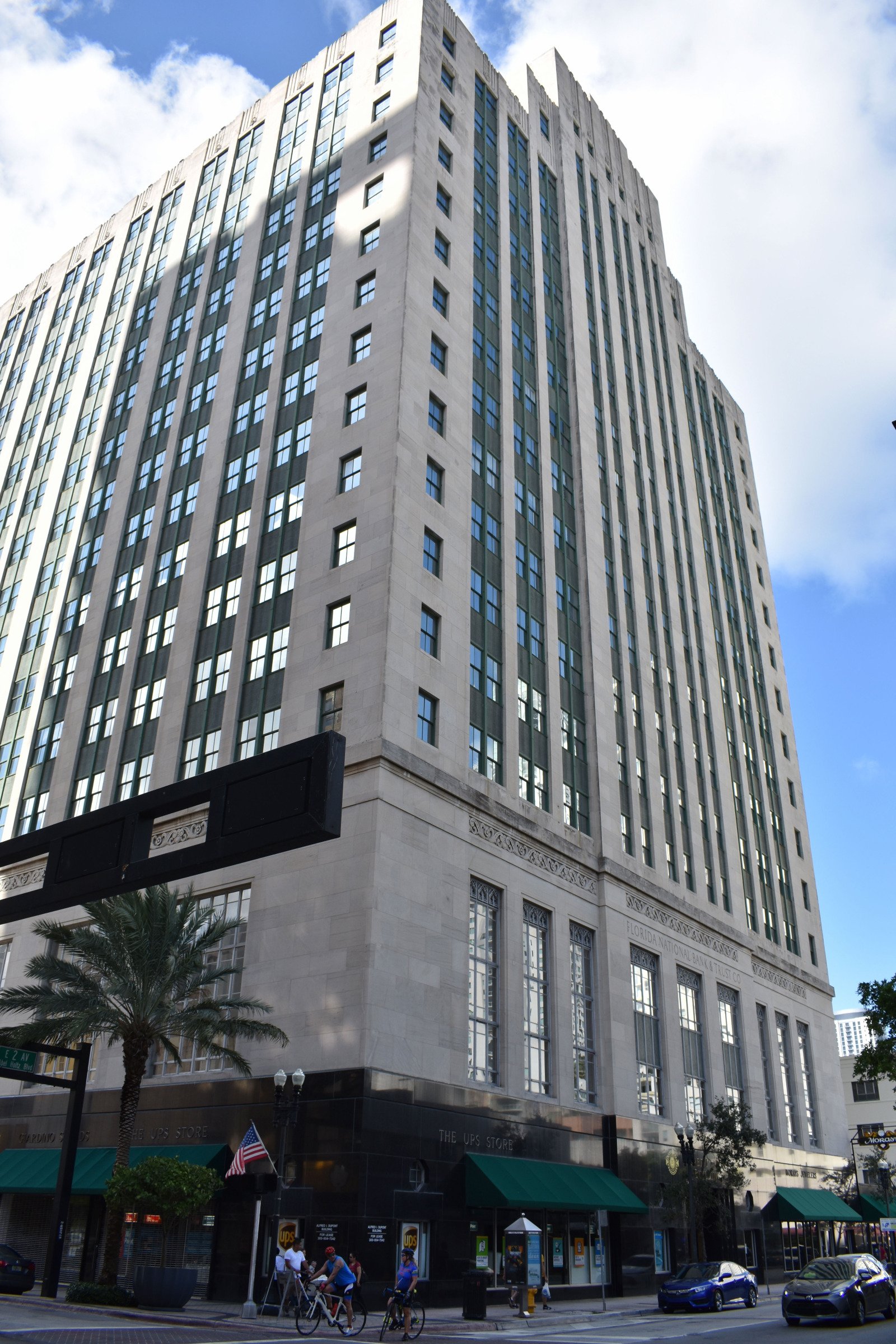
The first skyscraper to pierce Miami’s skyline after the crash of 1928, a 17-story proof that the city had survived its worst decade.
At a glance
Completed in 1939 at 169 East Flagler Street, the Alfred I. DuPont Building was downtown Miami’s first new skyscraper after the devastating bust that froze construction for over a decade. Seventeen stories tall, it combines a restrained Modern frame with Art Deco embellishments — ornamental spandrels, incised geometric patterns, bronze metalwork — that signal both the period’s stylistic moment and the financial ambition of the Florida National Bank, which occupied the lower floors. It was added to the National Register of Historic Places on January 4, 1989.
Key facts
- Address: 169 East Flagler Street, Miami, FL 33131
- Style: Modern with Art Deco embellishments
- Completed: 1939 (construction began 1937)
- Height: 17 stories
- Original tenant: Florida National Bank (Alfred I. duPont’s banking network)
- NRHP: Listed January 4, 1989
- Coordinates: 25.7745° N, 80.1906° W
History
Alfred I. du Pont (1864–1935) was a Delaware industrialist and heir to the du Pont chemical dynasty who relocated to Jacksonville, Florida, in 1926 to reorganize and expand a network of failed savings banks across the state. By the time of his death he controlled more than thirty institutions operating as Florida National Bank. The building bearing his name was commissioned by his widow Jessie Ball du Pont to serve as the bank’s Miami flagship.
Its completion in 1939 held symbolic weight for the city. Miami had absorbed a double blow — the catastrophic 1926 hurricane and the financial bust of 1928 — that killed the speculative land boom and stilled construction cranes for more than a decade. The DuPont Building rose as the first high-rise to break that silence, replaced the earlier Halcyon Hotel on the same site, and announced that capital, at least, had regained its nerve along Flagler Street.
What you see
The building’s exterior reads as disciplined rectangularity — a stepped tower form that was standard for late-1930s American commercial work — but Art Deco ornament breaks the austerity at key moments: geometric reliefs on the spandrel panels, bronze metalwork at the entry, and incised decorative bands that catch Miami’s flat afternoon light. The overall effect is less the exuberant geometry of Miami Beach’s pastel hotel row and more the civic gravity of a bank that wanted to project permanence rather than pleasure.
The ground floor retains elements of the original banking hall: terrazzo underfoot, bronze-framed windows, and high ceilings that once served the tellers of Florida National. The scale is conspicuous even by downtown standards, the 17-story bulk giving Flagler Street a sense of urban density unusual in a city that was still largely low-rise when the building opened.
Practical information
- Access: Commercial tenants; lobby visible during business hours.
- Best season: November–March (cooler, drier; the Flagler Street block is shaded by mid-afternoon).
- Time needed: 20–30 minutes for exterior and lobby walk-through.
- Photography: Best in morning light from the south side of Flagler Street.
Getting there
The building stands at 169 East Flagler Street in the heart of downtown Miami, one block east of SE 2nd Avenue. The nearest Metrorail station is Government Center (6 minutes north on Biscayne Boulevard). Metrobus routes serve the Flagler Street corridor throughout the day. Paid parking is available in garages on Brickell Avenue and near Bayside Marketplace.
Nearby
- Miami Dade Cultural Center (300 NE 1st Ave): adjacent complex housing Miami-Dade Public Library and History Miami Museum — 5-minute walk northeast.
- Brickell Financial District: the modern skyline that rose where the DuPont Building once stood alone — 10-minute walk south.
- Bayside Marketplace: waterfront retail and marina on Biscayne Bay — 5-minute walk northeast.
Sources
- Alfred I. DuPont Building — Wikipedia: en.wikipedia.org
- National Register of Historic Places — Listing no. 89002474 (January 4, 1989)
- History Miami Museum, Alfred I. du Pont collections
Find it on the map
See this place and what’s around it →Record researched and written by Luigi De Marchi for Cultural Heritage Online, 2026.
📷 Become a Cultural Heritage Online photographer
Share your photos of places: they stay published under your name as the author. The more they're seen, the more you get noticed — and soon a contest will reward the most appreciated photos.
Log in or sign up free to add a photoIs this page about you?
This page is read by travellers and heritage enthusiasts who find it on Google. Tell us how you are connected to this place and we will take it from there.