

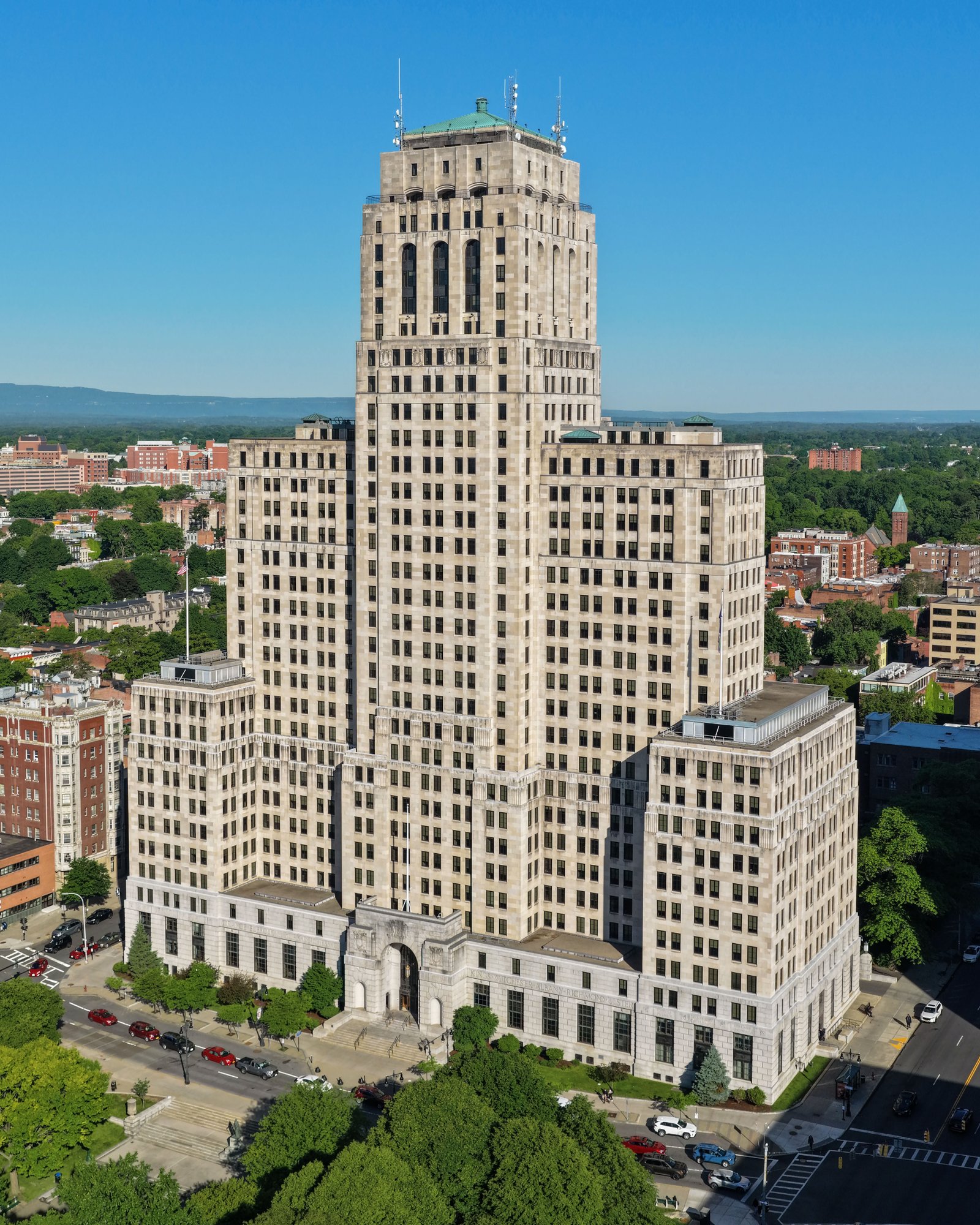
Standing immediately beside the Victorian Gothic towers of the New York State Capitol, the Alfred E. Smith State Office Building—a 34-story Art Deco skyscraper completed in 1930—represents one of the most dramatic encounters between historical and modernist architecture anywhere in the American Northeast, and an assertion by the New York state government that the Art Deco idiom was the appropriate language for twentieth-century public administration.
At a glance
The Alfred E. Smith Building at 80 State Street in Albany was designed by Sullivan W. Jones and completed in 1930 as a state office tower. Named after Governor Alfred E. Smith—the four-term Democratic governor of New York who later became the first Roman Catholic major-party presidential candidate in 1928—the building stands on the western slope of Capitol Hill in direct visual dialogue with the New York State Capitol building immediately to its north. At 34 stories, it was one of the tallest government office buildings in the United States at the time of its completion, and its distinctive Art Deco crown—a stepped pyramid of setbacks lit at night—has anchored the Albany skyline for nearly a century. The building operates today as state government offices.
Key facts
- Address: 80 State Street, Albany, NY 12207
- Architect: Sullivan W. Jones
- Completed: 1930
- Stories: 34
- Style: Art Deco
- Named for: Governor Alfred E. Smith (1923–1928)
- Landmark status: Albany County Landmark; National Register of Historic Places
- Current use: New York State government offices
History
Alfred E. Smith served four terms as Governor of New York between 1919 and 1928, making him one of the most consequential state executives in early twentieth-century America. He modernised the state government’s administrative structure, expanded public works investment, and built a political coalition that made New York a laboratory of progressive urban governance. The office tower that bears his name was commissioned during his governorship—though Smith did not live to see it complete as a building named in his honour—and was part of a broader programme of state capital investment that the Smith administration initiated.
Sullivan W. Jones, the New York State Architect who designed the building, chose an Art Deco vocabulary that was consistent with the commercial skyscraper architecture of the period while adapting it to a state governmental context. The result is a tower whose formal language references the setback skyscraper mode developed in New York City in the 1920s but applied at a scale suited to Albany’s smaller cityscape and the Capitol Hill setting. The building’s placement immediately adjacent to the New York State Capitol—the massive 1879 Richardson-influenced Romanesque-Renaissance hybrid building—created a visual contrast between the two structures that was discussed in the architectural press of the 1930s as a deliberate statement about the trajectory of public architecture.
The building was renamed for Alfred E. Smith after his death in 1944, in recognition of his role in expanding the New York state government’s administrative capacity. Smith’s 1928 presidential campaign—the first by a Roman Catholic candidate from a major party—had national significance, and the naming of the Albany tower was an expression of the Democratic Party’s esteem for his legacy. The building has operated as state government offices throughout its existence and remains one of the dominant landmarks of the Albany skyline.
What you see
The building is best understood from a distance, where its relationship to the Capitol becomes legible. The Capitol’s elaborate Victorian stonework—towers, dormers, carved ornament in the Richardson Romanesque manner—meets the Smith Building’s smooth limestone planes, geometric setbacks, and clean verticality at a distance of a city block, with the contrast between the two architectural epochs stark enough to function as an outdoor lesson in the history of American public building.
At street level, the Smith Building’s base presents a composition of dark polished stone, bronze lobby fittings, and an entrance portal of compressed Art Deco ornament: geometric reliefs, stylised botanical motifs, and metalwork trim that positions the transition from street to office lobby as a carefully considered sequence. The lobby retains much of its original decorative programme. Looking up from the base, the building’s setback massing carries the eye through each successive stage to the stepped pyramid summit, which is lit at night as a beacon across the Hudson Valley—a condition that makes the building as effective in darkness as in daylight.
Practical information
- The building operates as state government offices; the lobby is accessible during business hours (weekdays)
- The exterior and the view from Capitol Hill are accessible at any time; the juxtaposition with the Capitol is best appreciated from the intersection of State and Eagle Streets
- The New York State Capitol is open for guided tours (free) and self-guided visits during business hours; tours include the stunning Million Dollar Staircase and War Room
- The Empire State Plaza (1966–1978, Harrison & Abramovitz) is immediately to the south—a Brutalist civic complex of a very different character; the contrast with the Smith Building is instructive
Getting there
The Alfred E. Smith Building stands at 80 State Street in downtown Albany, immediately beside the New York State Capitol at the top of State Street Hill. CDTA bus services connect the Capitol area with the Albany train station. Amtrak’s Empire Service and Lake Shore Limited connect Albany-Rensselaer station—across the Hudson River, approximately 2 miles from the building—with New York Penn Station (approximately 2 hours south) and Chicago (approximately 13 hours west). Albany International Airport (ALB) is approximately 10 miles northwest.
Nearby
- New York State Capitol (1879) — immediately adjacent; H.H. Richardson’s Romanesque-Renaissance hybrid, one of the most ambitious state capitol buildings in America; free guided tours available
- New York State Museum — approximately 0.3 miles south in the Empire State Plaza; the state’s natural history, cultural history, and art collections; free admission
- Albany City Hall (1883) — approximately 0.3 miles east on Eagle Street; another H.H. Richardson Romanesque design, intact Victorian civic architecture
Sources
- National Register of Historic Places nomination: Alfred E. Smith State Office Building
- Albany County Legislature: landmark designation documentation
- Slayton, Robert A. Empire Statesman: The Rise and Redemption of Al Smith. New York: Free Press, 2001 (context for Governor Smith and his legacy)
- New York State Office of General Services: building history records
Find it on the map
See this place and what’s around it →📷 Become a Cultural Heritage Online photographer
Share your photos of places: they stay published under your name as the author. The more they're seen, the more you get noticed — and soon a contest will reward the most appreciated photos.
Log in or sign up free to add a photoIs this page about you?
This page is read by travellers and heritage enthusiasts who find it on Google. Tell us how you are connected to this place and we will take it from there.