
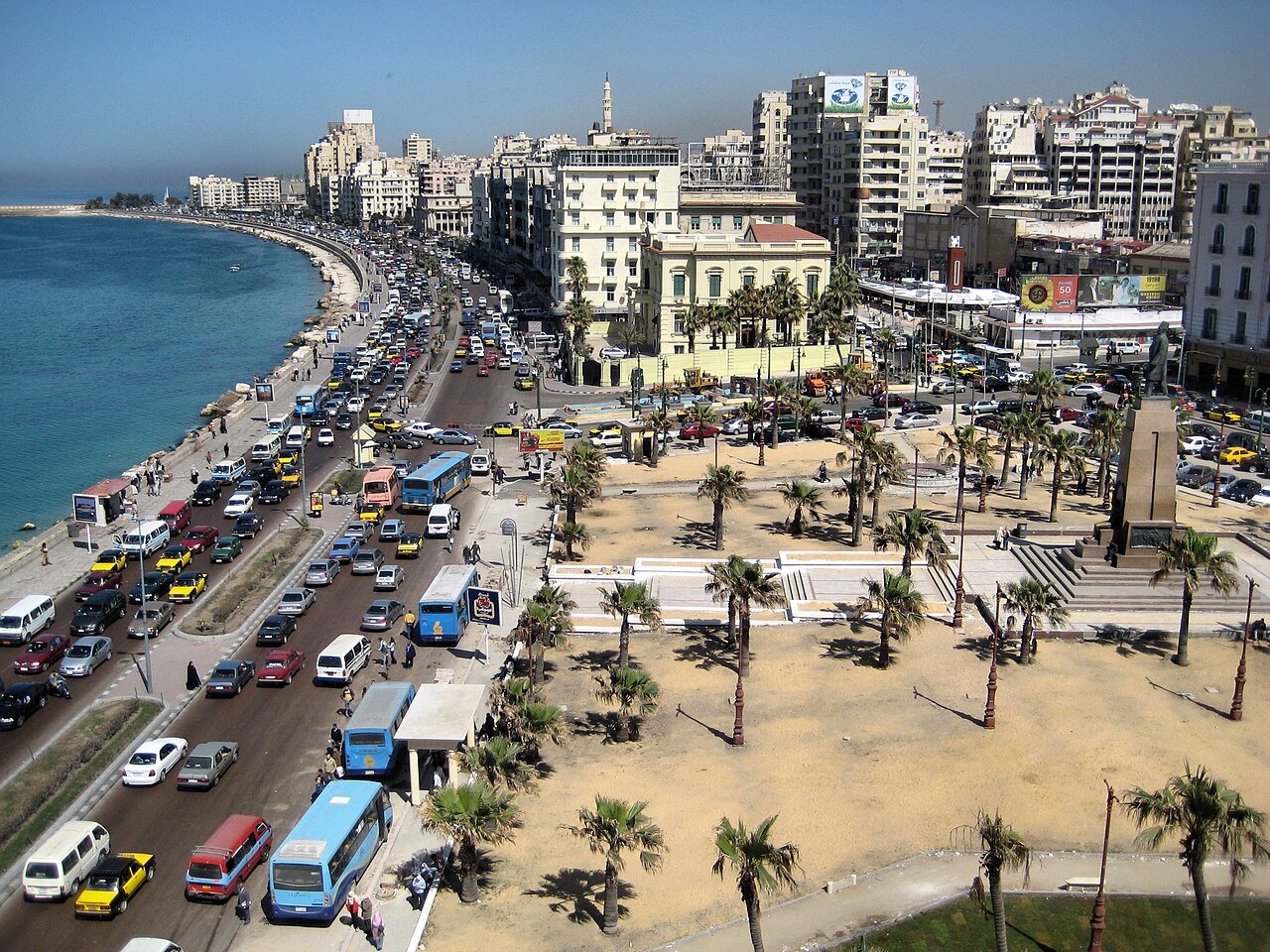
Egypt’s principal seaport rebuilt itself in the modern age as a Mediterranean crossroads. Its inter-war downtown still reads as a layered streetscape of Déco and eclectic facades.
At a glance
Alexandria is Egypt’s largest port and its second city after Cairo, strung along the Mediterranean coast where the Nile Delta meets the sea. Founded in 331 BC by Alexander the Great, it declined over the centuries and was rebuilt from around 1810 under Muhammad Ali, returning to prominence by the mid-19th century. The decades that followed turned it into one of the Mediterranean’s most cosmopolitan cities, home to Greek, Italian, Levantine and other European communities drawn by the cotton trade and the port economy. That mercantile prosperity, peaking in the inter-war years, financed the apartment houses, commercial blocks and waterfront facades that give central Alexandria its distinctive early-20th-century character today.
Key facts
- Country: Egypt
- Key period: 1920s–1940s
- Founded: 331 BC, by Alexander the Great
- Essential sites: the Corniche waterfront; Saad Zaghloul Square; the downtown commercial district
- Setting: Mediterranean coast, north-west of the Nile Delta
History
Ancient Alexandria was one of the great cities of the classical world, but successive centuries reduced it to a modest settlement. Its modern revival began around 1810, when Muhammad Ali, the Ottoman governor of Egypt, set about rebuilding it; by 1850 the city had recovered much of its former importance. As Egypt’s premier commercial hub, Alexandria attracted merchants and migrants from across the Mediterranean, and Greeks, followed by other Europeans, settled in growing numbers through the 19th century.
This cosmopolitan society left a strong cultural imprint. The Greek poet Constantine Cavafy (1863–1933) spent most of his life in the city, working as a civil servant while writing the verse that would make him one of modern Greek literature’s central figures. Later writers carried the city’s reputation abroad: E.M. Forster lived in Alexandria during the First World War, and Lawrence Durrell set his celebrated tetralogy The Alexandria Quartet (1957–1960) in its streets and society.
The city’s modern fabric was shaped by upheaval as well as wealth. In July 1882, during the Anglo-Egyptian War, the Royal Navy bombarded and occupied Alexandria, and large sections were damaged in the battle or destroyed in subsequent fires. Reconstruction and continued commercial growth carried the city into the inter-war decades, when its mixed population and trading fortunes were at their height, before the political changes of the 1950s reshaped its cosmopolitan world.
What you see
Central Alexandria reads as an eclectic European-influenced city laid over an Egyptian port. The downtown grid and the long sweep of the Corniche are lined with multi-storey apartment houses and commercial blocks raised during the late-19th and early-20th-century boom, their facades ranging from Belle Époque ornament to the cleaner geometry and stepped massing of Art Déco. Balconies, decorative cornices, shopfronts and tiled entrance halls survive in varying states of preservation, a record of the merchant prosperity that built them.
The waterfront is the natural place to read this heritage. The Corniche curves along the harbour past Saad Zaghloul Square, named for the Egyptian nationalist leader (1857–1927) whose statue stands there, with rows of period buildings facing the sea. Walking the downtown streets back from the shore reveals the everyday texture of the cosmopolitan city — its blocks, arcades and inter-war facades — best appreciated on foot and in good light.
Practical information
- The Corniche and downtown are best explored on foot; the waterfront walk is long, so pick a stretch around Saad Zaghloul Square.
- The Mediterranean climate makes spring and autumn the most comfortable seasons for walking the city.
- Many historic buildings are private apartment houses — admire facades from the street and respect residents’ privacy.
- Light from the sea is strongest in the late afternoon, ideal for photographing the waterfront facades.
- Combine a Corniche walk with the city’s museums and the Bibliotheca Alexandrina for a full day.
Getting there
Alexandria sits on Egypt’s Mediterranean coast, roughly 220 km north-west of Cairo. The most common approach is by train from Cairo, with frequent services running between the two cities; intercity buses also connect them. Alexandria is served by Borg El Arab Airport to the west of the city, while Cairo International Airport is the main long-haul gateway, with onward train or road transfer to the coast.
Related in CHO
- Cairo — Heliopolis, the Baron’s Palace and Belle Époque Downtown
- Casablanca — Art Déco and the Mauresque City
- Tunis — The Ville Nouvelle and Avenue Bourguiba
Sources
.jpg)
Find it on the map
See this place and what’s around it →Record researched and written by Luigi De Marchi for Cultural Heritage Online, 2026.
📷 Become a Cultural Heritage Online photographer
Share your photos of places: they stay published under your name as the author. The more they're seen, the more you get noticed — and soon a contest will reward the most appreciated photos.
Log in or sign up free to add a photo