
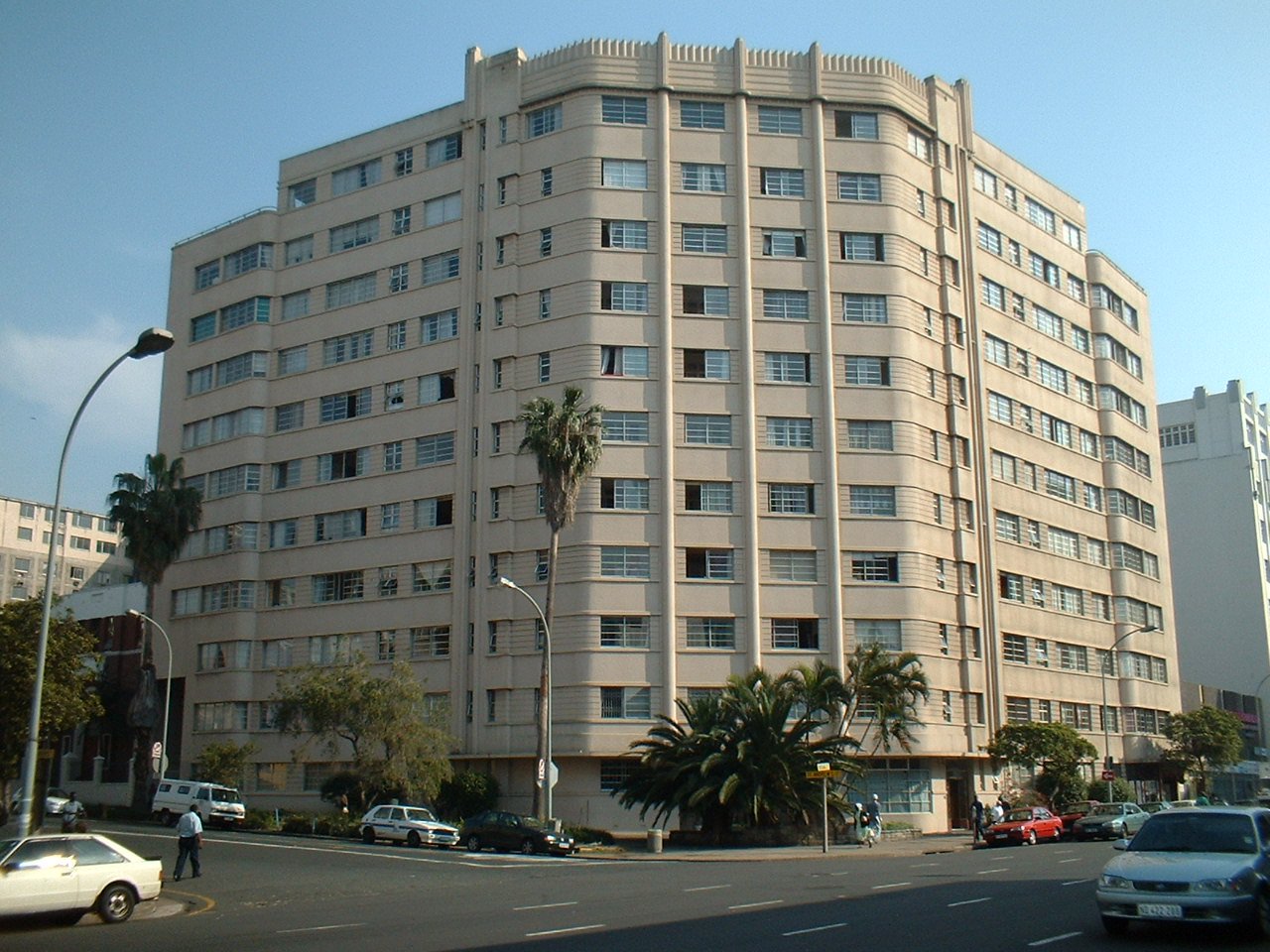
Granted city status in 1935, Durban grew through the decade that made Art Déco a worldwide language. The style, in Wikipedia’s phrase, “left its stamp on many of Durban’s buildings.”
At a glance
Durban is South Africa’s principal Indian Ocean port and, for the architecture traveller, an unexpected reserve of inter-war design. The flat city centre rises westward to the wooded ridge of the Berea, which overlooks both the downtown and the sea. Across the central streets and along the slopes stand apartment blocks, commercial corners and hotels carrying the geometry of the 1930s: stepped parapets, vertical fins, rounded corners and crisp horizontal lines. The city reached formal city status in 1935, at the height of the Art Déco moment, and the buildings of that decade remain among the most legible markers of its growth. Today a self-guided walk through the centre and the lower Berea reveals facade after facade in the idiom, weathered but intact.
Key facts
- Country: South Africa
- Key period: 1930s
- Essential areas: central Durban and the Berea ridge
- Style: Art Déco and Streamline Moderne
- City status: granted 1935
History
Durban developed in the nineteenth century as a colonial port on the Indian Ocean coast of what is now KwaZulu-Natal. By the 1930s it had become a commercial and shipping hub substantial enough to be granted city status, which it received in 1935. That decade coincided exactly with the international spread of Art Déco, the design language that had crystallised at the 1925 Paris exhibition and travelled outward through cinemas, hotels, offices and apartment houses. Durban’s expansion in those years was therefore recorded in the most fashionable architectural vocabulary of the moment.
The result is a downtown layered with inter-war construction. Apartment blocks and commercial buildings went up with the stepped massing, vertical emphasis and streamlined detailing typical of the period. Several survive with their names still on the parapet — Manhattan Court, Victoria Court, Broadwindsor and Augustines Corner among the buildings documented in Durban’s Art Déco district. The naming itself is telling: “Manhattan” and the verticality of the blocks nod to the American skyscraper imagery that Art Déco carried around the world.
The Berea, the forested ridge to the west of the centre, holds part of this story too. Once the site of some of Durban’s oldest mansions in what Wikipedia calls a “once-forested area,” it was progressively redeveloped through the twentieth century, with many of the old houses “converted into offices or made way for apartment buildings.” That cycle of replacement brought inter-war and later blocks onto the ridge, so that the climb from the centre to the Berea reads as a timeline of the city’s building decades.
What you see
The Durban inter-war facade is best read slowly, from the street. Look for the vertical accents that organise the elevation — fins, pilaster strips and stepped parapets that pull the eye upward — set against bands of horizontal grooving. Corner buildings often turn the angle with a curved bay, a Streamline Moderne move that smooths the junction of two streets into a single sweep. Window groupings are tight and rhythmic; balconies and string courses run as clean horizontals across the front. Names cast or carved into the parapet remain one of the simplest ways to identify a block of the period.
A coastal city encouraged the marine register of the style. Streamline Moderne, called “ocean liner style” in France, favoured rounded corners, long horizontal lines and details that, in Wikipedia’s words, resembled “the elements of ship” — porthole windows, curved railings and smooth, flowing surfaces. On a seafront where ocean liners once called, that nautical flavour reads naturally. To see the buildings, walk the central streets first, then climb toward the Berea for the elevated blocks and the view back over the city to the Indian Ocean. A camera with a moderate wide lens helps capture full elevations from the narrow pavements.
Practical information
- The Art Déco buildings are best explored on foot through central Durban during daylight hours.
- Most are private apartment blocks and offices; appreciate them from the street and respect residents’ privacy.
- Combine a centre walk with the climb to the Berea ridge for the elevated blocks and sea views.
- Bring a wide-angle lens to capture full facades from narrow pavements.
- As in any city centre, keep to busy streets and stay aware of your surroundings.
Getting there
Durban is served by King Shaka International Airport, which opened in May 2010 and lies about 36 kilometres north of the central city, handling both domestic and international flights. From the airport, road transfers reach the centre and the Berea; from there the inter-war districts are walkable.
Related in CHO
- Johannesburg — The Art Déco Skyline of the Gold City
- Cape Town — Mutual Heights and Cape Art Déco
- Miami — South Beach and Tropical Art Déco
Sources
Find it on the map
See this place and what’s around it →Record researched and written by Luigi De Marchi for Cultural Heritage Online, 2026.
📷 Become a Cultural Heritage Online photographer
Share your photos of places: they stay published under your name as the author. The more they're seen, the more you get noticed — and soon a contest will reward the most appreciated photos.
Log in or sign up free to add a photo