
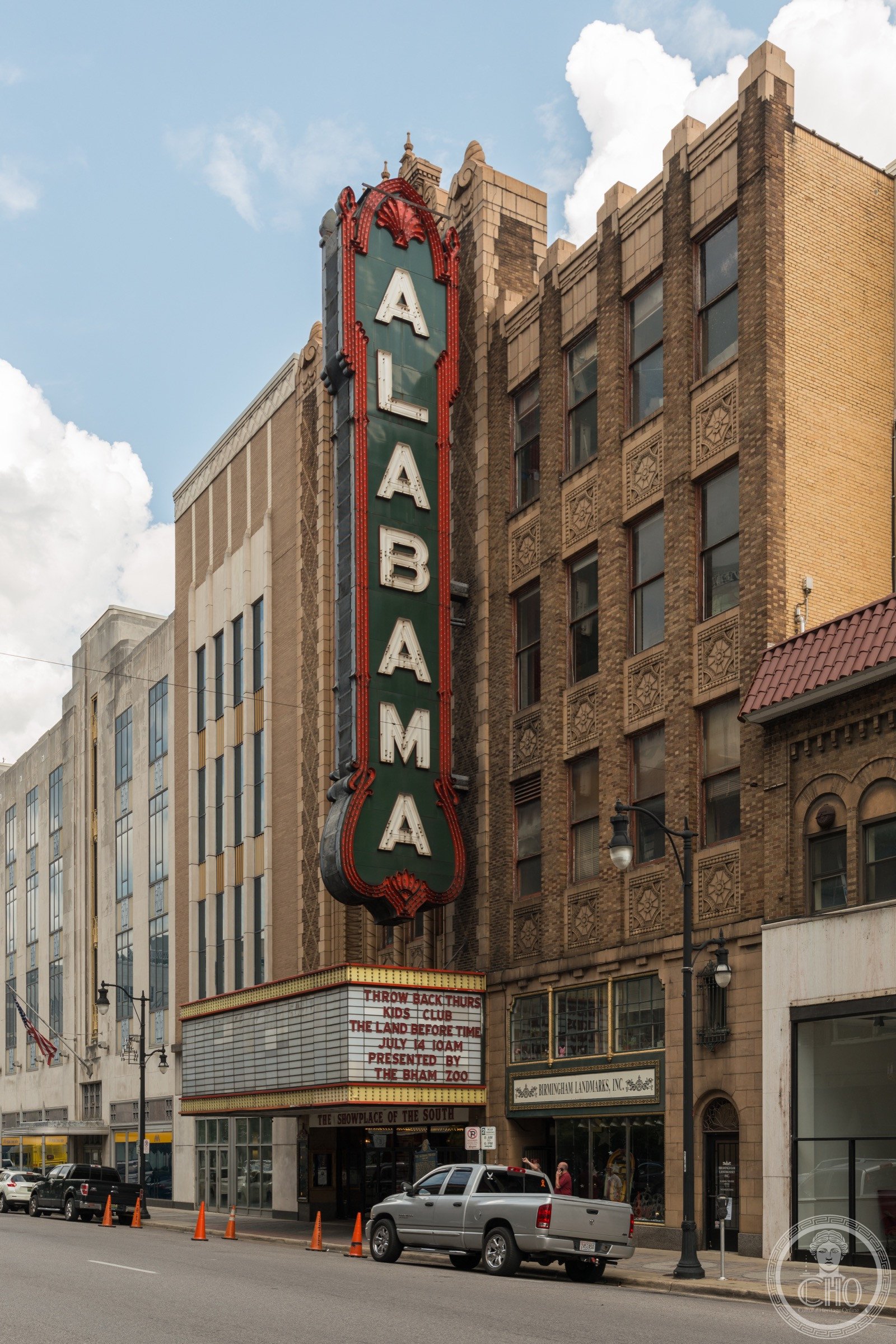
Known as the Showplace of the South since its 1927 opening, Birmingham’s Alabama Theatre is an intact atmospheric palace whose Moorish ceiling still produces the illusion of a southern night sky.
At a glance
The Alabama Theatre at 1817 Third Avenue North is the most celebrated surviving picture palace in the American South. Opened on Christmas Day 1927 as a flagship house for the Publix Theatres chain, it seats roughly 2,200 in an auditorium designed to evoke a Moorish courtyard beneath an open sky. The atmospheric ceiling — with its projected stars and illuminated clouds moving slowly overhead — remains operational, one of the few surviving examples of the technique in the country. The theatre is now managed by Birmingham Landmarks, Inc., and its 1927 Wurlitzer organ is still played before films and events.
Key facts
- Address: 1817 Third Avenue North, Birmingham, AL 35203
- Opened: December 25, 1927
- Style: Atmospheric Moorish Revival / Spanish Colonial Revival
- Status: NRHP Listed; active performing arts venue operated by Birmingham Landmarks
- Capacity: approximately 2,200 seats
- Notable: intact atmospheric ceiling; 1927 Wurlitzer organ still in use
- Theme: Art Deco USA
History
Birmingham in 1927 was a steel city at the height of its industrial prosperity — a population of nearly 260,000 and a commercial core that could support an entertainment venue of national scale. The Publix Theatres chain, the exhibition arm of Paramount Pictures, selected Birmingham as the site for a flagship southern house designed to compete with the grandest palaces in Chicago and New York. The result was the Alabama, built at a cost that reflected both the ambition of its owners and the booming confidence of the Jazz Age.
The atmospheric concept, pioneered by architect John Eberson from the early 1920s onward, replaced the conventional proscenium-box interior with a stage surrounded by faux outdoor walls — balconies, arches, towers, and garden elements — beneath a domed ceiling fitted with a Brenograph projector that cast moving clouds across a field of electric stars. The illusion was that the audience sat not in a theatre but in an open Moorish courtyard on a warm Alabama night. This sensory environment, unprecedented in the South, drew audiences who had never experienced anything comparable.
The Alabama remained a first-run cinema through the studio era and into the television age. By the 1980s it faced the fate common to urban movie palaces: declining patronage and the cost of maintaining a vast ornate building. Birmingham Landmarks, Inc. acquired the property and undertook restoration, reopening it as a performing arts center. Today the Alabama hosts classic film series, concerts, and special events; the Wurlitzer organ, restored to full function, is played by resident organists at screenings in the tradition of the silent-film era.
What you see
The Third Avenue facade is a composition in warm-toned terracotta and brick, with arched windows and ornamental banding that signal the Moorish interior to come. The marquee, a later addition, runs the full width of the ground floor. Inside, the atmospheric courtyard illusion begins at the lobby and intensifies in the main auditorium: the side walls are dressed as an Andalusian garden facade, with niches, iron grilles, and potted-plant silhouettes cast in plaster, while the ceiling dome recedes into a deep blue punctuated by hundreds of pinhole stars.
The 1927 Wurlitzer pipe organ — a four-manual, seventeen-rank instrument — occupies the stage-left organ chamber, its pipes concealed behind ornamental screens. The console rises from the orchestra pit on a hydraulic lift before performances, a theatrical gesture that has delighted audiences for nearly a century. The seating bowl, steeply raked in the balcony and gently curved in the orchestra, provides strong sightlines from all 2,200 positions.
Practical information
- Access: 1817 Third Avenue North, Birmingham city center; parking garages within two blocks
- Programming: classic film series, live concerts, organ presentations; check Birmingham Landmarks calendar
- Time needed: 2–3 hours for a full film or concert event
- Best season: year-round indoor venue; summers in Birmingham are hot, the air-conditioned auditorium is a relief
Getting there
Birmingham-Shuttlesworth International Airport (BHM) is approximately 6 miles northeast of downtown, with connections to major hubs. Amtrak’s Crescent route stops at Birmingham station (1819 Morris Avenue), roughly 0.4 miles southwest of the Alabama Theatre — a short walk through the Third Avenue North theatre district. The theatre sits at the core of Birmingham’s historic commercial center, within walking distance of the Birmingham Civil Rights District and the Carver Theatre.
Nearby
- Carver Theatre — former African American entertainment venue on Fourth Avenue North, now the Alabama Jazz Hall of Fame, approximately 0.3 miles east
- Birmingham Museum of Art — one of the South’s major municipal art museums, with significant collections of American decorative arts, kora textiles, and Asian art, approximately 0.5 miles northwest
- 16th Street Baptist Church — NRHP and National Historic Landmark; site of the 1963 bombing, now a civil rights memorial, approximately 0.4 miles west
Sources
- National Register of Historic Places — Alabama Theatre listing, Alabama Historical Commission
- Birmingham Landmarks, Inc. — operational history and organ documentation
- Theatre Historical Society of America — atmospheric theatre records
- Wikimedia Commons — Alabama Theatre Birmingham AL West view 20160714 1.jpg, CC BY-SA 4.0
Find it on the map
See this place and what’s around it →📷 Become a Cultural Heritage Online photographer
Share your photos of places: they stay published under your name as the author. The more they're seen, the more you get noticed — and soon a contest will reward the most appreciated photos.
Log in or sign up free to add a photoDo you manage this place?
This page is read by travellers and heritage enthusiasts who find it on Google. Keep it accurate — and make it work for you. Free for non-profit heritage institutions.