

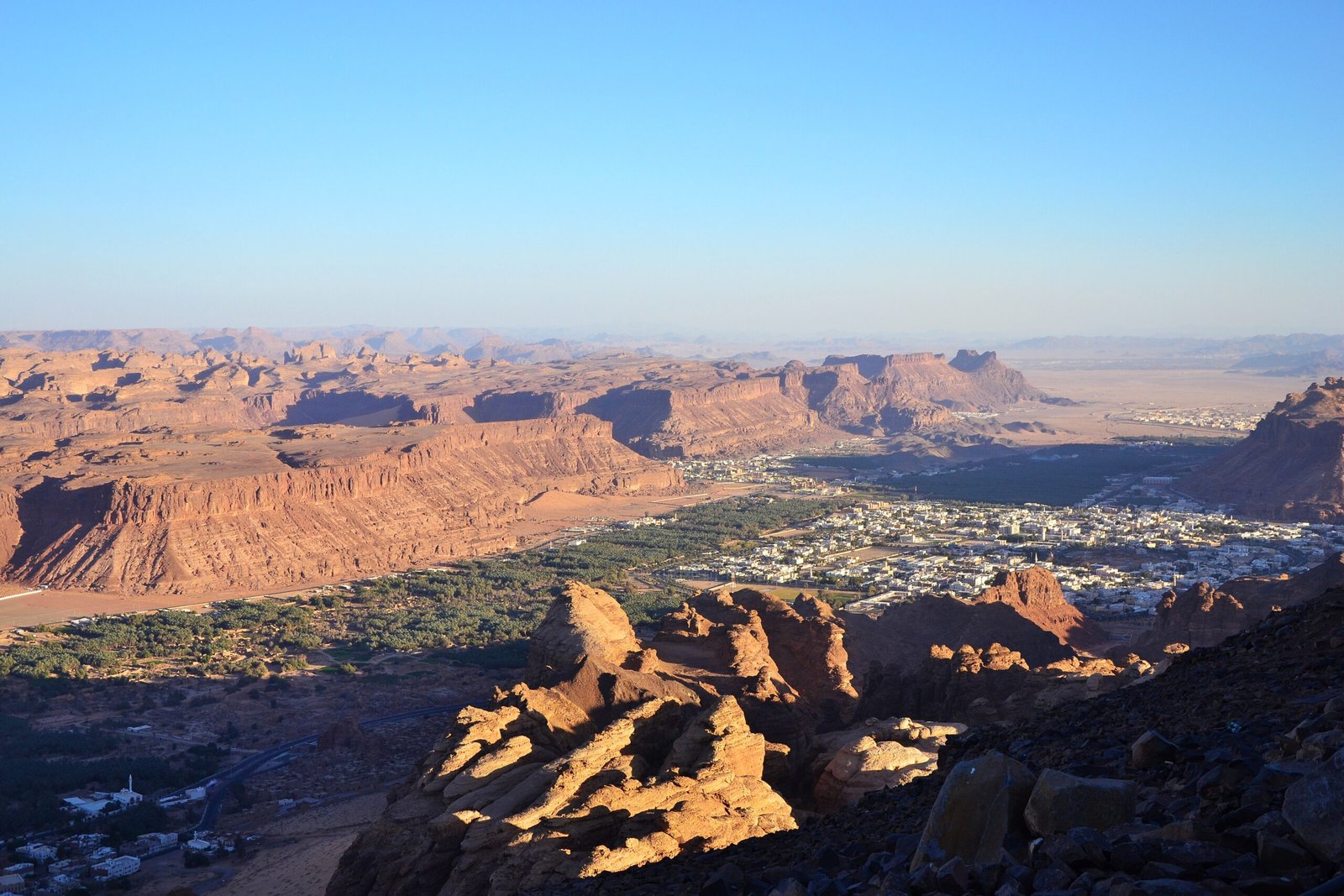
A fertile valley in the Hejaz region of northwestern Saudi Arabia, Al-Ula preserves 200,000 years of continuous human occupation and the layered remains of the Dedanite, Lihyanite, and Nabataean kingdoms — including the world’s largest outdoor collection of ancient Arabian inscriptions — within a living landscape of date palms and dramatic red sandstone outcrops.
At a glance
Al-Ula occupies a long, narrow valley in the Hejaz region of northwestern Saudi Arabia, roughly 300 kilometres north of Medina at approximately 900 metres elevation. Underground springs have sustained agricultural settlement since the Palaeolithic — Acheulean stone tools from the surrounding desert indicate human presence as far back as 200,000 years. The valley floor alternates between date palm gardens, traditional mud-brick architecture, and sandstone cliff faces covered in ancient inscriptions and rock art.
The site was the location of successive ancient Arabian kingdoms: the Dedanite Kingdom (c. 9th–5th centuries BCE) and its successor the Lihyanite Kingdom (c. 5th–1st centuries BCE), both controlling the northern Arabian incense trade routes. The Nabataean occupation (c. 1st century BCE) left the site’s most spectacular epigraphic monument: Jabal Ikmah, a sandstone cliff bearing hundreds of inscriptions in multiple ancient scripts — the largest open-air library of ancient Arabian inscriptions in the world. The mud-brick old town, occupied from the 12th century CE, was abandoned in 1983 and is now under conservation as part of a major heritage tourism development overseen by the Royal Commission for AlUla.
Key facts
- Location: Al-Ula, Medina Province, northwestern Saudi Arabia; 300 km north of Medina
- Civilizations: Dedanite (c. 9th–5th century BCE) → Lihyanite (c. 5th–1st century BCE) → Nabataean → Islamic
- Jabal Ikmah: Hundreds of inscriptions in Nabataean Aramaic, Dadanitic, Minaic, and Ancient North Arabian scripts
- Old Town: 13.5 ha; over 900 traditional mud-brick structures; abandoned 1983; under conservation
- Earliest human presence: c. 200,000 years (Acheulean stone tools)
- Tourism opening: International development from c. 2018 under Royal Commission for AlUla
- Nearby: Hegra (UNESCO WHS 2008) 20 km north; Tayma 150 km northeast
History
The Al-Ula valley has been a focal point of human settlement in the Arabian Peninsula since the Stone Age. The earliest historically documented civilization here was the Kingdom of Dadan (Dedanite Kingdom, c. 9th–5th century BCE), which controlled the critically important northern Arabian incense and spice trade routes — the overland caravan roads connecting the frankincense-producing kingdoms of south Arabia and east Africa with the great markets of Egypt, the Levant, and Mesopotamia. Dadan was a sophisticated urban centre: excavations have revealed stone architecture, temple complexes, and large-scale Lihyanite colossal statues — some nearly five metres tall — among the most remarkable pre-Islamic Arabian artworks known.
The Dedanite Kingdom was succeeded by the Lihyanite Kingdom (c. 5th–1st centuries BCE), which left a vast corpus of inscriptions in the Dadanitic script — one of the primary epigraphic records of pre-Islamic northern Arabian civilization and a precursor of the Arabic script itself. The Lihyanite period saw the greatest concentration of inscriptions at Jabal Ikmah. After the Nabataean absorption of the northern Arabian trade routes (c. 1st century BCE), additional Nabataean Aramaic inscriptions were added at Jabal Ikmah alongside earlier writings. The medieval old town was inhabited continuously from at least the 12th century CE until 1983, when the Saudi government relocated the population to a planned new town.
What you see
Jabal Ikmah. The centrepiece of any visit: a horseshoe-shaped sandstone cliff covered on its inner faces with hundreds of inscriptions in multiple ancient scripts — Dadanitic, Minaic, Nabataean Aramaic, Thamudic, and Ancient North Arabian — spanning roughly from the 5th century BCE to the early centuries CE. The inscriptions record dedications to deities, personal names, and territorial markings, making it the richest single concentration of ancient Arabian epigraphy in existence. Visitors walk a defined path with bilingual explanatory panels.
Old Town (Qaryat al-Hamra). The abandoned mud-brick town, its narrow lanes and courtyard houses now partially stabilised, is open for guided visits and gives a vivid impression of traditional Hejazi urban architecture from the 12th century CE onward. The original mosque minaret remains standing.
Dadan Archaeological Site. Ongoing excavations have exposed stone architecture, temple platforms, and foundations of a major religious precinct of the Lihyanite Kingdom. The colossal Lihyanite statues were discovered here; some remain in situ while others have been transferred to the National Museum in Riyadh.
The oasis landscape. The valley, still planted with thousands of date palms and intersected by traditional irrigation channels, is one of the most attractive natural settings in northwestern Saudi Arabia, with sandstone formations weathered into towers and arches providing a dramatic backdrop.
Practical information
- Airport: Prince Abdul Majeed bin Abdulaziz Airport (ULH), 15 km from old town; domestic flights from Riyadh, Jeddah, Medina. International hub: Medina (MED), 330 km south.
- Site access: Managed by Royal Commission for AlUla (RCU); tickets for Jabal Ikmah, Old Town, and Dadan via experiencealula.com or visitor centre. Most sites accessible only via guided tour or shuttle.
- Best time: October–March (cooler; peak season = Winter at Tantora festival, December–March). Summer regularly exceeds 40°C.
- Dress code: Modest dress required; shoulders and knees covered. Conservative dress expected for all visitors.
- Opening hours: Visitor centres typically 08:00–18:00 (winter); reduced hours in summer. Check rcualula.com for current schedules.
Getting there
The nearest international hub is Medina (MED), approximately 330 kilometres south. From Medina, the drive north via Highway 375 takes approximately 3.5 hours. Prince Abdul Majeed bin Abdulaziz Airport (ULH) at Al-Ula operates domestic connections to Riyadh (approx. 1 hr 15 min) and Jeddah (approx. 1 hr). The Royal Commission visitor centre organises shuttle transport to all major sites within the heritage zone.
Nearby
- Hegra (Mada’in Saleh) — The Nabataean southern capital and UNESCO WHS 2008, 20 km north; approximately 131 rock-cut tomb monuments in extraordinary preservation.
- Tayma — Ancient oasis and caravan city 150 km northeast; notable as the site where the Babylonian king Nabonidus spent a decade in self-imposed exile (c. 553–543 BCE).
- Khaybar — Volcanic oasis 140 km east; historically significant as a major settlement in pre-Islamic Arabia; famous for its basaltic lava fields and palm gardens.
Sources
- Royal Commission for AlUla: experiencealula.com
- Macdonald, M.C.A. (2004). Ancient North Arabian. In The Cambridge Encyclopedia of the World’s Ancient Languages. Cambridge University Press.
- Wikipedia: AlUla
Find it on the map
See this place and what’s around it →📷 Become a Cultural Heritage Online photographer
Share your photos of places: they stay published under your name as the author. The more they're seen, the more you get noticed — and soon a contest will reward the most appreciated photos.
Log in or sign up free to add a photo