
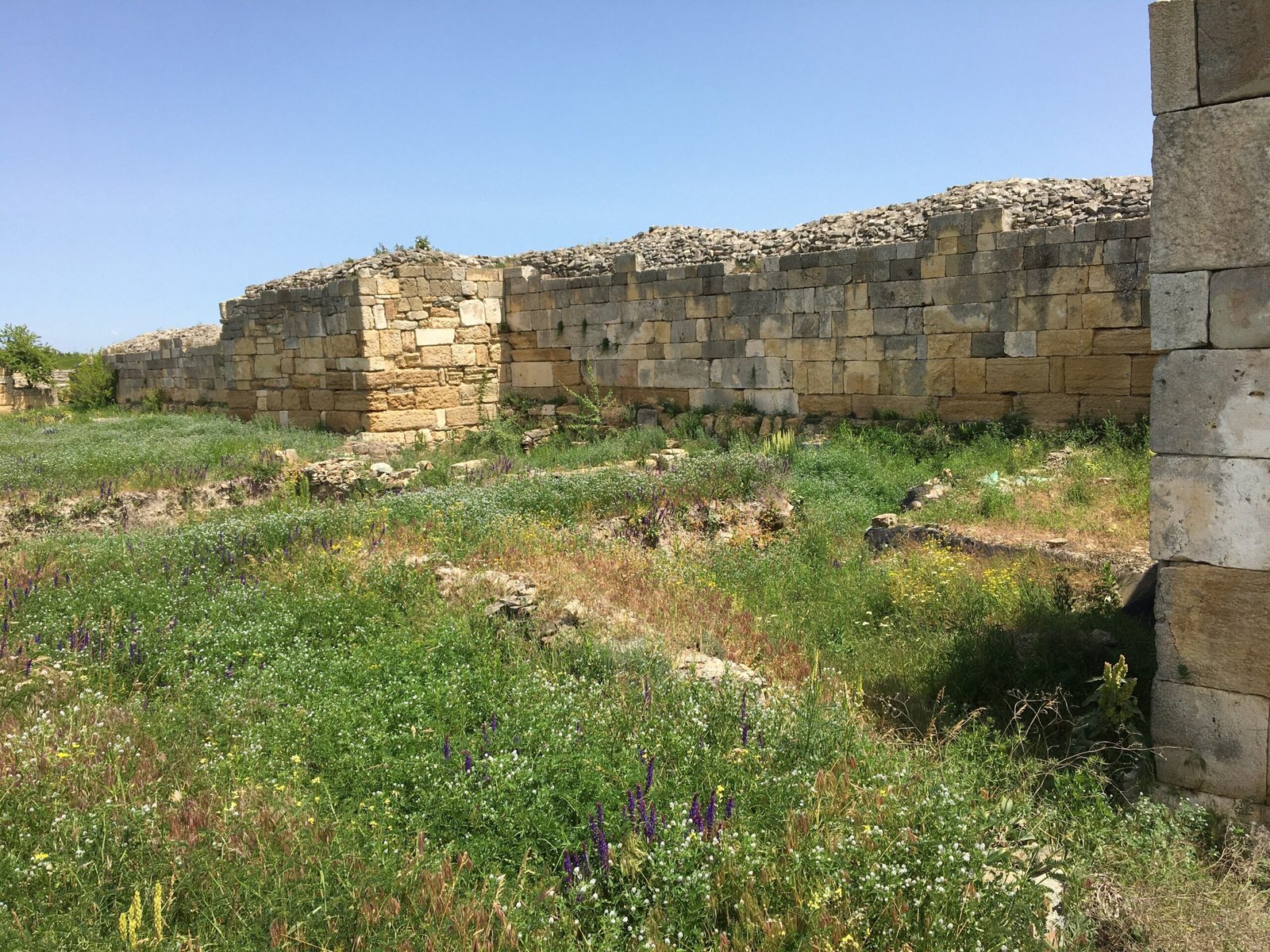
Founded on the Black Sea coast by Greek colonists from Miletus around 657 BCE, Histria is the oldest known city on Romanian territory — a site continuously occupied for nearly 1,400 years, from the Archaic Greek period through the Roman Empire and into Late Antiquity, before being abandoned to the advancing marshes of the Danube Delta.
At a glance
Histria stands on the western shore of the Sinoe Lagoon, a coastal wetland separated from the Black Sea by a narrow sand bar near the village of Istria, roughly 65 kilometres north of Constanța. Founded as a trading emporium where Greek manufactured goods were exchanged for grain, timber, and furs from the peoples of the lower Danube basin, the city functioned continuously for nearly fourteen centuries before siltation cut off its maritime access. Excavated since 1914, the stratified ruins cover about 40 hectares and yield a uniquely complete sequence of ancient urban life: Archaic walls, a Hellenistic street grid, a Roman forum, and a Late Antique basilica. The on-site museum holds over a century’s worth of outstanding finds including the earliest coins minted on Romanian territory.
Key facts
- Founded: c. 657 BCE, by colonists from Miletus
- Abandoned: 7th century CE, as the bay silted into impassable marsh
- Duration: approximately 1,400 years of continuous occupation
- Location: western shore of Sinoe Lagoon, ~65 km north of Constanța city
- Roman province: Moesia Inferior
- Excavations begun: 1914, by archaeologist Vasile Parvan
- Nearest city: Constanța — ancient Tomis, city of Ovid’s exile
- On-site museum: Histria Archaeological Museum, open seasonally
History
Miletus, the great Ionian city on the Aegean coast of modern Turkey, founded more colonies than any other Greek city along the Black Sea shores — which the Greeks called the Euxine, a euphemism for a body of water they initially found forbidding. Histria, established around 657 BCE on what was then a natural harbour on the northwestern Black Sea coast, was among the earliest of these foundations. Its name derives from the Istros, the Greek name for the Danube, whose delta lay a short distance to the north.
Through the Archaic period the city prospered as a trading emporium: Greek pottery, wine, and oil were exchanged for grain, timber, fish, slaves, and furs from the Getae and other peoples of the lower Danube plains. The city struck its own silver coins from the 5th century BCE — the earliest coins minted on Romanian territory — and maintained commercial relations with the Aegean world. Inscriptions record treaties with local dynasts and the city’s civic institutions: a council, popular assembly, magistrates, and a college of priests.
Under Hellenistic rule following Alexander’s conquests, Histria came within the orbit of the Macedonian successor kingdoms before becoming tributary to Rome during the 2nd and 1st centuries BCE. In the Roman Imperial period it was a prosperous city of Moesia Inferior, adorned with a forum, basilica, baths, and temples. From the mid-3rd century CE, repeated raids by Gothic and Carpic groups disrupted urban life. The city recovered partially in the 4th century, constructing new defensive walls and a large Christian basilica, but the progressive advance of Danube Delta siltation eventually cut off the city’s maritime access entirely. The settlement was abandoned in the early 7th century, likely in connection with the Slav and Avar invasions of the Balkans.
What you see today
The visible remains spread across a coastal plateau overlooking the Sinoe Lagoon and cover roughly 40 hectares. The most prominent surviving elements include sections of the Archaic and Hellenistic city walls — among the oldest Greek fortifications preserved in Romania; the Roman forum complex with the footprint of a columned basilica and temple podiums; the Sacred Zone, where successive temples from the Archaic through Roman periods occupied the same ground; the outlines of Hellenistic residential insulae with street grids; and a large Early Christian basilica with its baptistery. Substantial portions remain unexcavated. The Histria Archaeological Museum on the approach road displays the major finds: painted Archaic pottery from Miletus and Corinth, bronze tools, terracotta figurines, coin hoards, and inscribed stone blocks recording the city’s public life.
Practical information
- Address: Cetatea Histria, DN22C, commune of Istria, Constanța County, Romania
- Opening hours: daily approx. 09:00–20:00 in summer; reduced hours off-season
- On site: museum, limited refreshments, car park
- Best time to visit: May–June and September — site is largely exposed
- Duration: 2–3 hours for site and museum combined
Getting there
Histria is reached by car via the DN22C road from Navodari (approx. 40 km south) or from Tulcea (approx. 70 km north via Babadag). There is no regular public transport to the site. The nearest large city with accommodation options is Constanța, approximately 65 kilometres south. A hire car from Constanța is the most practical option for independent visitors.
Nearby
- Constanța — ancient Tomis, with the National History and Archaeology Museum and its Roman mosaic floor; ~65 km south
- Danube Delta Biosphere Reserve — largest wetland in the EU, UNESCO WHS; accessible from Tulcea ~70 km north
- Mangalia (ancient Callatis) — another Milesian colony on the Black Sea coast, with remains and a museum; ~90 km south
- Adamclisi — site of Tropaeum Traiani, the Roman triumphal monument of the Dacian Wars; ~100 km southwest
Sources
- Alexandrescu, P. (ed.), Histria, vols. I–VIII (Bucharest: Romanian Academy Press, 1954–2008)
- Parvan, V., Histria IV: Inscriptions trouvees a Histria (Bucharest, 1916)
- Avram, A., in Hansen and Nielsen (eds.), An Inventory of Archaic and Classical Poleis (Oxford: OUP, 2004), no. 673
- Wikipedia contributors, “Histria (ancient city),” Wikipedia, consulted 2026
Find it on the map
See this place and what’s around it →📷 Become a Cultural Heritage Online photographer
Share your photos of places: they stay published under your name as the author. The more they're seen, the more you get noticed — and soon a contest will reward the most appreciated photos.
Log in or sign up free to add a photo