
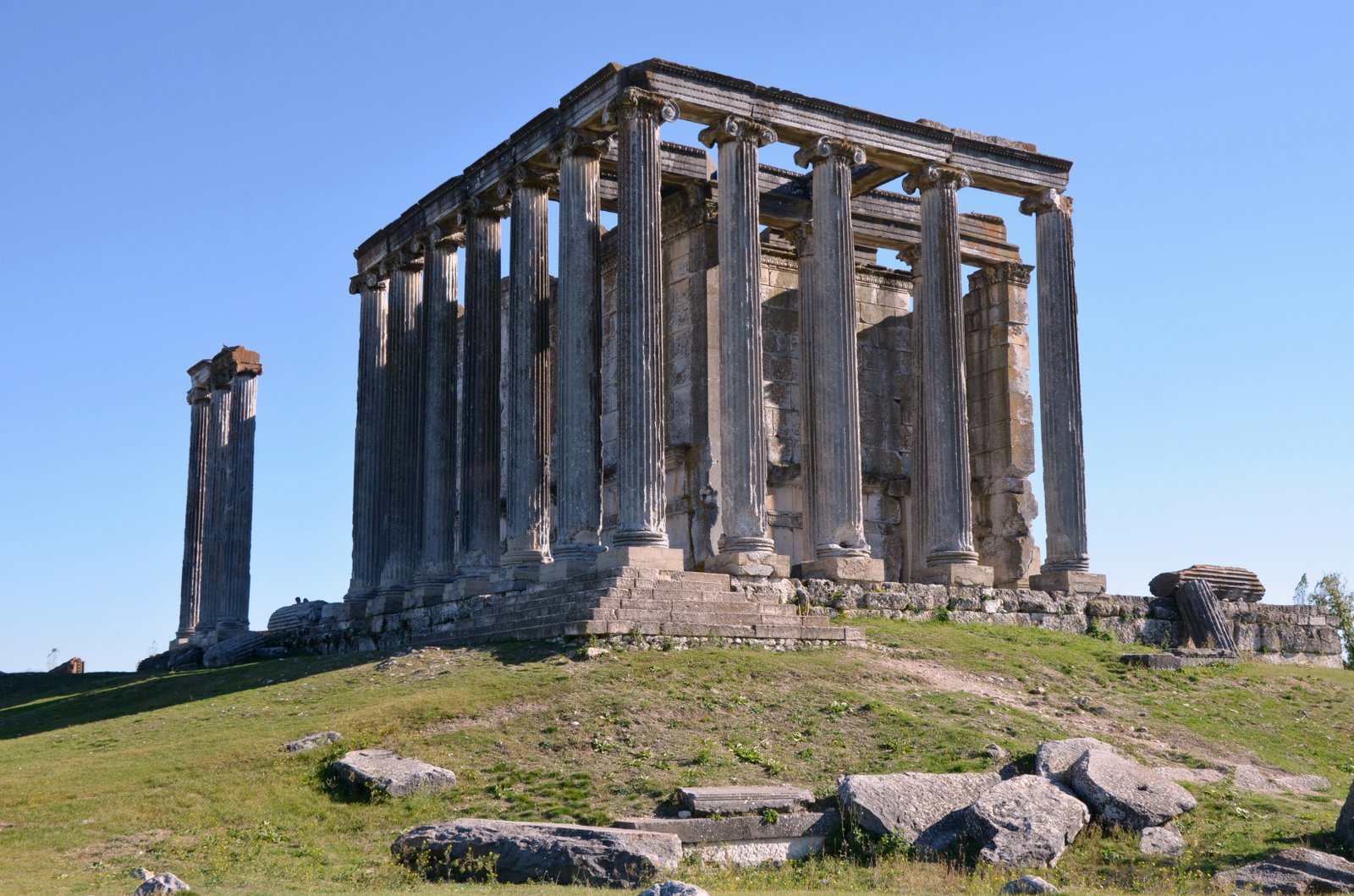
On a high plateau in western Anatolia, the ancient city of Aizanoi preserves one of the most completely intact Roman temple facades in the world alongside a theatre-stadium complex, colonnaded streets, and the marble walls that once displayed the Price Edict of Diocletian — a landmark document of Roman economic history.
At a glance
Aizanoi (also spelled Aezani) was a city of the Roman province of Phrygia, set on the Penkalas River approximately 55 kilometres southwest of modern Kütahya. Its monuments survive to a degree exceptional even by Anatolian standards: the Temple of Zeus still stands with all columns of its shorter facades intact, the theatre-stadium complex is one of only two such combined structures known in the ancient world, and the macellum walls preserve the first complete text of Diocletian’s Edict on Maximum Prices ever identified. Systematic excavations by a German-Turkish team since 1926 continue to reveal new structures; the site is a UNESCO World Heritage candidate.
Key facts
- Location: Çavdarhisar, Kütahya Province, western Anatolia, Turkey
- Coordinates: 39.0436° N, 29.6517° E
- Period: c. 3rd century BCE (Hellenistic) – 7th century CE (Byzantine)
- UNESCO status: Candidate (Tentative List)
- Temple of Zeus: Peripteral Ionic marble temple, c. 125 CE (Hadrianic); 15 × 8 columns; podium with underground Cybele sanctuary
- Theatre capacity: approximately 20,000 spectators
- Unique distinction: One of only two theatre-stadium complexes in the ancient world (cf. Aphrodisias)
- Edict of Diocletian: First complete text identified here in 1800
- Nearest city: Kütahya (~55 km northeast)
History
The site was inhabited from at least the 3rd century BCE, when it functioned as a Hellenistic city with connections to the kingdom of Pergamon. Under Roman rule, Aizanoi flourished in the 1st–3rd centuries CE as a prosperous city of Phrygia, benefiting from the region’s trade routes and agricultural wealth. The Emperor Hadrian (r. 117–138 CE) took a personal interest in the city, granting it privileges and overseeing the completion of the Temple of Zeus — a project that had begun earlier but reached its definitive Hadrianic form around 125 CE.
The city continued under late Roman and Byzantine rule, though with declining intensity after the 3rd century crises. By the 7th century CE, the site was substantially abandoned or reduced to a small settlement. The ruins were never systematically stripped for building material on the scale seen at many other ancient sites, which accounts for their exceptional survival. A German-Turkish archaeological expedition has worked at the site since 1926, with excavations still active.
A pivotal moment in the scholarly history of the site came in 1800, when the French antiquarian Paul Lucas identified inscriptions on the walls of the macellum as fragments of the Edict on Maximum Prices issued by the Emperor Diocletian in 301 CE — a document regulating the prices of hundreds of goods and services across the Roman Empire. The Aizanoi copy, combined with fragments found later at other sites, provided the first substantially complete text of this crucial economic document.
What you see
The Temple of Zeus dominates the site from its elevated podium. The temple is a peripteral structure (columns surrounding all four sides) in the Ionic order, built of local white marble on a high Corinthian-style podium with a staircase on the east facade. Eight columns stand on the short (east and west) facades and 15 on the long sides; the two short facades survive almost entirely to their original height with architrave, frieze, and cornice blocks intact, making this one of the best-preserved Roman temple elevations anywhere in the Mediterranean world. Inside the cella, steps descend to an underground vaulted chamber — a feature unique to Aizanoi — believed to have functioned as a sanctuary of Cybele, the pre-Roman Phrygian deity, incorporated into the later Roman temple.
The theatre-stadium complex lies northeast of the temple. The theatre, carved into a natural hillside and faced with stone seating, held approximately 20,000 spectators; its stage building preserves the lower portions of a three-story scaenae frons. The stadium is attached directly to the theatre, sharing the same outer perimeter wall — a configuration found only at Aizanoi and Aphrodisias. The stadium track runs 262 metres.
The macellum (covered market hall) preserves a largely intact interior arcade. The colonnaded streets lead from the temple precinct toward the bath complex and agora area, several columns still upright. The bath complex (Roman thermae) and a smaller round building of disputed function complete the monumental core.
Why it matters
Aizanoi’s significance operates on several levels simultaneously. As an archaeological monument, the Temple of Zeus is in the same league as the Maison Carrée at Nîmes or the Pantheon in terms of survival completeness — yet it receives a fraction of the visitors, in part because western Anatolia remains less explored on the heritage tourism circuit than Italy or Greece.
As a historical document, the Edict of Diocletian text preserved on its macellum walls is a primary source of central importance for Roman economic and social history: no other document gives us comparable detail on the price structure of the Roman economy in the late 3rd century. The combination of monumental, urban, and documentary significance on a single site is extremely rare.
The theatre-stadium typology — two of the most spectator-intensive building types of the ancient world joined at their outer wall — represents a specific Anatolian architectural innovation documented in full at only two locations. Understanding Aizanoi means understanding a strand of Roman provincial urbanism that was creative, prosperous, and culturally hybrid in ways that the canonical Western Roman sites do not reveal.
Practical information
- Address: Çavdarhisar, Kütahya Province, Turkey
- Opening hours: Site open daily; hours vary seasonally (typically 08:30–17:30 in winter, 08:00–19:00 in summer)
- Admission: Fee applies (Turkish cultural heritage sites standard tariff)
- On-site museum: Adjacent site museum with sculptural finds and the Edict inscriptions
- Facilities: Parking, basic amenities at site entrance; limited options in village
- Best time to visit: Spring (April–June) and autumn (September–October)
Getting there
Aizanoi is located in the village of Çavdarhisar, approximately 55 km southwest of Kütahya. By car from Kütahya, take the D-330 road southwest (45–55 minutes). From Ankara: approximately 300 km via O-30 and D-200. From İzmir: approximately 350 km. Minibuses run from Kütahya to Çavdarhisar but services are infrequent; most visitors arrive by private vehicle or organised archaeological tour.
Nearby
- Kütahya (~55 km northeast) — Provincial capital famous for its ceramic and tile tradition
- Afyonkarahisar (~80 km south) — Ottoman and Byzantine heritage city; thermal spa region
- Pessinus (Ballıhisar) (~100 km east) — Ancient Phrygian sanctuary city, cult centre of Cybele
- Hierapolis (Pamukkale) (~170 km southwest) — UNESCO World Heritage Roman city
Sources
- Wikipedia — Aizanoi
- UNESCO World Heritage — Tentative Lists
- Rheidt, K. et al. — DAI / Aizanoi excavation reports (ongoing since 1926)
- Crawford, M.H. & Reynolds, J. (1979). “The Aizanoi copy of the Prices Edict.” Zeitschrift für Papyrologie und Epigraphik 34.
Find it on the map
See this place and what’s around it →📷 Become a Cultural Heritage Online photographer
Share your photos of places: they stay published under your name as the author. The more they're seen, the more you get noticed — and soon a contest will reward the most appreciated photos.
Log in or sign up free to add a photo