

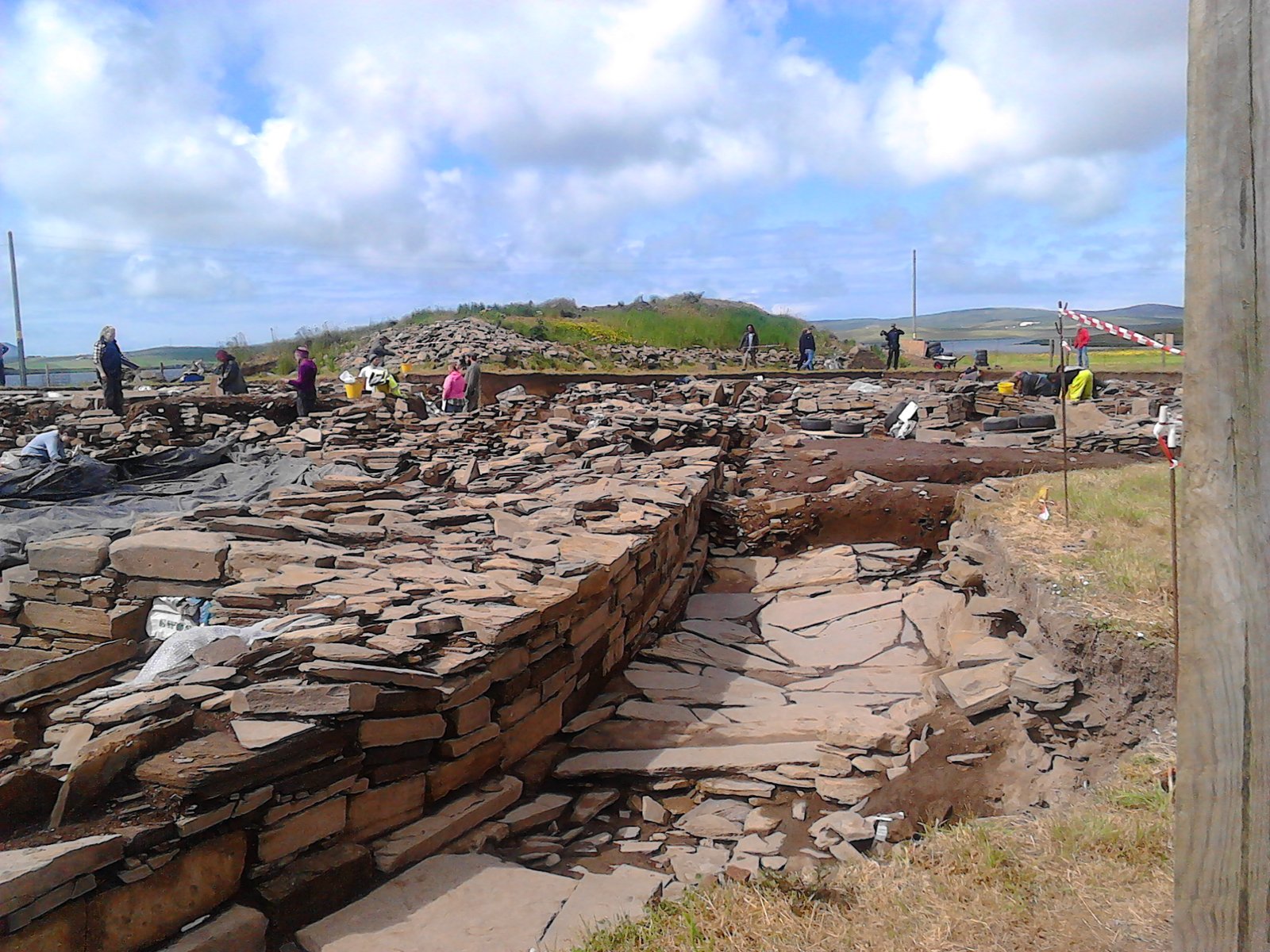
Beneath a narrow strip of land between two Orkney lochs, excavation since 2003 has uncovered a Neolithic ceremonial complex whose monumental buildings — larger and more elaborate than anything at Stonehenge — are rewriting the prehistory of Britain.
At a glance
The Ness of Brodgar is a peninsula (ness) connecting the Stones of Stenness to the Ring of Brodgar in the heart of the Orkney UNESCO World Heritage Site. Since excavations began in 2003 under Nick Card of the Orkney Research Centre for Archaeology (ORCA), the site has revealed a dense complex of large stone-built structures from the Neolithic period (c. 3300–2300 BCE): a massive enclosure wall (the Great Wall of Brodgar) up to 6 metres wide, at least twenty substantial stone buildings, a structure (Structure 10) that has been described as a cathedral and was the largest roofed building in Britain at the time of its construction, and vast middens (rubbish deposits) containing sheep, cattle, and red deer bones that speak to feasts of extraordinary scale. The site is not yet inscribed on the UNESCO World Heritage List in its own right, but it lies immediately between two of the four monuments that together form the Heart of Neolithic Orkney WHS (inscribed 1999): the Stones of Stenness and the Ring of Brodgar.
Key facts
- Period: c. 3300–2300 BCE (Neolithic); activity centred c. 3100–2600 BCE
- Excavation: Ongoing since 2003; Nick Card (ORCA) as lead archaeologist
- Area: The ness measures approximately 2.5 hectares; only a fraction has been excavated
- Structures: At least 20 large stone buildings identified; 5–6 excavated in full
- Structure 10: c. 25 metres × 19 metres — the largest known roofed prehistoric building in Britain at its time
- Great Wall of Brodgar: Enclosure wall up to 6 metres wide and over 100 metres long
- Midden deposits: Bones of at least 400 cattle slaughtered at a single feast event (c. 2350 BCE)
- Finds: Incised and painted stonework (rare in Neolithic Europe); Grooved Ware pottery; exotic stone axes from Wales, Cumbria, and the Alps
- UNESCO: Not yet inscribed independently; within the buffer zone of the Heart of Neolithic Orkney WHS (1999)
History
The Ness of Brodgar was not recognised as an archaeological site until 2002, when ploughing disturbed a decorated stone slab. The subsequent excavation — one of the largest Neolithic digs in Europe — has progressively overturned assumptions about what Neolithic people in Britain were capable of building and organising. The complex appears to have been a major centre of ceremonial activity for the entire Neolithic world of Atlantic Britain, drawing people, animals, and prestige goods from distant regions.
The site’s founding phase dates to around 3300 BCE, broadly contemporary with the construction of the Stones of Stenness (c. 3100 BCE) and predating the Ring of Brodgar (c. 2500 BCE). Structure 10, the largest and most elaborately decorated building, was occupied for approximately 800 years and received successive remodelling, painting of its interior walls with red and yellow pigment, and installation of decorative incised stonework — practices with almost no parallel in contemporary Neolithic Europe. Radiocarbon dates indicate that the complex was deliberately closed around 2300 BCE: a deliberate decommissioning event in which Structure 10 was filled with the carcasses of several hundred cattle, the roof was pulled down onto the fill, and the building was sealed. This final feast is the largest single-event assemblage of Neolithic animal bones known anywhere in Britain.
The extraordinary painted stonework from the Ness has led some archaeologists to reconsider the visual culture of Neolithic Europe: abstract patterns in red, orange, and yellow pigment suggest a far more colourful built environment than the bare grey stone that survives to the present day.
What you see
The excavated portion of the Ness is visible during the summer dig season (late July to early September) from a public walkway around the trenches, and guided tours are offered. Structure 10 — the cathedral — is the centrepiece: its floor area dwarfs any other roofed Neolithic building known in Britain, and its walls (surviving to over a metre in height) retain painted decoration visible in the shelter of the dig. Smaller structures (Structure 1, 8, 12, and others) surround the central building, separated by paved passages and drains. The Great Wall of Brodgar, a massive drystone enclosure wall, demarcates the ceremonial precinct on the isthmus.
Outside the dig season the site is covered and appears as a low grassy mound. The visitor centre near the Stenness end of the ness provides context, finds displays, and information about the ongoing research. The surrounding landscape — Ring of Brodgar to the north, Stones of Stenness to the south, Watch Stone on the loch shore — makes this one of the most evocative prehistoric landscapes in Europe.
In the Heart of Neolithic Orkney
The Ness sits within a landscape that has been a UNESCO World Heritage Site since 1999 under the name Heart of Neolithic Orkney, comprising four monuments: Skara Brae (the best-preserved Neolithic village in northern Europe), Maeshowe (the finest megalithic chambered tomb in Britain), the Stones of Stenness, and the Ring of Brodgar. The Ness of Brodgar is the most significant archaeological discovery made in Orkney since Skara Brae was exposed by a storm in 1850, and there is an active campaign to extend the WHS boundary to include it. The finds from the Ness are displayed in the Orkney Museum in Kirkwall and at the Ness of Brodgar Visitor Centre.
Practical information
- Open to the public: Dig season late July to early September (check orkneyjar.com/ness for annual dates); guided tours from the visitor centre.
- Outside dig season: The site is covered; the visitor centre may be closed. The surrounding monuments (Ring of Brodgar, Stones of Stenness) are always open and free.
- Visitor centre: Near the Stenness end of the B9055 road; displays of finds, research, and site history.
- Admission: Free to view from the public walkway; small charge for guided tours.
- Road access: B9055, between Stromness and Finstown, Orkney Mainland.
Getting there
The Ness of Brodgar is on the B9055 on the Orkney Mainland, approximately 5 km northeast of Stromness and 12 km west of Kirkwall. Orkney is reached by NorthLink overnight ferry from Aberdeen or Scrabster (near Thurso), or by Loganair flights from Edinburgh, Aberdeen, Inverness, and other UK airports to Kirkwall Airport. Bus services connect Kirkwall and Stromness; the Ness is walkable from the Ring of Brodgar car park (c. 1 km). A hire car gives the most flexibility for exploring the Neolithic landscape.
Nearby
- Ring of Brodgar (c. 800 m north): A henge and stone circle 104 metres in diameter, one of the largest in Britain; UNESCO WHS.
- Stones of Stenness (c. 1 km south): The tallest standing stones in Orkney (up to 6 metres); c. 3100 BCE; UNESCO WHS.
- Maeshowe (c. 3 km east): The finest megalithic chambered tomb in Europe, with Viking runic graffiti; UNESCO WHS.
- Skara Brae (c. 9 km northwest): The best-preserved Neolithic village in northern Europe, UNESCO WHS; visitor centre with full-scale replica house.
- Orkney Museum (Kirkwall): Finds from Ness of Brodgar and other Orcadian sites; free admission.
Sources
- Card, N., Edmonds, M., and Mitchell, A. (eds.) (2020). The Ness of Brodgar: As it Stands. Kirkwall: The Orcadian.
- Orkney Research Centre for Archaeology (ORCA) — annual excavation reports (orkneyjar.com/ness)
- Historic Environment Scotland — Heart of Neolithic Orkney WHS management plan
- Wikipedia: Ness of Brodgar
Find it on the map
See this place and what’s around it →📷 Become a Cultural Heritage Online photographer
Share your photos of places: they stay published under your name as the author. The more they're seen, the more you get noticed — and soon a contest will reward the most appreciated photos.
Log in or sign up free to add a photo