
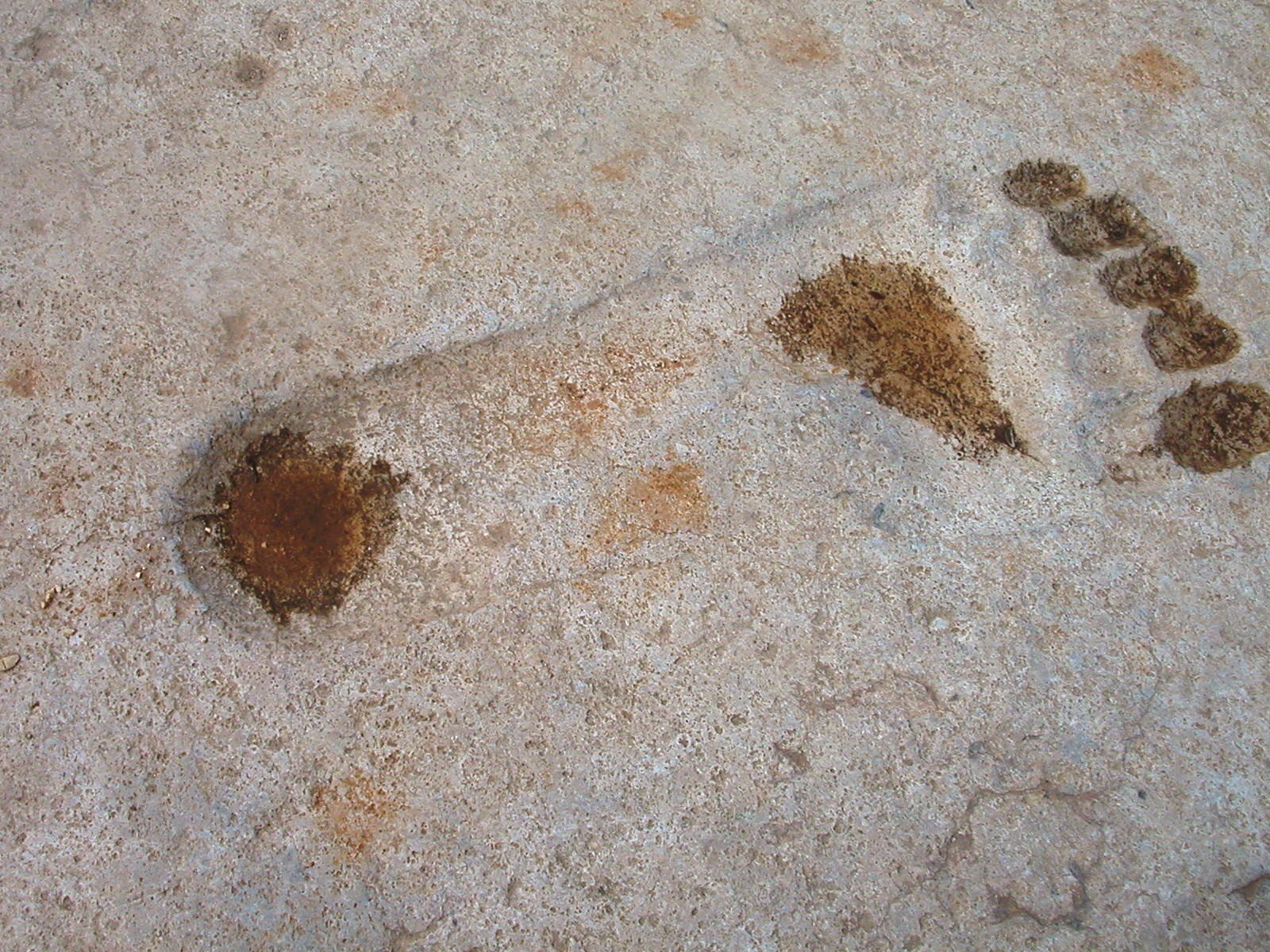
Ain Dara was one of the finest Syro-Hittite religious complexes in the ancient Near East — a basalt and limestone temple to the goddess Ishtar, famous above all for the colossal divine footprints carved into its threshold: the literal footsteps of a god, each one metre long, walking into the inner sanctuary. In January 2018, a Turkish airstrike destroyed approximately 40% of the site.
At a glance
Set on a hill above the Afrin River valley in northwestern Syria, Ain Dara was built around 1300 BC and continuously modified until the Assyrian destruction around 740 BC. The site was excavated systematically by Syrian archaeologists from the 1980s onward and was considered one of the best-preserved Syro-Hittite temple complexes in the region. Its carved lions and sphinxes, wall orthostats depicting divine processions, and — uniquely in the ancient world — the metre-long divine footprints in the entrance courtyard made it an irreplaceable record of Iron Age religious architecture and iconography. The 2018 airstrike destroyed the northwestern section and remains a landmark case in the legal and political debate over the destruction of cultural heritage in armed conflict.
Key facts
- Period: c. 1300–740 BC (Iron Age I–II; Syro-Hittite)
- Deity: Ishtar (or a local storm goddess equivalent)
- The divine footprints: a left footprint, then (20 metres away) a right footprint, each approximately 1 metre long, carved into the basalt threshold courtyard — unique in all of ancient Near Eastern archaeology
- Sculptural decoration: enormous carved lions and sphinxes at entrances; basalt orthostats with divine processions; carved column bases
- Destruction: approximately 40% destroyed by Turkish airstrike on 20 January 2018 (Operation Olive Branch); documented by ASOR satellite analysis
- Current status: in territory controlled by Turkey-aligned forces; inaccessible to archaeologists and international monitors
- Excavation history: Syrian Department of Antiquities from 1980s; key publication by Ali Abu Assaf, 1990
History
The temple of Ain Dara was built by the rulers of a Syro-Hittite city-state around 1300 BC, during the early Iron Age. Syro-Hittite culture emerged in northern Syria and southeastern Turkey after the collapse of the Hittite Empire around 1200 BC — a fusion of Hittite artistic and religious traditions with local Aramaic-speaking populations. The temple form — a rectangular sanctuary with a columned portico and an inner holy of holies (the debir) — is architecturally similar to the Temple of Solomon described in 1 Kings, and several scholars have used Ain Dara as a physical analogue for understanding biblical temple architecture, though the parallels are typological rather than direct.
The temple was dedicated to a goddess (most likely Ishtar, the Semitic goddess of love and war) and was in continuous use for approximately 550 years, with multiple rebuilding phases visible in the stratigraphy. During this period it accumulated its extraordinary sculptural programme: stone lions and sphinxes guarding the entrances, carved basalt orthostats lining the outer walls with images of gods, monsters, and divine attendants, and — most distinctively — the pair of metre-long footprints carved into the courtyard basalt.
The footprints narrate a divine arrival. The left foot appears first, near the entrance to the outer courtyard. Twenty metres later, as you approach the inner porch, the right foot appears. The story told by the threshold is that a divine being descends from the sky, lands in the outer courtyard, and walks into the inner sanctuary. No other ancient temple anywhere in the world has anything comparable. The feet are barefoot, anatomically realistically carved, and the toes are clearly delineated.
The Assyrians sacked and burned the temple around 740 BC during the campaigns of Tiglath-Pileser III, and the site was never reoccupied as a religious centre. It passed into agricultural use and then silence. Excavations began in the 1980s under Syrian archaeologist Ali Abu Assaf and continued into the 2000s.
On 20 January 2018, during the Turkish military Operation Olive Branch against Kurdish YPG forces in Afrin, a Turkish airstrike hit the temple mound. Analysis of before-and-after satellite imagery by ASOR Cultural Heritage Initiatives (published April 2018) showed approximately 40% of the site destroyed — the entire northwestern section obliterated, including structural elements, some orthostats, and the northern retaining wall. The giant carved lions at the entrance and the divine footprints in the southern threshold courtyard appear to have survived. International condemnation followed, but no accountability process was initiated. The site remains inaccessible.
What you see
Before 2018, the site offered extraordinary visible archaeology: the basalt threshold with its metre-long divine footprints; enormous carved lions and sphinxes (some standing over 2 metres tall) guarding the portico entrances; wall orthostats carved with processions of deities, monsters, and guardian figures in the Syro-Hittite style; carved column bases; and the clear tripartite plan of the temple (outer porch, inner porch, holy of holies) preserved in stone foundations.
After the 2018 airstrike, the state of the surviving elements is unknown. Satellite imagery confirms major structural destruction in the northwestern sector. The Syrian Department of Antiquities has declared all cultural heritage sites in the Afrin region inaccessible for monitoring purposes. Selected carved orthostats were removed to the Aleppo National Museum before the war; their current condition is unknown.
Practical information
- Current access: Not accessible — the site is in a conflict zone under the control of Turkey-aligned Syrian forces; no safe access for tourists or researchers
- Monitoring: ASOR Cultural Heritage Initiatives publishes ongoing satellite-based damage assessments at asor-syrianheritage.org
- Pre-war access: The site was a day trip from Aleppo (120 km south); road through Afrin district
- Finds: Selected orthostats at the Aleppo National Museum (access uncertain); photographs in Abu Assaf 1990 publication
Getting there
Ain Dara is located approximately 50 km northwest of Aleppo in the Afrin district of Aleppo Governorate. Before 2011, the standard approach was a day trip from Aleppo by private car or taxi through the Afrin district, with the site clearly signposted on the road north from the town of Afrin. Since 2018, all access routes pass through active or recent conflict areas and the site is not safely visitable by any independent traveller.
Nearby
- Cyrrhus (Nebi Huri) — 30 km northeast, a Hellenistic and Roman city with two well-preserved Roman tower tombs and a substantial city wall, in the same restricted zone
- Tell Afis — 60 km southeast, an important Bronze and Iron Age tell in the Idlib Governorate, with Aramaic inscriptions
- Aleppo Citadel — 120 km south, one of the largest and oldest medieval castles in the world; heavily damaged in the Syrian Civil War but partially restored
Sources
- Abu Assaf, Ali — Der Tempel von ‘Ain Dara, Damaszener Forschungen 3, Philipp von Zabern, 1990
- ASOR Cultural Heritage Initiatives — Satellite damage assessments, 2018
- Monson, J. — “The New ‘Ain Dara Temple: Closest Solomonic Parallel,” Biblical Archaeology Review 26(3), 2000
- Wikipedia — Ain Dara (archaeological site)
Find it on the map
See this place and what’s around it →📷 Become a Cultural Heritage Online photographer
Share your photos of places: they stay published under your name as the author. The more they're seen, the more you get noticed — and soon a contest will reward the most appreciated photos.
Log in or sign up free to add a photoIs this page about you?
This page is read by travellers and heritage enthusiasts who find it on Google. Tell us how you are connected to this place and we will take it from there.