

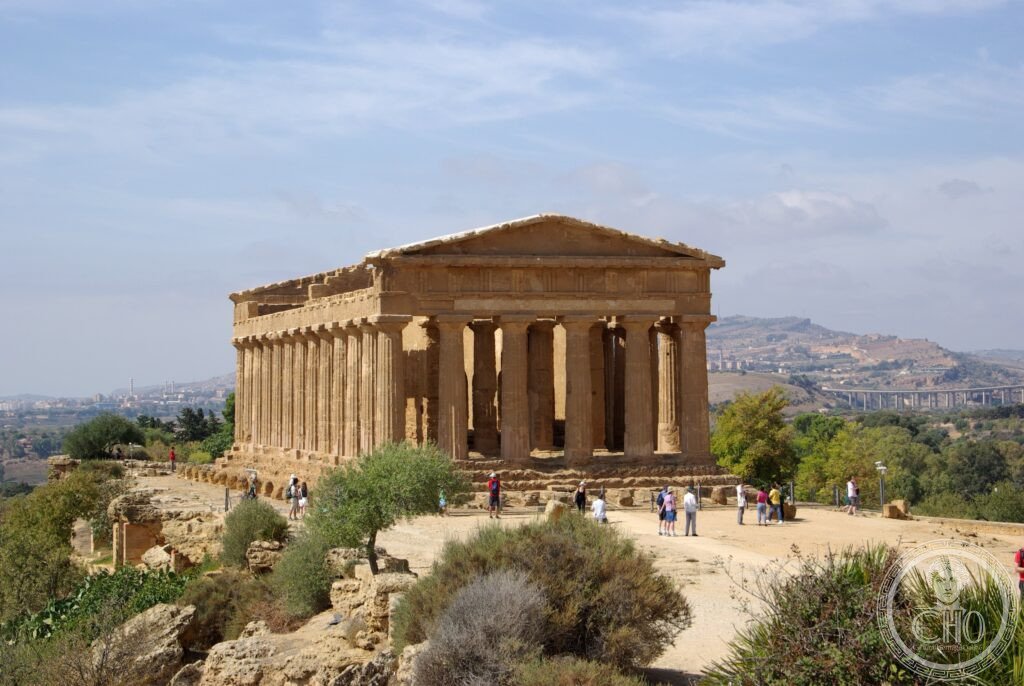
On a limestone ridge above the Sicilian coast stand seven Doric temples raised by the Greek colony of Akragas in the 5th century BCE. Chief among them, the Temple of Concordia survives almost intact, rivalled only by the Parthenon, while the unfinished Temple of Zeus hints at a building project ancient Greece never completed.
At a glance
Despite its name, the Valle dei Templi is not a valley but a ridge, the Rupe Atenea, running east to west above the sea a short distance south of modern Agrigento. The temples stand along its southern rim, facing the water, within a protected archaeological area covering some 1,300 hectares, said to be the largest Greek archaeological park anywhere.
Seven Doric temples from the 5th century BCE survive here in varying states, built by the citizens of Akragas, then among the largest cities in the Greek world.
Key facts
- Location: Agrigento, Sicily, on a ridge roughly three kilometres south of the modern town and four kilometres from the coast.
- Founded: the Greek colony of Akragas, established around 580 BCE by settlers from Gela, itself a colony of Rhodes and Crete, with further colonists arriving directly from Rhodes.
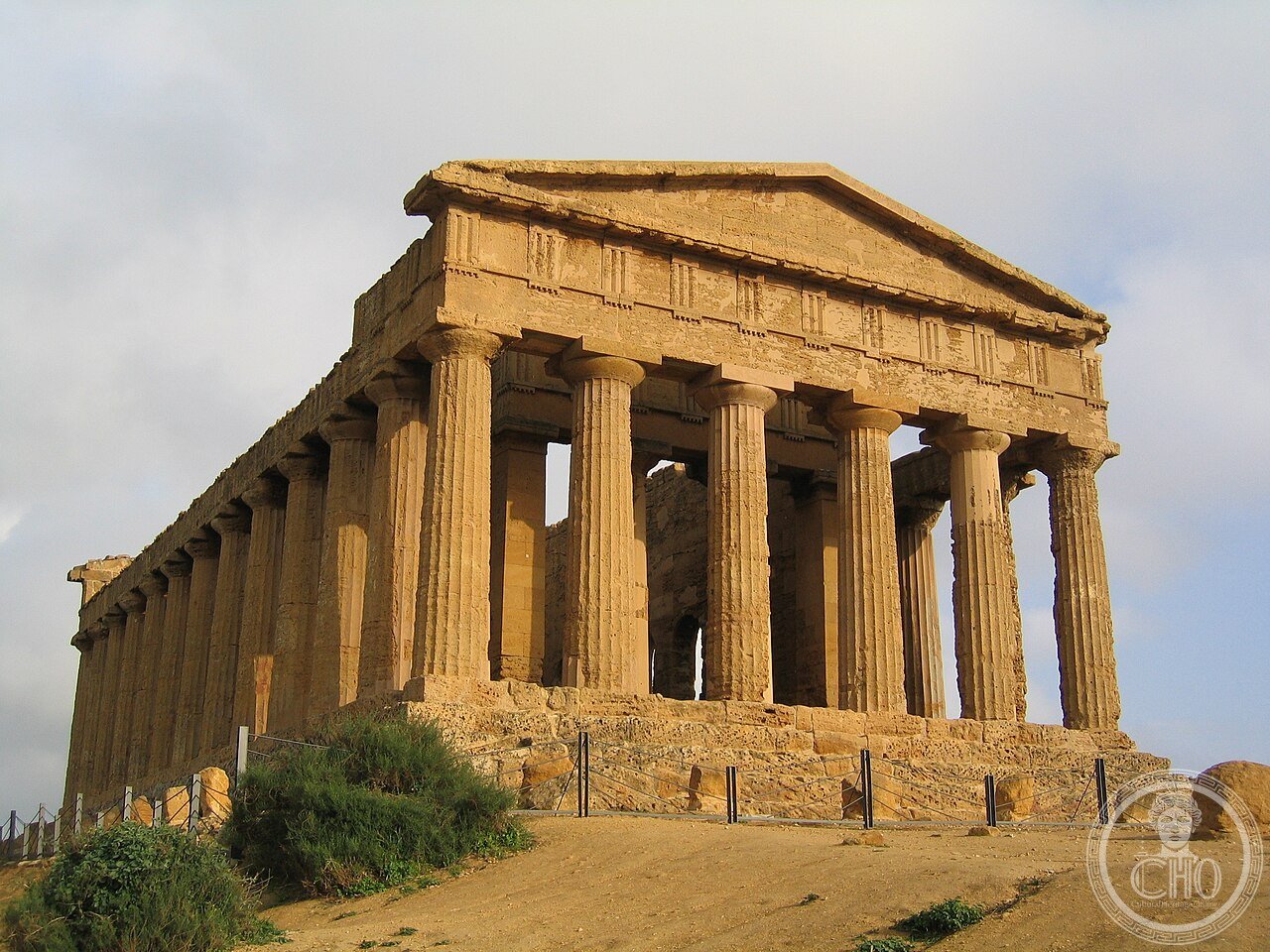
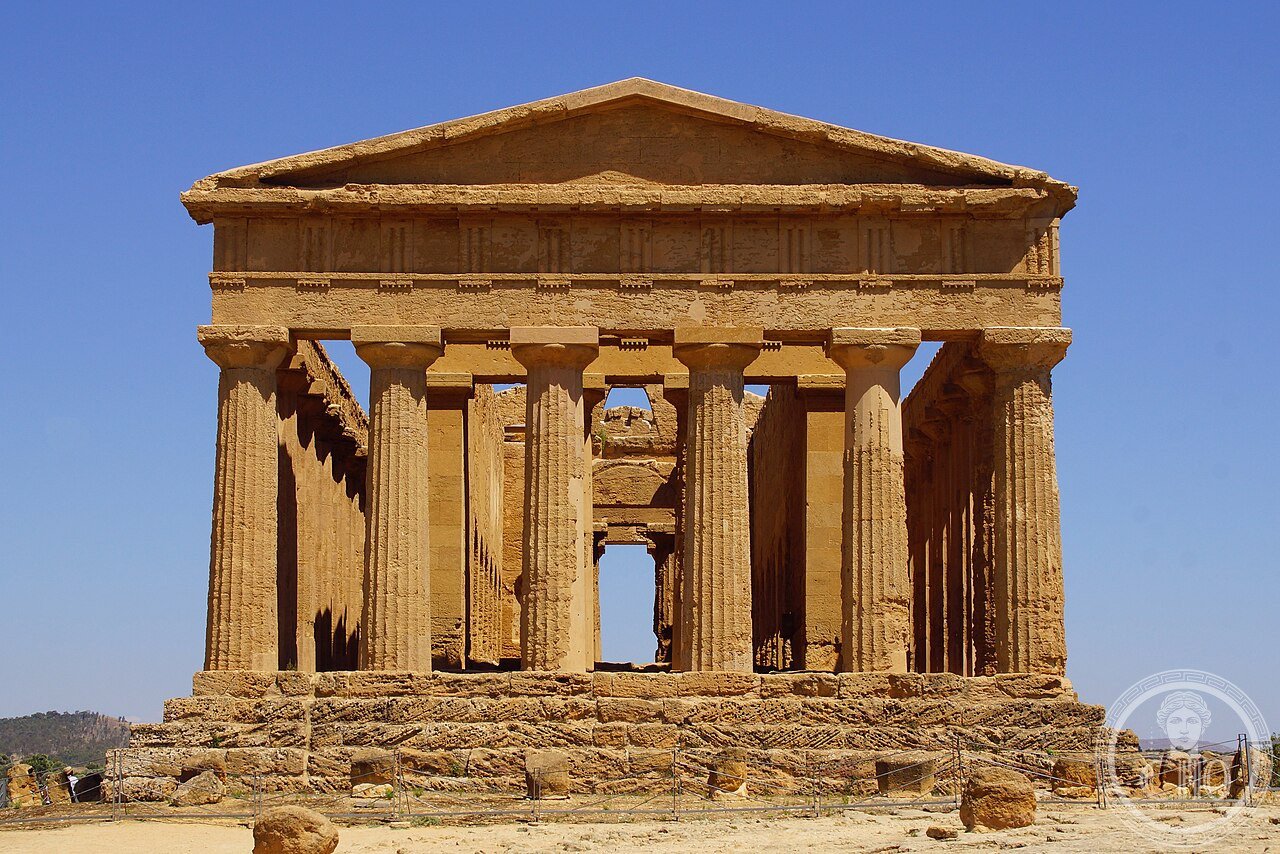
- Best-preserved monument: the Temple of Concordia, of about 440 BCE, considered the most complete Doric temple in the world outside the Parthenon.
- Largest project: the Temple of Olympian Zeus, begun around 480 BCE and never finished, designed as the largest Greek temple ever attempted.
- Recognition: inscribed on the UNESCO World Heritage List in 1997, reference 831.
History
Ancient writers place the founding of Akragas around 580 BCE. Thucydides records it as 108 years after the foundation of Gela, and Diodorus Siculus dates it to the 50th Olympiad, both pointing to the same period. The city was settled by around 4,000 colonists from Gela, joined by further arrivals from Rhodes.
The 5th century BCE was Akragas’s high point. Ancient sources describe it as one of the largest cities in the Greek world after Athens and Syracuse, with population figures running into the hundreds of thousands, though modern archaeologists regard these as exaggerated and suggest a more realistic range in the tens of thousands. Its wealth rested substantially on olive oil, exported to Carthage and Egypt; the surrounding countryside remains a major olive-growing area to this day.
In 406 BCE Carthage sacked and razed Akragas. Diodorus Siculus described the destruction as the most complete visited on a Greek city since the Persians burned Athens in 480 BCE. The population was enslaved or fled, and the city’s treasures were carried off, including the bronze bull of Phalaris, a torture device built by the tyrant Phalaris in the 6th century BCE, which was later returned to Sicily following the Roman conquest. The Valley of the Temples was inscribed by UNESCO in 1997.
What you see
Walking the ridge from west to east, visitors pass the Temple of Hephaestus and the Temple of Vulcan, both heavily ruined, before reaching the Temple of Concordia, its full colonnade of thirteen by six columns still standing. It owes its survival to its conversion into a Christian church in 597 CE, when Bishop Gregorius of Agrigento had the spaces between the columns walled up, cut new doorways through the cella and reversed the building’s orientation. Those alterations, later removed, are credited with helping the colonnade withstand centuries of earthquakes; traces of the church, including a raised platform and the arched doorways, remain visible inside.
Further east stands the Temple of Juno, of similar scale to Concordia, its stonework reddened on one side by fire, evidence of the Carthaginian sack of the city. The Temple of Hercules, the oldest on the ridge, has only nine of its original columns re-erected, work carried out by the English archaeologist Alexander Hardcastle in 1924.
To the west lies the Temple of Olympian Zeus, planned on a scale unmatched by any other Greek temple, more than twice the footprint of the Parthenon. Its outer wall was to have been supported by giant carved figures known as telamones, over seven metres tall, one of which lies reconstructed in the field beside the ruins; the fragments of an original telamon are kept in the Museo Regionale Archeologico Pietro Griffo. Construction stopped when Carthage destroyed Akragas in 406 BCE, and much of the temple’s stone was later quarried for building work elsewhere. Nearby, the Temple of the Dioscuri, with its four standing columns pieced together in 1836 from fragments of three different buildings, has become the most photographed image of the site, despite its partly reconstructed nature. The museum itself holds further finds from the temples and the wider necropolis, including a marble kouros known as the Ephebus of Agrigento and painted terracotta sarcophagi from the Heracleia burial ground.
Practical information
- Access: the archaeological area and museum can be visited separately or together; check the official Parco Valle dei Templi channels for current tickets and opening times.
- Walking: the temples are linked by a path along the ridge, the Via Sacra, suitable for walking the full circuit on foot.
- Season: the Concordia temple faces east, so early morning light is best for viewing its colonnade.
Getting there
The Valley of the Temples lies a short distance south of the town of Agrigento, on the ridge above the coast. The site is reached from the modern town, with the temples themselves set along the southern rim facing the sea.
Nearby
- Museo Regionale Archeologico Pietro Griffo — the archaeological museum holding finds from the temples and the Akragas necropolis, including the Ephebus of Agrigento and telamon fragments.
- Giardino della Kolymbethra — a historic irrigation garden within the archaeological park.
- Porto Empedocle — the modern harbour, part of whose jetty is said to have been built from stone quarried from the unfinished Temple of Zeus.
Sources
- Diodorus Siculus
- Thucydides
- UNESCO
- Museo Regionale Archeologico Pietro Griffo
Gallery
Find it on the map
See this place and what’s around it →
📷 Become a Cultural Heritage Online photographer
Share your photos of places: they stay published under your name as the author. The more they're seen, the more you get noticed — and soon a contest will reward the most appreciated photos.
Log in or sign up free to add a photo