

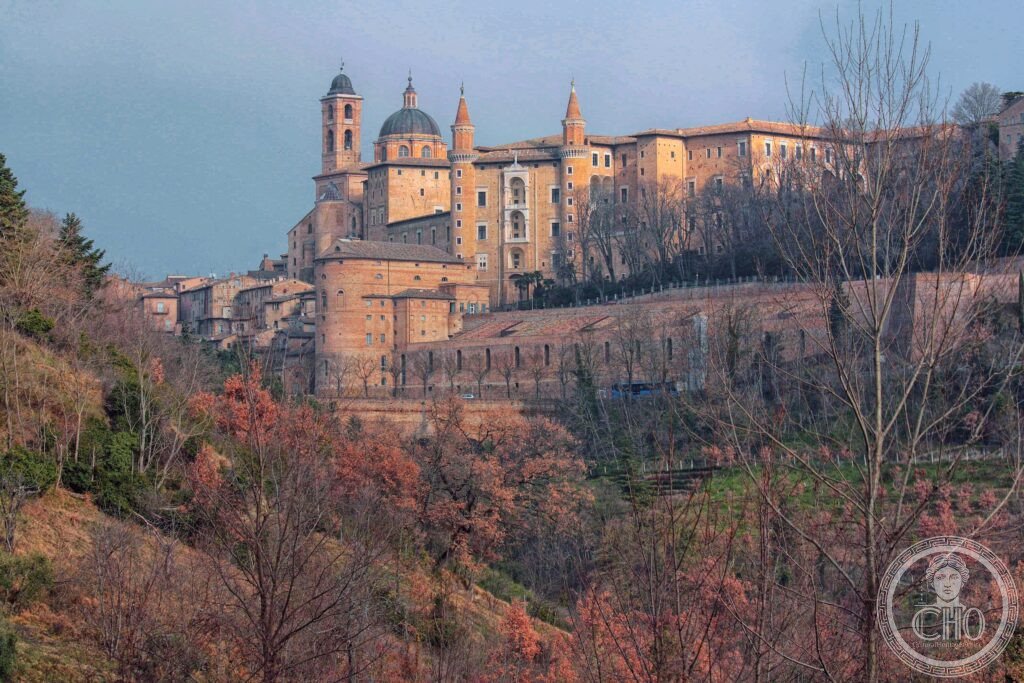
Urbino’s historic centre and the Ducal Palace form one of the most complete surviving expressions of the Italian Renaissance court, built for Federico da Montefeltro by architects and painters who defined the age, and still standing largely as they left it.
At a glance
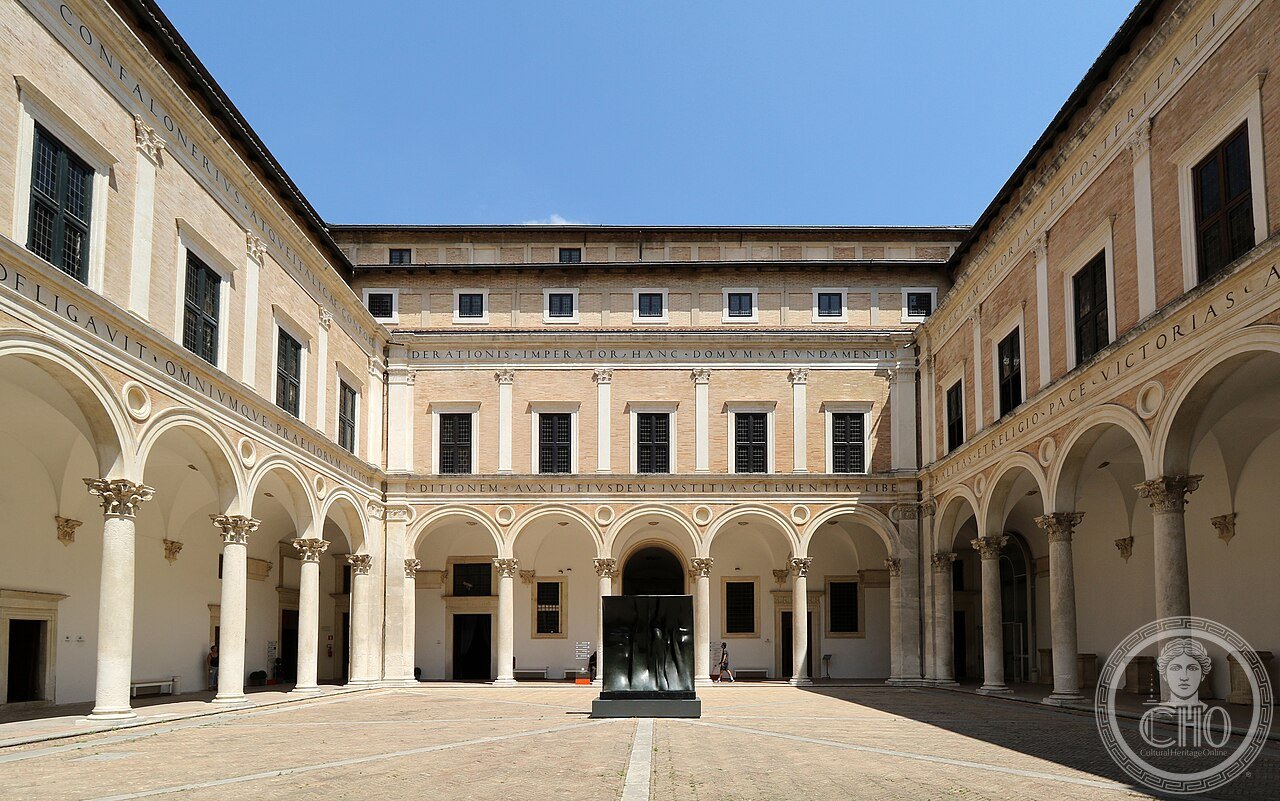
Urbino’s historic centre, inscribed by UNESCO in 1998, is dominated by the Ducal Palace built between 1468 and 1482 for Federico da Montefeltro. Its west facade, known as the facade of the torricini, pairs two slender cylindrical towers with a three-storey loggia and is widely regarded, by Vasari among others, as one of the most refined facades of the Italian Quattrocento.
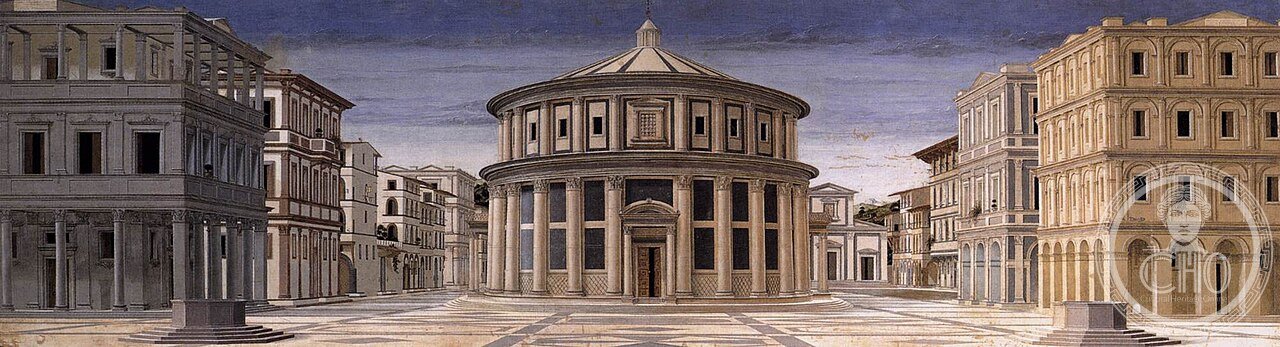
Inside, the palace holds the Studiolo of Federico da Montefeltro, a small private study lined with trompe l’oeil wood inlay, and the Galleria Nazionale delle Marche, whose collection includes Piero della Francesca’s Flagellazione and the panel known as the Città Ideale. Raphael was born in the town in 1483, and his family house survives as a small museum.
Key facts
- Palace built: 1468–1482, for Duke Federico da Montefeltro
- Architects: Luciano Laurana, then Francesco di Giorgio Martini
- Studiolo: a small study, about 3.6 by 3.6 metres, lined with intarsia wood panels attributed to the workshop of Giuliano da Maiano, 1474–1476
- Key painting: Piero della Francesca’s Flagellazione di Cristo, a small panel of disputed interpretation
- UNESCO status: historic centre of Urbino inscribed 1998, reference 828, covering 57.5 hectares within the walls
- Raphael: born in Urbino in 1483; his birthplace is preserved as the Casa di Raffaello
History
Urbino was ruled by the Montefeltro family from the thirteenth century, and reached its height under Federico da Montefeltro, who became lord of the city in 1444 and was made duke by the Pope. Trained as a condottiere, Federico was decorated by both Edward IV of England and Emperor Frederick III, and used the wealth of his military career to assemble one of the leading courts of the Italian Renaissance.
Between 1460 and 1482 that court brought together Piero della Francesca, the architect Luciano Laurana and later Francesco di Giorgio Martini, and the Spanish painter Pedro Berruguete, who painted Federico in armour with his son Guidobaldo. Laurana was appointed architect of the new palace in 1466 after the death of his predecessor, Maso di Bartolomeo, and oversaw the building of the torricini facade before Francesco di Giorgio Martini continued the work.
Raphael Sanzio was born in Urbino in 1483, a year after Federico’s death, the son of the court painter Giovanni Santi. The historic centre of the city was inscribed on the UNESCO World Heritage List in 1998, under reference 828.
What you see
The palace’s west facade presents two cylindrical towers, each of five storeys and about 32 metres high, framing a three-storey loggia with the window of the Duchess above. The Studiolo, reached through the palace’s ground-floor rooms, is covered in wood marquetry made from around 7,000 pieces of timber in some 28 identified species, arranged to depict bookshelves, musical and mathematical instruments and armour in convincing perspective, lit to match the direction of the room’s actual window.
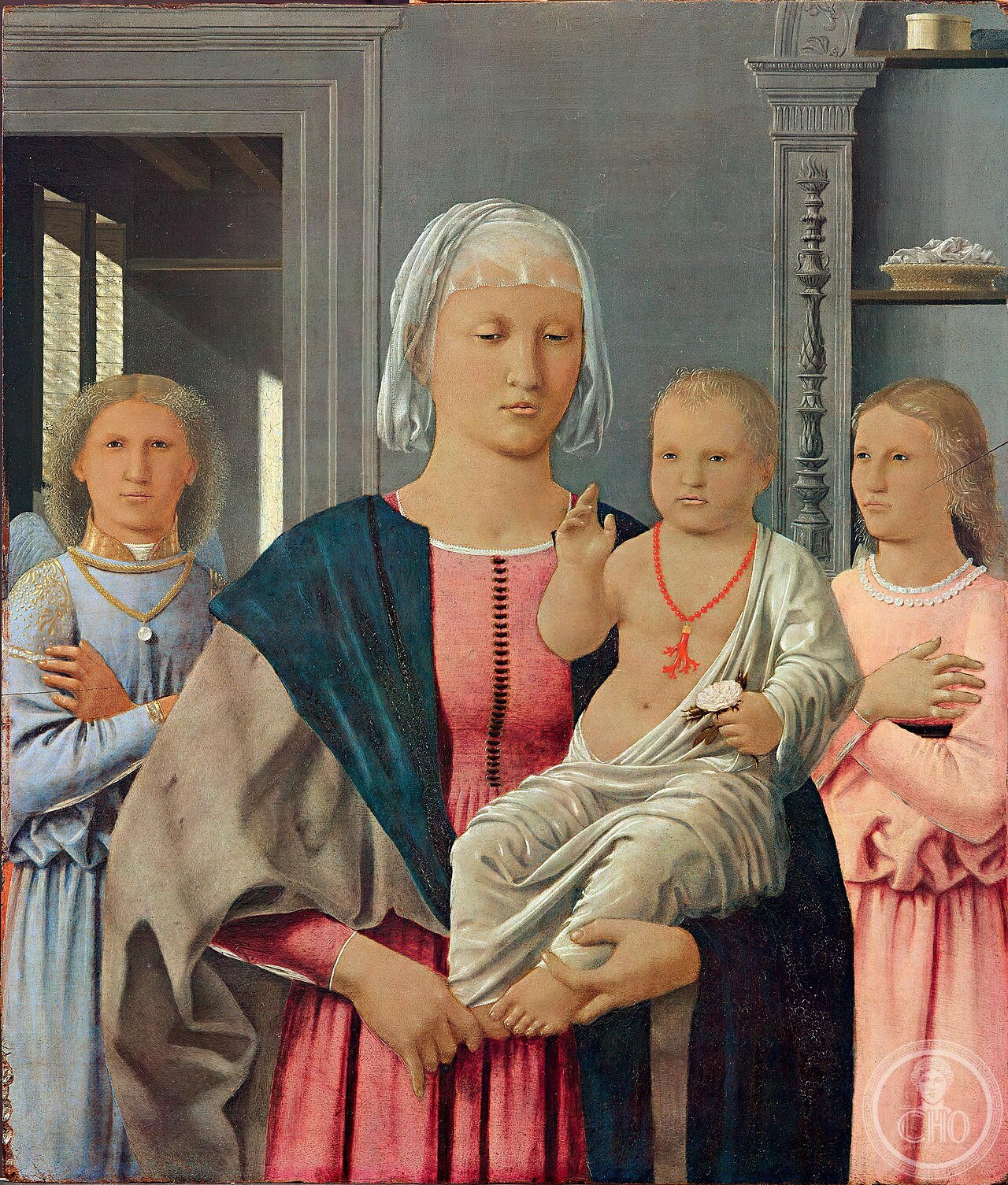
The Galleria Nazionale delle Marche occupies the first floor and mezzanine of the palace. Its holdings include Piero della Francesca’s Flagellazione di Cristo, a small panel whose perspective construction and the identity of its three foreground figures remain debated by scholars, his Madonna di Senigallia, and the Città Ideale, a panel showing an empty, geometrically perfect piazza whose authorship is disputed between Piero, Francesco di Giorgio Martini and Luciano Laurana.
Elsewhere in the town, the Casa di Raffaello preserves the house where Raphael was born, including a room with a fresco of the Madonna that infrared analysis in 2020 suggested may be an early work by the artist as a child. The Oratorio di San Giovanni holds fresco cycles by Jacopo and Lorenzo Salimbeni.
Practical information
- Galleria Nazionale delle Marche: housed in the Ducal Palace; check the museum’s official channels for current admission and opening times
- Casa di Raffaello: Via Raffaello 57; check official sources for visiting hours
- Oratorio di San Giovanni: Via Barocci 31, for the Salimbeni fresco cycle
- Visiting the Studiolo: the room is small and can feel crowded; arriving earlier in the day allows a quieter visit
Getting there
The Ducal Palace stands in Piazza Duca Federico in the centre of Urbino, within easy walking distance of the Casa di Raffaello and the town’s other historic sites, all contained within the walled historic centre.
Nearby
- Casa di Raffaello — a short walk from the Ducal Palace, the house where Raphael was born
- Oratorio di San Giovanni — nearby in Via Barocci, with fresco cycles by Jacopo and Lorenzo Salimbeni
- Gubbio Studiolo — not on site but worth knowing of: the near-identical studiolo made for Federico’s palace at Gubbio is now installed in the Metropolitan Museum of Art in New York
Sources
- UNESCO
- Vasari, Vite (1550)
- Jacob Burckhardt, The Civilisation of the Renaissance in Italy (1860)
- Metropolitan Museum of Art
Gallery
Find it on the map
See this place and what’s around it →📷 Become a Cultural Heritage Online photographer
Share your photos of places: they stay published under your name as the author. The more they're seen, the more you get noticed — and soon a contest will reward the most appreciated photos.
Log in or sign up free to add a photoIs this page about you?
This page is read by travellers and heritage enthusiasts who find it on Google. Tell us how you are connected to this place and we will take it from there.