Peru has 13 UNESCO World Heritage Sites — a list that ranges from the cloud-forest citadel of Machu Picchu and the Inca capital of Cusco to proto-urban ceremonial centres that predate the pyramids of Egypt, vast stretches of Andean royal road, and national parks sheltering species once believed gone from the world. From Cultural Heritage Online.
Why Peru’s list looks the way it does
Peru’s World Heritage portfolio is shaped by the extraordinary layering of its civilisations. Long before the Inca established their empire in the fifteenth century, Andean cultures had already built monumental centres, developed precise astronomical instruments, and organised complex trade networks across the continent. The sites inscribed in Peru reflect at least 4,000 years of that unbroken sequence — from the Norte Chico settlements of Caral to the colonial baroque of Cusco’s cathedral plaza.
Geography amplifies the diversity. The country encompasses Pacific desert coast, high-altitude altiplano, Andean cloud forest, and Amazonian lowland — four radically different environments that produced distinct cultures and distinct heritage types. Of the 13 inscribed sites, nine are cultural, two are natural, and two carry mixed status, recognised for outstanding value on both counts.
The first inscriptions
Peru entered the World Heritage List in 1983, at the seventh session of the World Heritage Committee held in Florence. Two sites were inscribed simultaneously — and both remain among the most recognised on the entire global list:
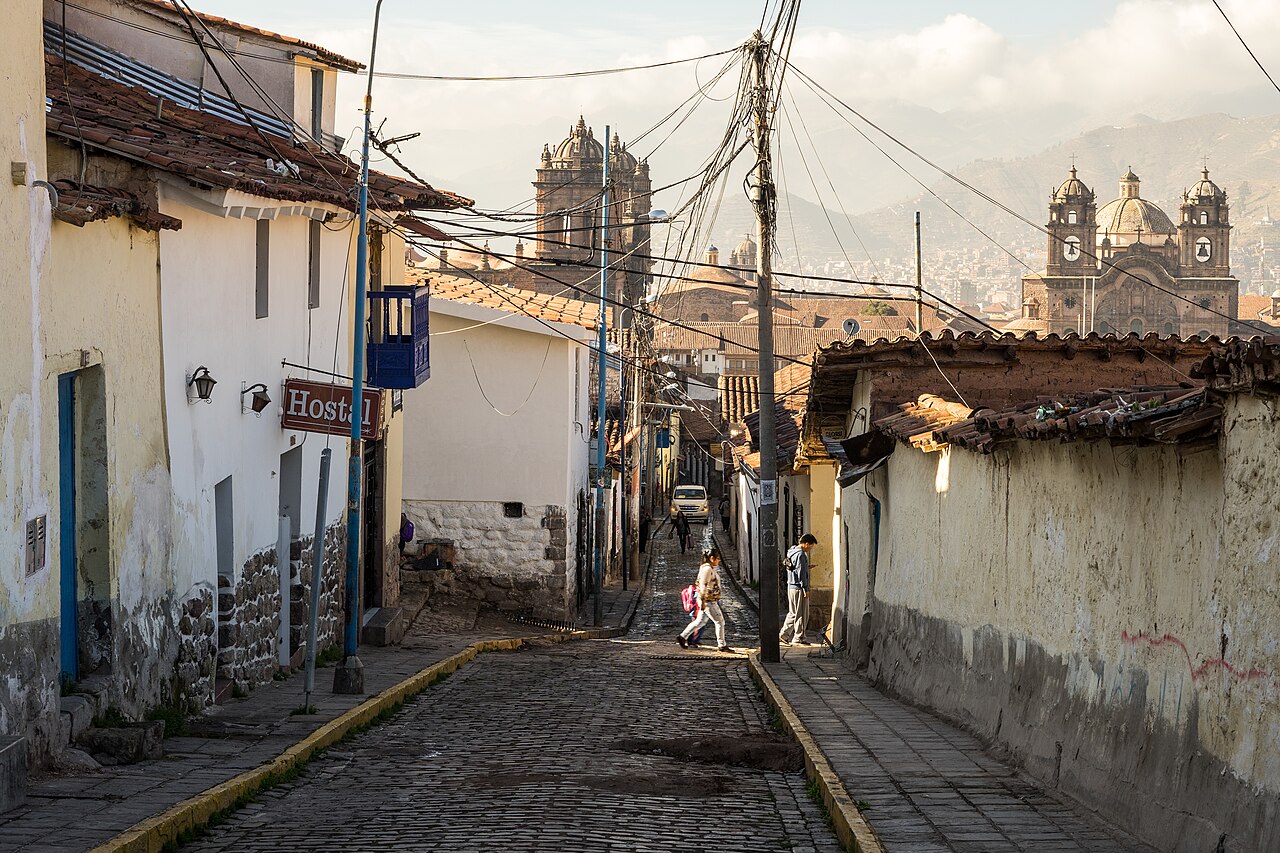
- City of Cusco — the former capital of the Inca Empire, whose urban fabric preserves monumental Inca stonework beneath and within its Spanish colonial architecture.
- Historic Sanctuary of Machu Picchu — the fifteenth-century royal estate set on a ridge above the Urubamba River, inscribed as a mixed site for its cultural significance and its exceptional mountain biodiversity.
The double inscription signalled from the outset what Peru’s list would become: sites where human achievement and natural setting are inseparable.
The most visited — and the alternatives
Machu Picchu draws well over a million visitors annually and requires advance booking for entry to the citadel and the Inca Trail approaches. Cusco, as the gateway city and a World Heritage Site in its own right, is similarly crowded along its main tourist corridor. Both are unquestionably worth the effort — but Peru’s list holds several inscribed sites that see a fraction of that footfall.
- Chavín Archaeological Site (Ancash, inscribed 1985) — the ceremonial centre of the Chavín culture, which flourished between roughly 1500 and 300 BC, characterised by elaborate stone reliefs, subterranean galleries, and sophisticated drainage systems.
- Sacred City of Caral-Supe (inscribed 2009) — considered the earliest known urban settlement in the Americas, predating other New World civilisations by more than a millennium, with monumental platform mounds still rising from the desert coast north of Lima.
- Chankillo Archaeoastronomical Complex (inscribed 2021) — Peru’s most recent addition, a set of prehistoric towers on the Casma-Sechín desert that functioned as a precise solar calendar, marking solstices, equinoxes, and intermediate dates with one to two days’ accuracy.
- Lines and Geoglyphs of Nasca and Pampas de Jumana (inscribed 1994) — the immense ground drawings etched into the southern desert, whose scale and precision continue to generate serious scholarly debate about their function.
Natural and shared sites
Peru’s two purely natural World Heritage Sites protect Andean and Amazonian ecosystems of global significance. Huascarán National Park (inscribed 1985) encompasses Peru’s highest peak and a chain of glacial lakes in the Cordillera Blanca; it is a critical water source for the Pacific coast. Manu National Park (inscribed 1987) covers a dramatic altitudinal range from Andean grassland to lowland rainforest and holds one of the highest recorded levels of species diversity anywhere on Earth. A third site, Rio Abiseo National Park (inscribed 1990 and extended to mixed status in 1992), gained renewed attention after the yellow-tailed woolly monkey — long considered extinct — was rediscovered within its cloud-forest boundaries.
Peru also participates in one major transnational serial inscription: Qhapaq Ñan, Andean Road System (2014), a 30,000-kilometre network of Inca roads shared with Argentina, Bolivia, Chile, Colombia, and Ecuador. The inscription recognises not just the engineering of the road itself but the entire social and logistical infrastructure the Inca built to maintain it across six modern nations.
How to find them
Peru’s World Heritage sites sit alongside thousands of other places on CHO’s interactive map, with GPS and sourced editorial history for each. See also our guides to Italy’s and France’s UNESCO sites, and our piece on cultural travel beyond mass tourism.
Frequently Asked Questions
How many UNESCO World Heritage Sites does Peru have?
Peru has 13 UNESCO World Heritage Sites as of 2021, comprising nine cultural sites, two natural sites, and two mixed sites recognised for outstanding value under both cultural and natural criteria.
What was Peru’s first UNESCO World Heritage Site?
Peru’s first inscriptions came in 1983, when the City of Cusco and the Historic Sanctuary of Machu Picchu were added to the World Heritage List simultaneously at the seventh session of the World Heritage Committee in Florence. Both remain among the country’s most visited sites.
What is the most recently inscribed World Heritage Site in Peru?
The Chankillo Archaeoastronomical Complex was inscribed in 2021. Located on the Casma-Sechín desert on Peru’s northern coast, it is a prehistoric solar observatory capable of marking dates throughout the year with one to two days’ precision — the earliest known solar calendar in the Americas.
Does Peru have any transnational UNESCO World Heritage Sites?
Yes. Peru is one of six countries that share the Qhapaq Ñan, Andean Road System inscription, added to the World Heritage List in 2014. The serial site covers over 30,000 kilometres of Inca roads and associated infrastructure across Argentina, Bolivia, Chile, Colombia, Ecuador, and Peru.
Sources used in this article
- UNESCO — State Party Peru — World Heritage list.
- UNESCO — Peru: World Heritage Sites.
- CHO magazine — What is a World Heritage Site?
- CHO — Interactive map of heritage sites.