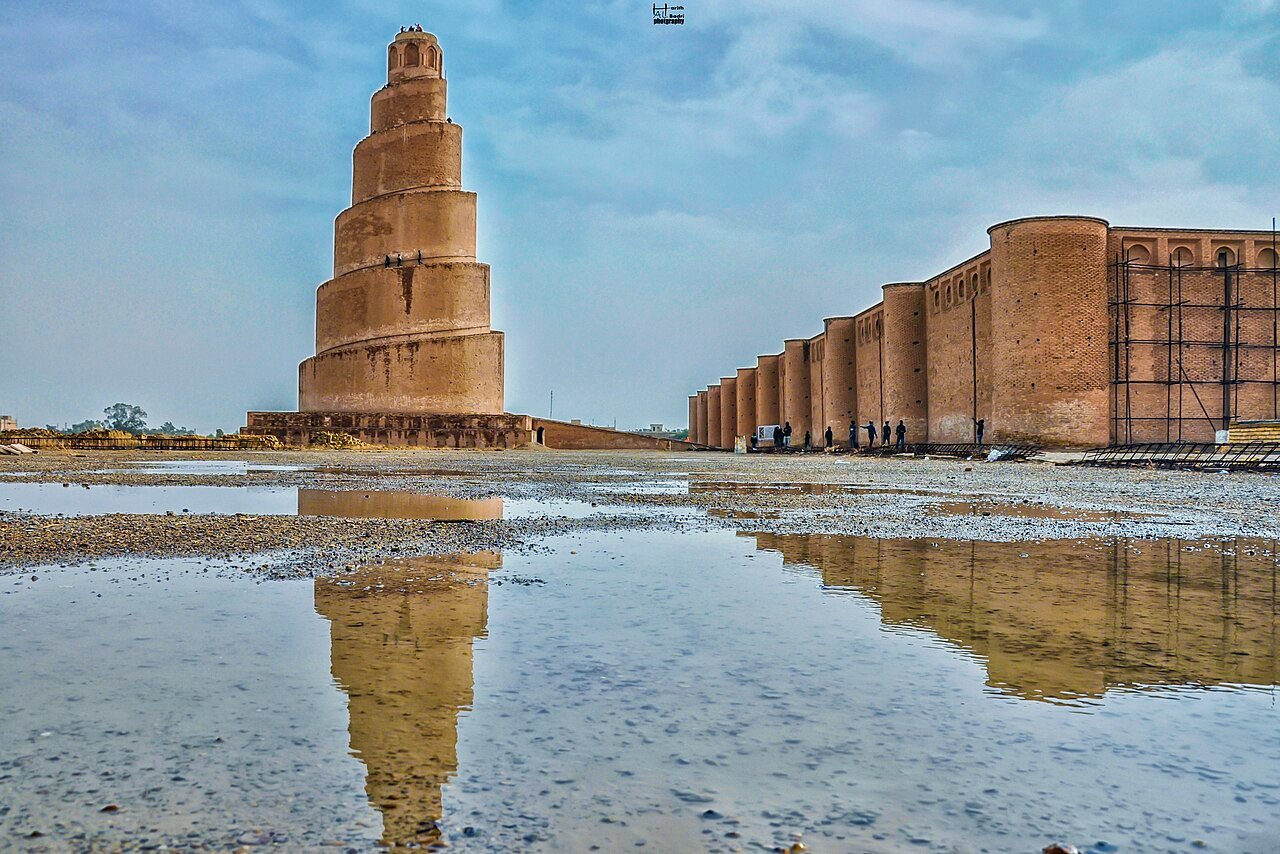
Iraq has six UNESCO World Heritage Sites, a number modest in count but extraordinary in depth — spanning the Assyrian capitals of the ancient Near East, the wetland civilisations of the southern marshes, and the legendary city of Babylon itself. The list spans roughly four millennia of continuous human settlement and reaches across the full length of the country, from the Kurdish highlands of the north to the reed-bed lagoons of the far south. From Cultural Heritage Online.
Why Iraq’s list looks the way it does
All six of Iraq’s inscribed properties are classified as cultural or mixed — the country has no purely natural World Heritage Sites. This reflects both the extraordinary density of archaeological remains in Mesopotamia, the region historically described as the cradle of urban civilisation, and the practical difficulty of nominating natural landscapes in a country that has experienced prolonged conflict and political instability since the 1980s.
The pace of inscription has been slow but steady: one site in 1985, two more between 2003 and 2007, and then three further additions between 2014 and 2019 as Iraq re-engaged with UNESCO’s nomination process. The 2016 inscription of the Ahwar of Southern Iraq marked a significant milestone, becoming the country’s first — and so far only — mixed cultural-and-natural property.
The first inscriptions
Iraq’s engagement with the World Heritage list began at the 9th session of the World Heritage Committee, held in Paris in 1985, with the inscription of a single site that set the tone for everything that followed.
- Hatra (1985) — A large fortified city of the Parthian Empire and the first capital of the Arab Kingdom, Hatra resisted Roman invasion in the second and third centuries CE. Its well-preserved temples fuse Hellenistic and Roman architecture with Eastern decorative traditions in a way found almost nowhere else.
Two further inscriptions followed in the early 2000s, as the country began nominating properties that had long been on its tentative list:
- Ashur / Qal’at Sherqat (2003) — The first capital of the Assyrian Empire, inscribed simultaneously on the List of World Heritage in Danger due to a proposed dam that threatened to flood the site.
- Samarra Archaeological City (2007) — A ninth-century Abbasid capital that stretched for forty kilometres along the Tigris and served as the seat of the caliphate for half a century.
The most visited — and the alternatives
Babylon, inscribed in 2019, is by far the most widely recognised name on Iraq’s list. The remains of the city on the Euphrates — including traces of the Ishtar Gate, the processional way, and the palace of Nebuchadnezzar II — draw the largest share of international interest, though the site’s long use as a military base during recent conflicts has left conservation challenges that continue to be addressed.
Less visited but no less significant are the three older inscriptions. Hatra’s circular city plan and hybrid architectural vocabulary reward close attention. Samarra Archaeological City contains the Great Mosque of Samarra and its famous spiral minaret, the Malwiya — one of the most recognisable structures in Islamic architectural history — as well as the smaller Abu Dulaf Mosque, which shares the same unusual helical form. Ashur, positioned at the northern end of the Tigris alluvial plain, preserves the layered remains of a city occupied without interruption from the third millennium BCE to the fourteenth century CE.
Natural and shared sites
Iraq has no purely natural World Heritage Sites, but the Ahwar of Southern Iraq (2016) contains a significant natural component alongside its archaeological dimension. The property encompasses the Mesopotamian Marshes — a vast wetland ecosystem in the delta of the Tigris and Euphrates rivers — together with the ruins of three Sumerian cities: Uruk, Ur, and Eridu. The marshes were largely drained during the 1990s and have since partially recovered, making the site as much a story of environmental restoration as of ancient heritage.
Iraq does not yet have any fully transnational World Heritage inscriptions, though pilgrimage routes connecting the country to neighbouring states appear on tentative lists. The Ahwar is itself a serial nomination, combining four wetland areas and three archaeological zones into a single property — a format that allowed UNESCO to recognise the inseparable relationship between the ancient cities and the water landscape that sustained them.
How to find them
Iraq’s six World Heritage Sites range from the Kurdish north — where Erbil Citadel rises above one of the oldest continuously inhabited urban settlements on earth — to the extreme south, where the Ahwar marshes border Kuwait and Iran. Travel access varies considerably by region and by the security conditions that apply at any given time; independent travellers should consult current government guidance before visiting.
Iraq’s World Heritage sites sit alongside thousands of other places on CHO’s interactive map, with GPS and sourced editorial history for each. See also our guides to Italy’s and France’s UNESCO sites, and our piece on cultural travel beyond mass tourism.
Frequently Asked Questions
How many UNESCO World Heritage Sites does Iraq have?
Iraq has six UNESCO World Heritage Sites, all inscribed between 1985 and 2019. Five are classified as cultural properties and one — the Ahwar of Southern Iraq — is classified as mixed, combining natural wetland areas with ancient Sumerian archaeological zones.
What was Iraq’s first UNESCO World Heritage Site?
Hatra was Iraq’s first UNESCO World Heritage Site, inscribed in 1985 at the 9th session of the World Heritage Committee in Paris. A fortified Parthian-era city that resisted Roman sieges, Hatra is celebrated for its temples, which blend Hellenistic, Roman, and Arabian architectural elements.
What is the most recently inscribed World Heritage Site in Iraq?
Babylon was inscribed on the UNESCO World Heritage List in 2019, making it the most recent addition from Iraq. The ancient city on the Euphrates is associated with Nebuchadnezzar II and features remains of the Ishtar Gate and the processional way, though conservation efforts are ongoing due to damage sustained in recent decades.
Does Iraq have any natural UNESCO World Heritage Sites?
Iraq has no purely natural World Heritage Sites. The Ahwar of Southern Iraq, inscribed in 2016, is the closest — a mixed property that encompasses the Mesopotamian Marshes alongside the ruins of the Sumerian cities of Uruk, Ur, and Eridu, recognising both the ecological and the archaeological significance of the region.
Sources used in this article
- UNESCO — State Party Iraq — World Heritage list.
- UNESCO — Iraq: World Heritage Sites.
- CHO magazine — What is a World Heritage Site?
- CHO — Interactive map of heritage sites.
Sources
- S1 — Roux, Georges. Ancient Iraq. Penguin Books, 1992. ISBN 978-0-14-012523-8.
- S2 — Leick, Gwendolyn. Mesopotamia: The Invention of the City. Penguin Books, 2001. ISBN 978-0-14-026574-3.
Spotted an error? Write to editorial@culturalheritageonline.com and we correct it the same day.