
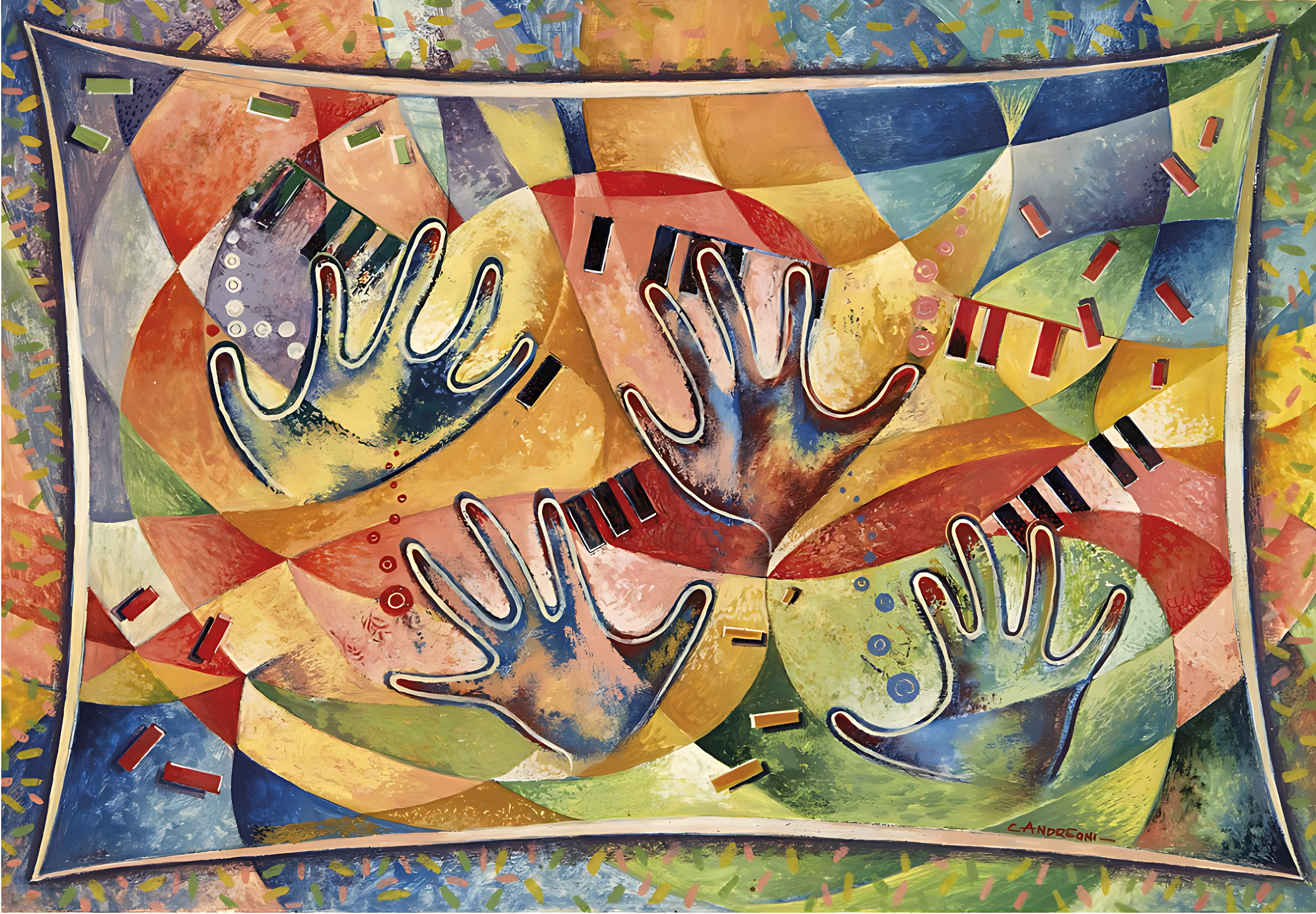
Il paese del cieco is a painting by Cesare Andreoni, created around 1935. Andreoni (1903–1961) was an Italian Futurist artist based in Milan, where he spent his entire career.
The work dates from the mature phase of Andreoni’s artistic practice, following his decisive turn toward Futurism. His early training at the Accademia di Brera under Professor Cattaneo gave way to engagement with the Futurist movement, which became central to his artistic identity. Il paese del cieco exemplifies the Futurist preoccupation with dynamism, modernity, and visual intensity characteristic of the movement during the 1930s.
About Cesare Andreoni
Born in Milan on 30 June 1903, Andreoni studied sporadically at the Accademia di Brera from 1924 onward. Before dedicating himself to art, he pursued adventurous experiences: at sixteen he briefly followed D’Annunzio during the Fiume episode, and from 1921 to 1923 he served in Africa under General Graziani. His public artistic debut came in 1925 at the Mostra degli Artisti lombardi. Andreoni remained active in Milan’s artistic circles until his death on 1 July 1961.
Details
- Creator: Cesare Andreoni
- Year: circa 1935
- Movement: Italian Futurism
- Artist’s base: Milan
Explore more: 193 heritage places in Milano
Frequently asked questions
Who was Cesare Andreoni?
Cesare Andreoni (1903–1961) was an Italian Futurist painter born and based in Milan. After early adventurous pursuits in his youth, he studied at the Accademia di Brera and became known for his engagement with Futurist aesthetics.
When was this painting created?
The work dates to approximately 1935, placing it within the mature phase of Andreoni’s Futurist practice during the interwar period.
What movement does this work belong to?
The painting is part of Italian Futurism, an avant-garde movement emphasizing dynamism, speed, and modernity that flourished in early twentieth-century Italy.
Sources
- S1 — Andreoni, Cesare. Cesare Andreoni e il Futurismo a Milano. Silvana Editoriale, 1992. ISBN 978-88-366-0374-9.
- S2 — Crispolti, Enrico. Storia e critica del Futurismo. Laterza, 1986. ISBN 978-88-420-2780-5.
Spotted an error? Write to editorial@culturalheritageonline.com and we correct it the same day.


