Giuseppe Terragni died at thirty-nine, and in barely fifteen working years he became the defining figure of Italian Rationalism. He left a handful of buildings, most of them in and around Como, that Cultural Heritage Online keeps in its archive. This is the life behind them.
Meda, Como and the Politecnico
Terragni was born in Meda, north of Milan, on 18 April 1904, and grew up in Como, where his family ran a building firm. He took his degree at the Scuola superiore di architettura of the Politecnico di Milano in 1926, and set up practice in Como almost at once. He would spend his whole short career tied to the lake city, turning a provincial capital into the testing ground of a new architecture.
Gruppo 7 and a manifesto
In December 1926, still in his early twenties, Terragni joined six other young architects to form Gruppo 7, and signed the founding statement of Italian Rationalism — a call to break with both academic revivalism and the decorative Novecento, and to build in the clear, structural language of the European Modern Movement. He became the best known of the seven, and the one who would prove the manifesto in stone and concrete.
Novocomum: the scandal
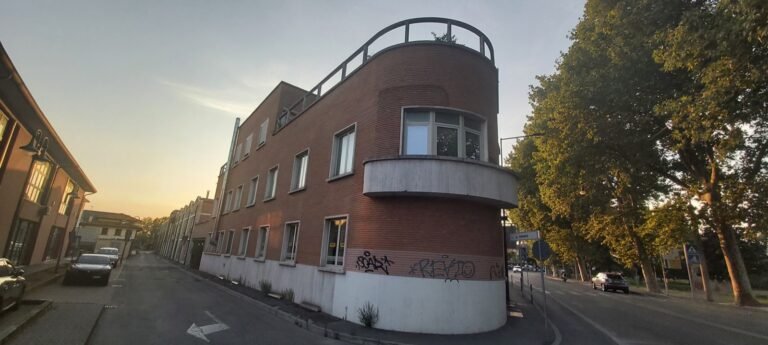
His first major building made his name and nearly ended his career. The Novocomum apartment block (1927–1929), on the edge of Como’s public gardens, wrapped its corners in glass and ribbon windows that looked, to a startled city, like an ocean liner run aground. Locals nicknamed it the Transatlantico. The building committee tried to stop it; Terragni saw it through, and Italian architecture had its first Rationalist landmark.
The Casa del Fascio
His masterpiece rose on the cathedral square. The Casa del Fascio of Como (1932–1936), built as the local Fascist party headquarters, is a half-cube of reinforced concrete faced in Botticino marble, organised around a covered inner court and a glazed entrance wall of sixteen doors. It is among the most closely studied buildings of twentieth-century Italy, admired as pure architecture and inseparable, at the same time, from the regime that commissioned it. Terragni never resolved that tension in words; he resolved it in proportion.
Lingeri, Milan and the Danteum
From 1933 Terragni worked in partnership with the architect Pietro Lingeri, opening a Milan studio and designing a series of apartment houses in the city — among them Casa Rustici and Casa Toninello. With Lingeri he also drew, in 1938, the Danteum: an unbuilt temple to Dante planned for Rome, one of the strangest and most ambitious projects of the decade. Between the two cities he built the Asilo Sant’Elia in Como (1934–1937), a nursery school that remains a model of how Rationalism could serve everyday public life.
War and an early death
The war cut the career short. Mobilised as an artillery captain in 1939, Terragni was sent to the Eastern Front, and the campaign broke his health and his nerves. Repatriated in 1943, he died in Como on 19 July that year, at thirty-nine. His last major work, the Casa Giuliani-Frigerio (1939–1940), had been finished only a few years before. What he left is small in number and enormous in influence: a body of work that still defines what Italian Rationalism was capable of.
In the archive
Follow Giuseppe Terragni across Cultural Heritage Online — the buildings he designed, the route that links them, and the anniversaries we mark:
- Novocomum, Como — the 1928 apartment block that startled the city.
- Casa del Fascio, Como — his marble-and-glass masterpiece on the cathedral square.
- Casa Rustici, Milan — a Terragni–Lingeri apartment house on Corso Sempione.
- Casa Toninello, Milan — the partnership’s smaller Milan block.
- Terragni Rationalism RoadBook — the four-building route from Como to Milan.
- Terragni in Como: The City That Built Italian Rationalism — the buildings in depth.
- 18 April 1904 — the birth of Giuseppe Terragni, in the CHO anniversary calendar.
- 19 July 1943 — the death of Giuseppe Terragni.
Sources
- S1 — Eisenman, Peter. Giuseppe Terragni: Transformations, Decompositions, Critiques. The Monacelli Press, 2003. ISBN 978-1-58093-041-3.
- S2 — Ciucci, Giorgio. Giuseppe Terragni: Opera completa. Electa, 1996. ISBN 978-88-435-5297-9.
Spotted an error? Write to editorial@culturalheritageonline.com and we correct it the same day.